Mauro

Gender: Masculine
Origin: Latin
Meaning: “dark-skinned.”

The name is a Spanish and Italian form of the Latin male name, Maurus, which may have been originally used as a nickname for someone with dark hair or a dark complexion.

The name was borne by numerous saints.

Currently, Mauro is the 58th most popular male name in Belgium, (2008). His rankings in other countries are as follows:

  • # 83 (Croatia, 2010)
  • # 336 (Netherlands, 2010)

Other forms of the name include:

  • Mawr Маўр (Belarusian)
  • Maur (Catalan/Czech/French/Polish/Slovak)
  • Mauro (Croatian/Dutch/German/Italian/Portuguese/Spanish)
  • Mór (Hungarian)
  • Maurus (Latin)
  • Mavr Мавр (Russian/Ukrainian)
  • Mauru (Sardinian)

A feminine form is Maura.

Quentin

Gender: Masculine
Origin: Latin
Meaning: “fifth.”
Eng (KWEN-tin)

The name is an English form of the Latin cognomen, Quintinus meaning “the fifth.”

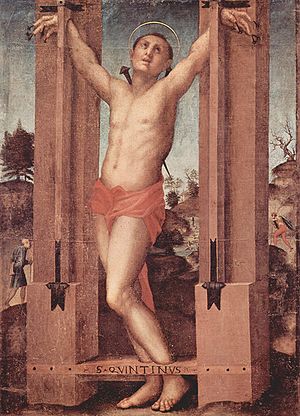
The name was popularized by a 3rd-century Gaulic saint, missionary and martyr who was beheaded by the Romans in what is now Picardy. He is considered the patron saint of Picardy and as a result, the name has always been common in that particular region of France.

It was introduced into England after the Norman Conquest.

In the United States, the name was brought to spotlight by Theodore Roosevelt’s son, Quentin Roosevelt (1897-1918) who was killed in World War I.

Currently, Quentin is the 35th most popular male name in France, (2009), while its Dutch form of Quinten is the 60th most popular male name in Belgium, (2008) and the 67th most popular in the Netherlands, (2010).

Quentin is the 396th most popular male in the United States, while Quinten is the 884th most popular, (2010).

Other forms of the name include:

  • Kindin (Basque)
  • Kentin (Breton)
  • Quintí (Catalan)
  • Quintinu (Corsican)
  • Kvintin Квинтин (Croatian/Russian/Serbian/Slovene/Ukrainian)
  • Quinten (Dutch/English)
  • Quentijn (Dutch)
  • Quintijn (Dutch)
  • Kwinten (Flemish)
  • Quentin (French/English/Picard)
  • Quintin (German/Slovak)
  • Koïntínos Κοϊντίνος (Greek)
  • Quintino (Italian/Portuguese/Spanish)
  • Quintinus (Latin)
  • Kventinas (Lithuanian)
  • Kintin (Picard)
  • Kwintyn (Polish)
  • Caointean (Scottish)
  • Quintín (Spanish)
  • Qvintin (Swedish)
  • Qvintinus (Swedish)

Common diminutive forms include:

  • Quentinek (Czech)
  • Quenty (English/German)
  • Quinn (English/German)
  • Quint (English/German)
  • Quinty (English/German)

Feminine forms include:

  • Quintina (Catalan/Italian/Latin/Portuguese/Spanish)
  • Quentine (French)
  • Quintine (French)
  • Kintine (Picard)
  • Kwintyna (Polish)

Sumayya

Gender: Feminine
Origin: Arabic  سميّة Сумаыя
Meaning: “high above.”
(soo-MAY-yah)

The name was borne by Sumayya bint Khayyat (died 615 C.E.) an early convert to Islam and also considered the first Muslim Martyr.

As of 2009, Sumayya was the most popular female name in Tajikistan.

Other forms of the name include:

  • Sumejja (Albanian/Bosnian)
  • Soumaia (Algerian/Moroccan)
  • Sumayyah (Indonesian/Malaysian)
  • Sümeyye (Turkish)

Anahita

Gender: Feminine
Origin: Persian
Meaning: “immaculate.”

The name is composed of the Avestan elements, a (not) and ahit (unclean).

It was borne in Persian and Armenian mythology by a fertility goddess associated with water, wisdom and healing.

The name’s usage has survived both Christianity and Islam, being a popular name throughout the Near East and Central Asia.

As of 2009, its Tajik variant of Anohito was the 5th most popular female name in Tajikistan, (2009).

Other forms of the name include:

  • Anahid/Anahit Անահիդ (Armenian/Azeri)
  • Anahita (Assyrian/Lebanese/Persian/Syrian)
  • Anais (Azeri)
  • Anaitis (Greek)
  • Anahîta (Kurdish)
  • Nahid  ناهید (Persian)
  • Anohito Анохито (Tajik/Uzbek)
  • Noxid Ноҳид (Tajik)
  • Onoxito Оноҳито (Tajik)

Indira

Gender: Feminine
Origin: Sanskrit  इन्दिरा Индира
Meaning: “beauty.”
(IN-deer-uh)

The name comes from the Sanskrit element, Indu, meaning “beauty.” In Hinduism, it is one of the many names of the goddess Lakshmi.

The name was popularized outside of India via India’s first female Prime Minister, Indira Ghandi (1917-1984).

The name has become quite popular in Central Asia, particularly in the former Soviet Republics after Indira Ghandi had established close relations with the Soviet Union. The name is currently the 6th most popular female name in Tajikistan, (2010).

It is also occasionally used in Bosnia, Croatia and Serbia.