Poppy

Gender: Feminine
Origin: English

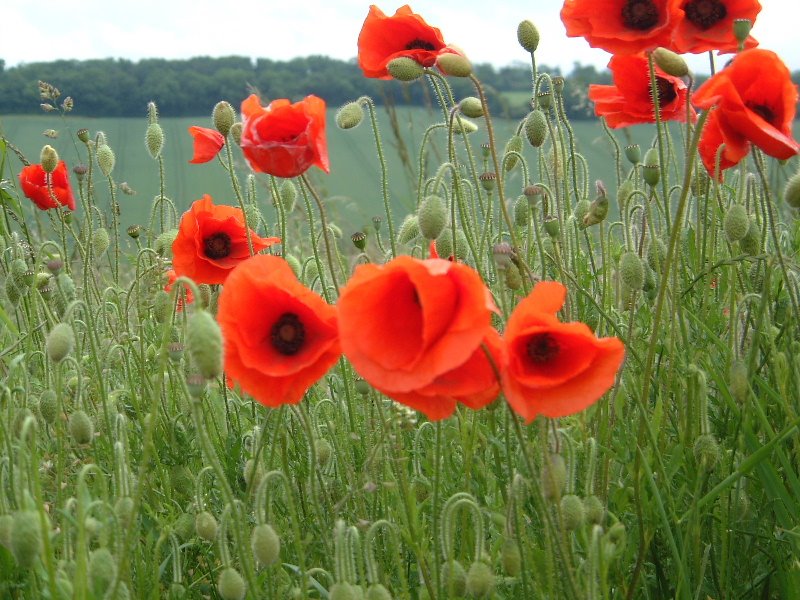
Are you loving Lily? Maybe the popularity has gotten to you. There is this spunky floral moniker that has already reached outrageous popularity in Great Britain. Poppy is a sweet little floral that has been in usage since at least the 19th century. The name may seem a bit too insubstantial for some, hence is why it is sometimes listed as a nickname for such names as Parthenope, Penelope, Persephone, Pippilotta, Philippa, Pomeline and Perpetua.

The associations with the flower are beautiful! Who wouldn’t want to be named for a deep red, eye popping flower (no pun intended). Then again, its symbolisms with death and sleep can be a bit of a turn off for others.

In Ancient Rome and Greece, the poppy was a funerary flower, they were usually placed on graves. The poppy got the association of death and sleep, since opium, (which is extracted from poppy seeds), was such a strong barbiturate. In fact, it was so strong, that the ancients used it as an anesthetic while conducting surgeries. However, Poppy does have the redeeming qualities of being associated with resurrection, since after being put under a death like sleep from opium during an operation, the patients always seemed to awaken as if they had come back to life. Its symbolism for dead soldiers comes from a poem written by John McCrae, entitled in Flanders Fields (1915). McCrae writes how he witnessed his friend perish amidst a field of poppies during WWI, and he compares the field of poppies to all the fallen dead soldiers. The name could be a nice way to honour a relative that has perished in a war.

As of 2010, Poppy was the 16th most popular female name in England/Wales. Her rankings in other countries are as follows:
  • # 47 (Scotland, 2010)
  • # 52 (Northern Ireland, 2010)
  • # 66 (Australia, NSW, 2010)
In the United States, it doesn’t even rank in the top 1000. However, with its growing popularity in Britain along with its similar appeal to other red hot climbers such as Scarlett and Ruby, she just might be making her way into the top 1000 by next year.
Another interesting side note is that Poppy is the flower of the month of August. Not a bad choice for an August baby.
A famous American bearer is CNN news anchor and reporter, Poppy Harlow (née Katharine) b.1982

Summer

Gender: Feminine
Origin: English
(SUM-mer)

The name comes directly from the English word for the season. Though a more modern introduction into the lexicon of English given names, the word summer in various languages has been used as a traditional female name for centuries in other cultures. Examples include Vasare, Verë, Suvi and a host of other names.

Summer seems to have first appeared in 1949, albeit rare, it was given to at least 5 girls born in the United States that year. She really started to soar in 1971, the year she first entered the top 1000 coming in as the 869th most popular female name and she has remained in the U.S. top 1000 since.

As of 2010, Summer was the 30th most popular female name in England/Wales. Her rankings in other countries are as follows:

  • # 36 (Scotland, 2010)
  • # 37 (Australia, 2010)
  • # 51 (Canada, B.C., 2010)
  • # 82 (Northern Ireland, 2010)
  • # 164 (United States, 2010)

Its German form of Sommer just recently came into usage in German-speaking countries.

Minttu

Gender: Feminine
Origin: Finnish
Meaning: “mint.”

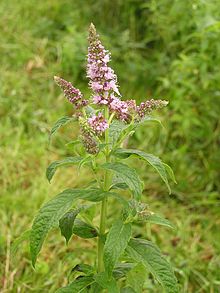
The name comes directly from the Finnish word for mint.

Its designated name-day is October 6.

The name is borne by Finnish actress Minttu Mustakaillo (b.1973). It is also the name of a popular Finnish peppermint-flavored liqueur, despite the liqueur associations, the name seems to be fairly common in Finland.

The Holidays aren’t too far off and if you due around that time and are considering a Holiday-themed name with a bit of an edge, this might be just what you are looking for.

Update: As of 2011, Minttu is the 43rd most popular female name in Finland.

Hilla

Gender: Feminine
Origin: Finnish
Meaning: “cloudberry.”
(HEEL-lah)

The name was initially used as a form of Hilda or Hilja, but became even more popular in Finland due to the fact that it translates as, “cloudberry.”

As of 2011, Hilla was the 42nd most popular female name in Finland.

Other forms of the name include:

  • Hilkka (Finnish)
  • Hillá (Sami)

Helmi

Gender: Feminine
Origin: Finnish/Estonian
Meaning: “pearl”
(HEL-mee)

The name was originally a diminutive form of the name Vilhelmiina, but later became an independent name in Finland due to its coincidental meaning of “pearl,” in Finnish. The pronunciation could be heard here: http://www.forvo.com/word/helmi/

As of 2011, Helmi was the 11th most popular female name among Finnish speakers in Finland.

The designated name-day in Finland and Estonia is May 7th. In Sweden, it is April 6th.

Sólja, Sóley

Gender: Feminine
Origin: Faroese/Icelandic
Meaning: “buttercup.”
(SOLE-yah); (SOO-lay).

Both names are derived from the Norse word sol meaning “sun.” In modern vernacular both names are used to refer to the buttercup flower in their own respective languages. Sólja is the Faroese form and Sóley the Icelandic. Though Sóley is used as a given name in the Faroe Islands as well.

As of 2010 Sólja was the 8th most popular female name in the Faroe Islands.

Aegir

Gender: Masculine
Origin: Old Norse
Meaning: “to frighten; sea; ocean.”
(I-geer)

The name may be related to the Old Norse verb aegja, meaning, “to frighten.” In modern Icelandic, it is used as a poetic term for the ocean.
In Norse mythology, he was a minor sea god and husband to Rán. He was feared by sailors because if angered, Aegir was the one responsible for horrific sea storms. He was believed to have pre-dated the Aesir and the Vanir and was indestructible, (unlike the other gods), being able to survive the prophetic days of Ragnarok.
He shared his hall with his wife Ran on the Isle of Hlesey where he brewed ale for the gods. It was in his hall where Loki had murdered the beautiful god Baldur.
Aegir was known by other names such as, Oegis (EW-gees); Hler and; Gymir (the Blinder).
He was often depicted as a skinny old man with long white hair and crab claws for fingers.
The name is not used as a name in Iceland, (it is not on the approved list), probably due to its close sound to the word aegja. However, the female spin off name of Aegileif is a very common name. In Old Norse Aegileif meant “life of Aegir” however in modern Icelandic it literally means, “the fear of leaving food uneaten.” Aegir, however, is usable in other Scandinavian countries, but is rare. It is possible that he may catch on with the revival of other pre-Christian Nordic such names as Viking, Loki, Frejr and Odin.
Update: As of 2010, Ægir was the 8th most popular male name in the Faroe Islands. Contrary to what was written a few years back, my research has shown that the name is used in Iceland, and it is fairly common.
Other forms of the name include:
  • Ægir (Danish/Faroese/Icelandic/Old Norse)
  • Æge (Norwegian)
  • Egir (Norwegian)
  • Aegir (Swedish)
  • Ägir (Swedish)