Nike

Gender: Feminine
Origin: Greek Νικη
Meaning: “victory.”
Eng (NYE-kee); Grk (NEE-kay); Germ (NEE-keh)

The name comes directly from the Greek word for victory.

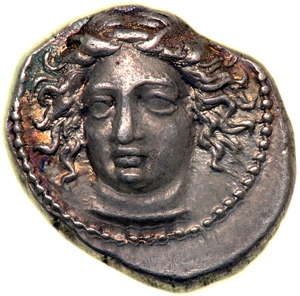
It was borne in Greek mythology by the goddess and personification of Victory, her Roman counterpart being Victoria. She was the daughter of Pallas and Styx and the sister of Cratos (Strength), Bia (Force) and Zelus (Zeal). She was believed to fly around battlefields on a chariot awarding glory and fame to victors.

Coincidentally, Nike can also be a Nigerian name meaning, “cherished.”

The name has experienced usage in modern Greece, Russia, Israel and Germany. In Germany, her popularity may be due to Nike Wagner (b.1945) the great-granddaughter of Richard Wagner.

It is currently the 323rd most popular female name in Germany, (2011).

The Russian and Belarusian form is Nika Ника.

It is also the name of the shoe company which was named for the Greek goddess.

Quirin

Gender: Masculine
Origin: Latin

Quirin is a German form of the Latin, Quirinus, which was borne by a Sabine god who was later absorbed into the general Roman pantheon. He was sometimes associated as the deified form of Romulus or as a counterpart of Mars. The Qurinal Hill in Rome was named in his honour.

Most agree that the name is derived from the Latin quirus (spear), others have suggested that it is from the name of a Sabine town, Cures, or that it is related to curia.

It was also borne by several early Christian saints. Most notably, St. Quirin of Neuss, a Roman martyr whose body was eventually interred in Neuss Germany.

Another notable bearer is Quirin Kuhlmann (1651-1689) a German poet and mystic.

Currently, Quirin is the 387th most popular male name in Germany, (2011).

Other forms of the name include:

  • Quirí (Catalan)
  • Kvirin (Croatian)
  • Corin (French)
  • Quirin (French/German)
  • Quirino (Italian/Portuguese/Spanish)
  • Kvirinas (Lithuanian)
  • Kwiryn (Polish)

Hagen

Gender: Masculine
Origin: German
Meaning: debated
Eng (HAY-gen); Germ (HAH-gen)

The name could be of three possible etymologies, it could be a borrowing from the Danish form of Håkon. Other sources have suggested that it comes directly from the Old High German meaning, “grove; enclosure.” In the case of the German city, this is the most likely etymology. Another possibility is that it is the German form of the Old Norse Högni (protection).

In the Medieval German epic, The Song of the Nibelungs, it is the name of Hagen of Tronje, the slayer of Siegfried and the thief of Nibelungs’ treasure. According to legend, he is half elf and has one eye. He appears in several other German folktales in which he is sometimes portrayed as the hero or the antagonist.

Currently, Hagen is the 430th most popular male name in Germany, (2011).

Another form of the name is Hagano.


Erwin, Irvin

Gender: Masculine
Origin: German
Meaning: “army friend.”
Germ (AIR-veen), Eng (ER-vin)

The name is derived from the Old High German, Hariwini, which is composed of the elements, hari (army) and win (friend).

A notable bearer was Austrian physicist, Ervin Schroediger (1887-1961).

It is currently the 419th most popular male name in Germany, (2011), while Ervin is the 87th most popular male name in Bosnia & Herzegovina, (2010)

Other forms of the name include:

  • Ervin (Albanian/Bosnian/Croatian/Hungarian/Slovene)
  • Erwin (Dutch/German/Polish/Swedish)
  • Irvin (English)
  • Ervino (Italian)
  • Ervīns (Latvian)
  • Ervín (Slovak)
 Feminine forms are the Hungarian, Ervina and the Polish, Erwina.


Thales

Gender: Masculine
Origin: Greek Θαλης
Meaning: “to blossom.”

The name is derived from the Greek θαλλω (thallo) meaning, “to blossom.” It was borne by a 6th-century BCE Greek philosopher and Mathematician, Thales of Miletus.

The name shares the same etymological root as Thalia.

Currently, Thales is the 90th most popular male name in Brazil, (2011).

Other forms of the name include:

  • Fales Фалес (Azeri/Belarusian/Bulgarian/Russian)
  • Tales (Catalan/Polish/Portuguese/Spanish)
  • Thalés (Czech)
  • Thales (English/Greek/Portuguese-Brazilian/Zazaki)
  • Thalès (French)
  • Tailéas (Gaelic)
  • Thalész (Hungarian)
  • Talete (Italian)
  • Talesi თალესი (Georgian)
  • Taless (Latvian)
  • Talee (Lombard)
  • Talis (Lithuanian)
  • Taleti (Sicilian)


Eloise

Gender: Feminine
Origin: French
Meaning: “wide and healthy.”
Eng (EL-o-eez, el-o-EEZ )

The name is an anglicized form of the Old French, Héloïse which is derived from the Germanic name Helewidis, composed of the elements heil (healthy) and wide (wide). The meaning of the name is probably in reference of the parents wishing for an overweight child. In the early Medieval world, being overweight was a sign of wealth and health, especially in the harsh climes of Northern Europe.

The name was borne by a Medieval French philosopher, writer, nun, scholar and abbess, Héloïse d’Argenteuil (1101-1164). She and her lover Abelard are the source of many medieval romances. According to the story, Héloïse became a nun after her jealous uncle castrated her lover, who she was legally yet secretly married to at the time.

The name was also borne by a few early French saints.

In England, the name has been in usage since at least after the Norman Conquest. The common Medieval English form was Helewis, which died off and was later replaced by Eloise in the 19th-century.

Eloise is also the name of a series of childrens’ books written by Kay Thompson in the 1950s.

Currently, its Portuguese form of Heloisa is the 35th most popular female name in Brazil, (2011). Her rankings in other countries are as follows:

  • # 61 (France, Éloïse, 2009)
  • # 93 (France, Héloïse, 2009)
  • # 530 (United States, 2010)

Other forms of the name include:

  • Eloiza (Azeri)
  • Heloïsa (Catalan)
  • Eloise (English/Swedish)
  • Helewis (English)
  • Éloïse (French)
  • Héloïse (French)
  • Helewidis (German)
  • Heloisa (German)
  • Eloisa (Italian)
  • Eloisia (Italian)
  • Heloiza (Polish)
  • Heloísa (Portuguese)
  • Jeloíza Элои́за (Russian)
  • Eloísa (Spanish)


Melissa

Gender: Feminine
Origin: Greek Μέλισσα
Meaning: “honey-bee.”
Eng (meh-LIS-sah)

The name comes directly from the Greek word μέλισσα (melissa) which shares a root with the Greek word for honey μέλι (meli). In fact, the Hititte word, melit (honey) shares the same etymological root.

The name is borne in Greek mythology by a nymph who taught mankind how to harvest honey, it is believed that this same nymph also nursed the god Zeus. It is actually borne by several characters in Greek mythology, including a priestess of Demeter who was murdered when she refused to release the secrets of initiation rights of Demeter.

It seems the name was common in ancient Greece, as it was also borne by a female Pythagorean philosopher (6th-century, CE).

The Italian poet Ludovico Ariosto used it as a name for the good witch who helps Ruggiero escape from the evil Alcina in Orlando Furioso (1516).

Melissa is also the scientific name of the lemon balm plant.

In the English-speaking world, the name caught on during the 18th-century and remained a common name since. The highest she ranked in U.S. naming history was between 1977 and 1979 when it was the 2nd most popular female name. Currently, she is the 157th most popular female name in the United States, (2010).

In Brazil, she is the 37th most popular female name, (2011). Her rankings in other countries are as follows:

  • # 49 (France, 2009)
  • # 74 (Germany, 2011)
  • # 80 (Sweden, 2010)
  • # 97 (Scotland, 2010)
  • # 142 (the Netherlands, 2010)

Other forms of the name include:

  • Melisa (Albanian/Kurdish/Polish/Spanish/Turkish)
  • Melissa ميليسا (Catalan/Dutch/English/French/German/Greek/Italian/Lebanese/Portuguese/Scandinavian/Slovak)
  • Mélissa (French)
  • Melitta (German/Greek)
  • Melika (Hawaiian)
A common English diminutive is Missy, in Polish is it Melcia or Meliska.


Lavinia

Gender: Feminine
Origin: Latin
Meaning: uncertain
Eng (lah-VIN-nee-uh)

The name is possibly of Etruscan origins but its meaning has been lost to history. It is borne in the in Roman legend by the wife of Aeneas and the ancestor of the Roman people. Her story has been retoled throughout the centuries and was lately the subject of the 2008 eponymous novel by Ursula K. Le Guin. According to legend, the city of Lavinium was named by Aeneas in honour of his wife.

The name has been borne by a few other famous literary characters such as Shakespeares tragic heroine in Titus Andronicus (1588) and a character in Frances Hodgson Burnett’s 1905 novel, A Little Princess.

It is also the name of a genus of fish and butterfly and it is the name of a suburb of São Paolo Brazil.

Lavinia seems to have been a very popular name in the 18th and 19th-century in both England and the United States. It was often shortened to Vinny or Lovie. Both of which appear as occasional independent given names around the same time.

Its Portuguese form of Lavínia is currently the 45th most popular female name in Brazil, (2011).

Other forms of the name include:

  • Lavynyya Лавиния (Bulgarian)
  • Lavínia (Catalan/Hungarian/Portuguese)
  • Lavinia (Dutch/English/French/German/Italian/Latin/Romanian/Spanish)
  • Lavina (English/Italian)
  • Lauinia (Latin)
  • Lawinia (Polish)
  • Lavinija Лавиния (Russian)
  • Lavíniya Лаві́нія (Ukrainian)
An obscure Polish masculine form is Lawiniusz.

Larissa

Gender: Feminine
Origin: Greek Λαρισα
Meaning: “citadel.”
Eng (lah-RIS-suh)

The name is borne in Greek mythology by a nymph of Thessaly and daughter of Pelasgus. It is also the name of the capitol city of Thessaly, Greece, which is believed to have gotten its name from the nymph, who was considered a sort of patron of the city in pre-Christian times.

The name has always been popular throughout Eastern Europe due to the veneration of an Eastern Orthodox saint of the same name.

It was introduced into the English-speaking world via Boris Pasternak’s 1957 novel, Doctor Zhivago, in which the heroine is named Larissa nicknamed Lara.

Currently, Larissa is the 33rd most popular female name in Brazil, (2011). Her rankings in other countries are as follows:

  • # 41 (Switzerland, German-Speaking, 2010)
  • # 44 (Austria, 2010)
  • # 48 (Slovenia, Larisa, 2010)
  • # 55 (Bosnia & Herzegovina, Larisa, 2010)
  • # 95 (Germany, 2011)
  • # 259 (the Netherlands, 2010)
  • # 760 (United States, 2010)

Other forms of the name include:

  • Larisa Лариса (Bosnian/Bulgarian/Croatian/Greek/Latvian/Lithuanian/Romanian/Russian/Serbian/Slovene)
  • Làrissa (Catalan)
  • Larissa (Dutch/English/German/Italian/Portuguese)
  • Larysa Лариса (Polish/Ukrainian)
A common Russian short form is Lara.

Julian

Gender: Masculine
Origin: Latin

The name is an anglicized form of the French male name, Julien, which is derived from the Latin Julianus (See Julius).

In history, the name was borne by the last non-Christian Roman emperor, Julian the Apostate (4th-century CE). It was also borne by a very popular French saint, Julien the Hospitaller.

In Medieval Englian, Julian was a female name and the traditional masculine cognate was Jolyon. Both names went out of usage by the Renaissance and neither were revived until the 19th-century.

Currently, Julian is the 12th most popular male name in Austria, (2010). His rankings in other countries are as follows:

  • # 15 (Germany, 2011)
  • # 17 (the Netherlands, 2010)
  • # 32 (Norway, 2010)
  • # 53 (United States, 2010)
  • # 59 (France, Julien, 2009)
  • # 66 (Belgium, Julien, 2009)
  • # 98 (Sweden, 2010)
  • # 147 (France, Julian, 2009)
  • # 561 (United States, Julien, 2010)

Other forms of the name include:

  • Juljan (Albanian)
  • Julen (Basque)
  • Juluan (Breton)
  • Yulian Юлиан (Bulgarian/Russian/Ukrainian)
  • Julià (Catalan)
  • Julijan (Croatian/Macedonian/Serbian/Slovene)
  • Julian (Dutch/English/German/Occitanian/Polish/Scandinavian)
  • Jolyon (English)
  • Julien (French)
  • Xulián (Galician)
  • Ioulianos Ιουλιανός (Greek)
  • Giuliano (Italian)
  • Iulianus (Latin)
  • Julijonas (Lithuanian)
  • Juliano (Portuguese/Spanish)
  • Julião (Portuguese)
  • Iulian (Romanian)
  • Julián (Spanish)
  • Turiano (Tahitian)

For feminine forms (see Juliana)