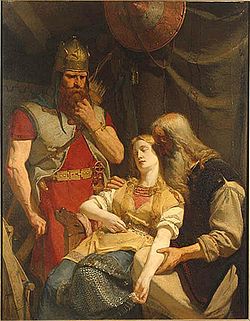
From the Old Norse word for “embers,” in Norse Mythology, this was the daughter of the jötunn known as Logi (fire), the latter who is considered the personification of fire, a long with his wife Glöð (glowing embers). He fathered another daughter Eisa (glowing ember), both of whom were said to be stunningly beautiful.
Its status as a given-name in most Scandinavian countries is a relic from the past but may appeal to parents drawn to authentic early Nordic names.
The name comes directly from the Old Norse word meaning “glowing ember.” In Norse Mythology, this is the name of one of the beautiful daughters of Logi (fire), and Glöð (glowing embers).
Later, it came to be associated as a pet form of Elizabeth or a German form of Aise (short form of any Nordic name beginning in the Egg-, Agi– element.)
Note: the name can also be an Arabic form of Jesus.
The name comes directly from the Old Norse word for “flame; blaze,” and is also used as a poetic word for a sword. It is born in Norse Mythology by Logi, a jötunn and the personification of fire. He was the son of Fornjótr. He is known for winning a meat eating competition against Loki.
A Swedish variation is Loge
It is a cooler and fresher alternative to Logan, with a spark.
The name is either derived from the Old Norse gandr (magic wand; magic staff), or the Old Norse gǫndul meaning, “magical animal; werewolf.”
In Norse Mythology, this is the name of one of the Valkyries. She appears in several early sources, including the Heimskringla, in which it is written:
“Gǫndul and Skögul sent out / to choose among kings.” Their presence seals Hákon’s fate, and they greet him after death — both destroyers and honour-givers.”
In the Poetic Edda, specifically Hákonarmál, she is again one of the Valkyries who welcome Hákon to Valhalla, confirming her dual role as harbinger of death and divine escort.
In the Norse sagas and Skaldic poetry, gǫndul can also function as a kenning (poetic metaphor) for “valkyrie” or “battle-witch,” used interchangeably with other names like Skögul, Hildr, and Mist.
Its rarely used these days in Nordic countries, but whose to say it won’t become popular with the rise of other Norse myth names. However, in modern Icelandic, it may sound a touch to close to the Icelandic slang term, göndull (cock, dick, penis), which yes, shares the same etymology as the name, referring to a staff or a wand, but other Nordic languages wouldn’t have the same associations.
From the Old Norse, Gandálfr, it’s a compound of gandr (“magic, charm, witchcraft; monster) supernatural being”) + álfr (“elf”).
Gandalf is listed in the Völuspá—one of the earliest poems of the Poetic Edda—as the name of a dwarf, not a wizard. Many dwarf-names in Tolkien’s The Hobbit and The Lord of the Rings come directly from this same list.
When creating the Grey Wizard of Middle-earth, Tolkien borrowed the ancient name wholesale, changing only the grammar from Old Norse Gandalfr to the more Anglicized Gandalf.
Cultural Impact: Since the publication of The Hobbit (1937) and The Lord of the Rings (1954–55), Gandalf has become one of the most recognized fantasy names worldwide.
The name is a modern form of the Old Norse by-name, Taki, which is derived from the Old Norse verb, taka (to take). The same word is related to the modern English verb, “to take.”
Örvar (modern spellings often drop the umlaut to Orvar) is an Old Norse name meaning “arrow.” It comes from the Old Norse noun örvar (plural of ör “arrow, dart”).
The name is best known from the legendary Icelandic saga hero Örvar-Oddr (“Arrow-Odd”), a famous 13th-century saga recounting the adventures of a far-traveling archer and warrior.
The name was used across the Norse world and carried into later Scandinavian naming traditions
Its designated name-days are July 8th in Finland and September 18th in Sweden.
Notable bearers include Swedish football player, Orvar Bengmark (1930-2004) and Icelandic musician, Örvar Þóreyjarson Smárason (b. 1977).
Other forms include:
Ørvar (Faroese, Norwegian)
Orvar (Finnish, Icelandic, Scandinavian)*
Örvar (Icelandic)
Orwar (Swedish)
*Note: I use this term to designate Danish, Norwegian, Swedish)
The root name is the Frankish Audomar, which is composed of the elements aud (wealth, fortune), and mari (fame).
It was borne by an 8th-century saint and monk, an abbot of St. Gall, Switzerland and a 7th-century Frankish saint, after whom the French commune of St-Omer was named.