Constance

Gender: Feminine
Origin: Latin
Meaning: “constant; steadfast.”
Eng (KAHN-stənts); Fre (kawn-STAWNS)

The name is an anglicized form of the Late Latin female name Constantia which is a feminine form of Constantius derived from the Latin constans meaning “steadfast; constant.”

The name was very common throughout Medieval Europe and was borne by several European royals. In the English-speaking world it was notably the daughter of William the Conqueror who actually introduced the name to England.

Its Spanish form of Constanza is currently the 11th most popular female name in Chile, (2010), while Constance was the 131st most popular female name in France, (2009).

Other forms of the name include:

  • Konstantza (Basque)
  • Constança (Catalan/Occitanian/Portuguese)
  • Konstanca (Croatian)
  • Konstance (Czech)
  • Konstancie (Czech)
  • Constance (Dutch/English/French)
  • Constanze (German)
  • Konstanze (German)
  • Konstancia (Hungarian)
  • Costanza (Italian)
  • Constantia (Latin)
  • Konstanse (Norwegian)
  • Constància (Occitanian)
  • Konstancja (Polish)
  • Constanta (Romanian)
  • Konstantia (Scandinavian)
  • Constanza (Spanish)
  • Konstans (Turkish: obscure)
  • Konstancija Констанція (Ukrainian)

Diminutives include:

  • Kony (Czech)
  • Stanka (Czech)
  • Connie (English/German)
  • Stanzi (German)

Masculine forms include:

  • Constant (English)
  • Costanzo (Italian)
  • Costante (Italian)
  • Constans (Latin)
  • Constantius (Latin)


Saul

Gender: Masculine
Origin: Hebrew שָׁאוּל
Meaning: “asked for; prayed for.”
Eng (SAWL); Sp (sah-OOL); Heb (shah-OOL)

The name appears several times in the Old Testament, the most notable of all being King Saul, the first king of the ancient Kingdom of Israel as recorded in the Book of Samuel. It appears again in the New Testament as the Hebrew name for Paul of Tarsus.

The name has always been common among Jews and Spanish-speaking Christians. In Mexico, it is currently the 94th most popular male name, while in Spain it is the 95th most popular, (2010). In the United States, however, it only ranks in as the 376th most popular male name, (2010).

Other forms of the name include:

  • Saül (Catalan/French)
  • Šaul (Croatian)
  • Saul (Czech/Dutch/English/German/Hungarian/Italian/Polish/Portuguese/Scandinavian)
  • Sauli საული (Finnish/Georgian)
  • Saoul Σαουλ (Greek)
  • Sha’ul שָׁאוּל (Hebrew)
  • Sauls (Latin)
  • Saulius (Lithuanian)
  • Szaul (Polish)
  • Saúl Сау́л (Belarusian/Bulgarian/Russian/Spanish)
Sources

Arnold

Gender: Masculine
Origin: German
Meaning: “eagle power.”

The name is composed of the Germanic elements arn (eagle) and wald (power). In pre-Norman England it appeared in the Anglo-Saxon form of Earnwald it was subsequently replaced with the more Norman Arnold and fell out of usage by the Renaissance being revived once again in the 19th-century.

The name is borne by several saints, including an 11th-century French bishop who is venerated as the patron saint of brewers.

Its French form of Arnaud is currently 71st most popular male name in Quebec, Canada (2010).

Other forms of the name include:

  • Earnwald (Anglo-Saxon)
  • Arnald (Catalan)
  • Arnau (Catalan)
  • Arnold (Czech/English/German/Hungarian/Polish/Scandinavian/Slovak/Slovene)
  • Aart (Dutch)
  • Arend (Dutch)
  • Arnoud (Dutch)
  • Arnout (Dutch)
  • Aarno/Arno (Finnish)
  • Arnaud (French)
  • Arnault (French)
  • Arendt (German)
  • Arndt (German)
  • Arne (German)
  • Arnót (Hungarian)
  • Arnaldur (Icelandic)
  • Arnaldo (Italian/Portuguese/Spanish)
  • Nöl (Limburgish)
  • Nölke (Limburgish)
  • Arnoldas (Lithuanian)
  • Arnwald (Old German)
  • Arnaldr (Old Norse)
  • Arnado (Spanish)

Obscure feminine forms include the German Arnoldine, the French Arnaude and the Southern European Arnalda.

The name is borne by actor and form California governor Arnold Schwarzenegger  (b.1947).

A common English short form is Arnie.

Sources

  1. http://www.behindthename.com/name/arnold


Clovis

Gender: Masculine
Origin: Frankish
Meaning: “praised fighter.”

The name is derived from the old Frankish name Chlodevich which is composed of the elements, chlod (praise) and vech (fighter).

It is believed that Clovis is the proto-name of Louis.

The name was borne by Clovis I (466-511), the first king to unite all the Frankish tribes under one ruler. Three other Frankish kings bore the name after him.

Currently, Clovis is the 157th most popular male name in Quebec, Canada (2010) and the 223rd most popular in France, (2009).

Other forms of the name include:

  • Clodeveu (Aragonese/Catalan)
  • Klovis (Basque/Frisian)
  • C’hlodwig (Breton)
  • Hlodwig (Breton)
  • Klodvig (Croatian/Hungarian)
  • Chlodvík (Czech)
  • Clovis (Dutch/English/French)
  • Klodvig (Finnish/Norwegian)
  • Chlodwig (German/Polish)
  • Clodoveo (Italian/Spanish)
  • Chlodovechus (Latin)
  • Chlodvigas (Lithuanian)
  • Clodovèu (Occitanian)
  • Clóvis (Portuguese)
  • Klodevig (Scandinavian)
  • Cluduveu (Sicilian)
Sources

Ophelia

Gender: Feminine
Origin: Greek
Meaning: “help”
o-FEEL-yə

The name is derived from the Greek οφελος (ofelos) meaning “help.”

It first appears in Jacopo Sannazaro’s poem Arcadia. Shakespeare bestowed the name upon his tragic heroine of Hamlet (1600). Despite its tragic connotations, the name seems to have been used since at least the 19th-century.

Its French form of Ophélie is currently the 101st most popular female name in Quebec Canada (2010) and the 242nd most popular in France, (2009).

Other forms of the name include:

  • Ophelia (Dutch/English)
  • Ophélie (French)
  • Ofelia (Italian/Polish/Scandinavian/Romanian/Spanish)
  • Ofélia (Portuguese)
Source

Anne-Sophie

The name is a compound of Anne and Sophie. It is currently the 122nd most popular female name in Quebec, Canada (2010).

It is also used in Scandinavian countries and in German-speaking countries.

Its Spanish form is Ana Sofía. Scandinavian variations include Annesophie, Annesofie and Anne-Sofie.

Micah

Gender: Masculine
Origin: Hebrew
Meaning: “who is like Yahweh?”

The name is found in the Old Testament as the title of a book and the name of one of the minor prophets who predicted the destruction of Jerusalem.

Currently, Micah is the 108th most popular male name in the United States, (2010).

Other forms of the name include:

  • Michaiah (Biblical Hebrew)
  • Miquees (Catalan)
  • Mihej Михеј (Croatian/Serbian)
  • Micheáš (Czech/Slovak)
  • Micha (Dutch/German/Latin)
  • Miika (Finnish)
  • Michée (French)
  • Mikayahu מִיכָיְהוּ (Hebrew)
  • Mikha מִיכָה (Hebrew)
  • Michea (Italian)
  • Michėjo (Lithuanian)
  • Micheasz (Polish)
  • Miqueias (Portuguese)
  • Mica (Romanian)
  • Mihéja Михе́я (Russian)
  • Mika (Scandinavian)
  • Miqueas (Spanish)
Source

Malachi

Gender: Masculine
Origin: Hebrew  מַלְאָכִי
Meaning: “my messenger.”

The name is found in the Old Testament as the name of a prophet and the author of the Book of Malachi. He is known for his prophecies, in Christian tradition it is believed that his prophecies foretell the coming of Christ.

Its Irish form of Malachy has always been a common name in Ireland. It was borne by an early Irish saint who is also considered a prophet and a mystic. Though, it is sometimes suggested that Malachy is an anglicized form of Máel Sechlainn.

Currently, Malachi is the 163rd most popular male name in the United States, (2010).

Other forms of the name include:

  • Maleachi (Afrikaans/German)
  • Malaquies (Catalan)
  • Malachiáš (Czech/Slovak)
  • Malachias (Dutch/German/Greek)
  • Malachie (French)
  • Malachy (Irish)
  • Malachia (Italian)
  • Malachiasz (Polish)
  • Malahija Мала́хия (Russian/Serbian)
  • Malaki (Scandinavian)
  • Malaquías (Spanish)
Occasional English short forms are Mal and Chai (KYE).
Source

Kenneth

Gender: Masculine
Origin: Scottish
Meaning: “born of fire.”
(KEN-neth)

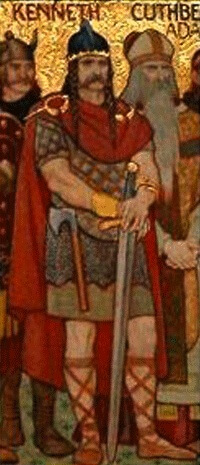
The name is an anglicized form of the Scots Gaelic Cináed meaning “born of fire.” It was borne by the first king of the Scots and Picts in the 9th-century. It was by several subsequent Scottish kings thereafter. It was also borne by a few early Scottish and Welsh saints.

It was used by Sir Walter Scott as the name of a hero in his 1825 novel The Talisman.

Currently, Kenneth is the 160th most popular male name in the United States, (2010).

Other forms of the name include:

  • Kenneth (English)
  • Cináed (Irish/Scottish: kin-NADE)
  • Cionaodh (Irish)
  • Ciniod (Pictish)
  • Kennet (Scandinavian)
  • Cen(n)ydd (Welsh. KEN-nith)
  • Cunedda (Welsh. kun-NETH-thuh)
Common short forms are Ken and Kenny.
Scottish feminine forms are Kenina and Kenna.
Source

Maya

The name can either be from the Sanskrit meaning “illusion.” In this case it is the name of a concept found both in Hinduisim and Sikhism. It is also another name for the goddess Durga.

In Buddhism it is the name of the mother of Buddha.

It could also be a contraction of Maria.

In Eastern European languages, it is the word for May and may be used in reference to the month.

Currently, Maya is the 19th most popular female name in the United States, (2010). Her rankings in other countries are as follows:

  • # 46 (Australia, NSW, 2010)
  • # 51 (Belgium, 2010)
  • # 57 (England/Wales, 2010)
  • # 64 (Scotland, 2010)
  • # 67 (United States, 2010)
  • # 75 (France, 2009)
  • # 84 (Ireland, 2010)
  • # 91 (Norway, 2010)
  • # 193 (the Netherlands, 2010)

Spelled Maja she is one of the most popular female names on continental Europe. Her rankings are as follows:

  • # 1 (Sweden, 2010)
  • # 2 (Poland, 2010)
  • # 7 (Denmark, 2010)
  • # 10 (Slovenia, 2010)
  • # 19 (Norway, 2010)
  • # 26 (Croatia, 2010)
  • # 35 (Austria, 2010)
  • # 37 (Hungary, 2010)
  • # 54 (Ireland, 2010)
  • # 277 (the Netherlands, 2010)
Another form is the Finnish Maija.

Source

  1. http://www.behindthename.com/name/maja-2