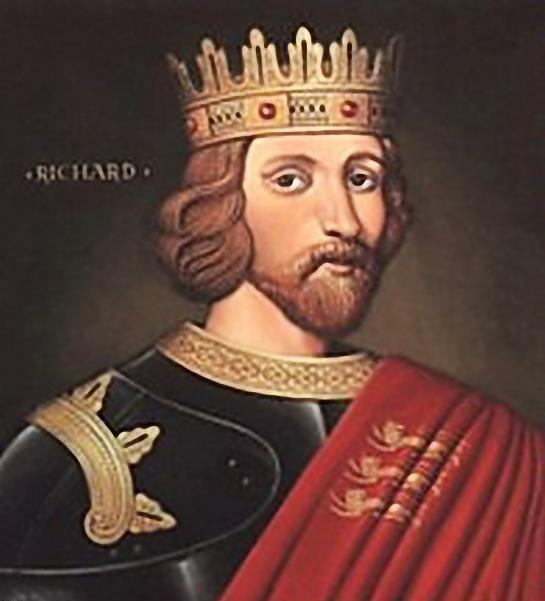
Richard

Gender: Masculine
Origin: German
Meaning: “brave power.”
Eng (RICH-erd)

The name was first introduced into the English speaking world by the Norman Conquerors, and the name has been a long standing classic since.

It was most notably borne by Richard I the Lionhearted of England, who has remained a sort of national folk hero in Britain.

Richard has been declining somewhat in the U.S. popularity charts, coming in as the 107th most popular male name (2008), in 2007, he was the 100th most popular male name.

The name is composed of the Germanic elements ric meaning “power; rule” and hard meaning “brave; hardy.”

His rankings in other countries are as follows:

  • # 53 Ricardo (Chile, 2006)
  • # 39 Richárd (Hungary, 2008)
  • # 328 Ricardo (the Netherlands, 2009)
  • # 480 (the Netherlands, 2009)

Other forms of the name include:

  • Rikard Рычард (Basque/Belarusian/Bosnian/Bulgarian)
  • Richarzh (Breton)
  • Ricard Ричард (Catalan/Occitanian/Serbian)
  • Ričard (Croatian)
  • Rikard (Croatian/Danish/Finnish/Norwegian/Swedish)
  • Richard Ричард (Czech/Dutch/English/French/German/Romanian/Russian/Slovak/Ukrainian)
  • Rijkert (Dutch: RYE-kairt)
  • Riho (Estonian)
  • Rikhard (Finnish)
  • Rickert (Frisian)
  • Ricohard (German: very rare and archaic)
  • Richárdos Ριχάρδος (Greek: Modern)
  • Richárd/Rikárd (Hungarian)
  • Ríkarður (Icelandic)
  • Risteárd (Irish-Gaelic: RISH-taird)
  • Riccadetto (Italian)
  • Riccardino (Italian)
  • Riccardo (Italian: common form)
  • Ricciardo (Italian)
  • Ricco (Italian)
  • Rizzardo (Italian)
  • Rîşarê (Kurdish)
  • Richardus (Late Latin)
  • Ričards (Latvian)
  • Rihards (Latvian)
  • Ričardas (Lithuanian)
  • Ryszard (Polish: RIH-shard)
  • Ricardo (Portuguese/Romanian/Spanish)
  • Rico (Romansch)
  • Rikkar (Saami)
  • Ruiseart (Scottish-Gaelic)
  • Riccardu (Sicilian)
  • Rihard (Slovene)
  • Rhisiart (Welsh)

Diminutives include the Medieval English Hudde (HUD) the inspiration of such surnames as Hudson. Others include Dick, Dicky, Rich, Richie, Rick and Ricky.
Czech diminutive: Ríša
Finnish diminutive: Riku
Polish: RysiekRysioRysiu and Rychu
Slovak diminutives: Rišo, Riško
Spanish: Caíto, Cayo (Guatemala), Ricardito, Rico, Ricky, Riqui

Feminine forms are include:

  • Richardine (French)
  • Ricarda (German/Spanish)
  • Riccarda (Italian)
  • Riccardina (Italian)
  • Ricca (Italian)
  • Ricciarda (Italian)
  • Rizzarda (Italian)

The designated name-days are: April 3 (Czech Republic, France, Hungary and Slovakia), February 7 (Estonia).

Sources

  1. http://www.behindthename.com/php/find.php?name=richard
  2. http://www.askoxford.com/firstnames/richard?view=uk

Charles, Caroline

Gender: Masculine
Origin: German
Meaning: “man; free man”

The name is derived from a Germanic root word describing someone who is of the farm or peasant class. It corresponds with the Anglo-Saxon term ceorl (churl) and the Old German word karl. Both words were used to describe a male member of society who came from the lowest ranks but was not considered a servant or thrall. It is believed that its Old High German counterpart, karal, was originally used to describe any man. Interestingly enough, in the Poetic Edda, the progenitor of the peasant class is named Karl.

Its usage as a given name seems to have begun with the Frankish King and Holy Roman Emperor, Charles the Great also known as Charlemagne. As a result, the name became extremely common among French royalty and was later introduced to the British Royal Line when Mary Queen of Scots named her son Charles, later known as Charles I Stuart. Since Mary of Scots grew up in France, it is believed that her naming choices may have been influenced by her early habitation among French royalty.

The name was also extremely common among Swedish, German and Spanish Royalty.

It has also been borne by several saints.

Charles remains a fairly prevalent name throughout the Western World. In the English-speaking world, Charles’ rankings are as follows (vernacular forms are italicized):

  • # 72 (Australia, 2008)
  • # 85 (Canada, B.C., 2008)
  • # 2 Karlo (Croatia, 2009)
  • # 56 (England/Wales, 2008)
  • # 21 Carlos (Spain, 2008)
  • #63 (United States, 2008)

Its diminutive form of Charlie is often used as an independent given name, sometimes ranking even higher on the charts than its formal counterpart. His rankings are as follows:

  • # 26 (Australia, 2008)
  • # 7 (England/Wales, 2008)
  • #29 (Ireland, 2008)
  • # 1 (Isle of Man, 2009)
  • # 8 (Northern Ireland, 2009)
  • # 22 (Scotland, 2009)
  • # 42 (Sweden, 2009)
  • # 307 (United States, 2008)

Other forms of the name include:

  • Karlo (Albanian/Croatian/Finnish/Serbian)
  • Kirollis كيرولوس(Arabic: used primarily among Arab Christians if used at all)
  • Carllos (Asturian)
  • Carlos (Asturian/Galician/Portuguese/Spanish)
  • Karla/Karlos (Basque)
  • Karol (Basque/Polish/Slovak)
  • Xarles (Basque)
  • Charlez (Breton)
  • Carl/Karl Карл (Bulgarian/Finnish/German/Russian/Scandinavian/Ukrainian)
  • Carles (Catalan)
  • Charlys (Cornish)
  • Carlu (Corsican/Sicilian)
  • Karel (Czech/Dutch/Limburgish/Slovene)
  • Karelius (Danish/Norwegian: archaic)
  • Carolus (Dutch/Latin)
  • Kaarel (Estonian)
  • Kaarle/Kaarlo (Finnish)
  • Charles (French/English)
  • Charlot (French: originally a diminutive form, now completely out of usage. SHAR-lo)
  • Keerl/Kerll (German: rare form)
  • Karolos Κάρολος (Greek: Modern)
  • Kale (Hawaiian)
  • Károly (Hungarian: Kah-roi)
  • Séarlas (Irish-Gaelic)
  • Carlino/Carolino (Italian)
  • Carlo (Italian/Welsh)
  • Kārlis (Latvian)
  • Charel (Lexumbourgish: KAH-rel)
  • Sjarel (Limburgish. SHAH-rel)
  • Karolis (Lithuanian. kah-roh-lis)
  • Karlu (Maltese)
  • Carol (Romanian)
  • Carli (Romansch)
  • Carule/Carlus (Sardinian)
  • Tèarlach (Scottish-Gaelic)
  • Korla (Sorbian)
  • Kalle (Swedish: a diminutive form commonly used as an independent name. KAHL-le)
  • Siarl (Welsh: SHARL)

Czech diminutives: Karlík, Karlíček.
English diminutives: Charlie, Chas, Chaz, Chip, Chuck, Chuckie
French diminutives: Charlie, Charlot
Hungarian diminutives: Karcsi
Italian diminutives: Carletto, Carluccio
Polish diminutives: Karolek, Lolek
Portuguese/Spanish diminutives: Carlito, Carlitos

Its feminine offshoot of Caroline is a French borrowing. Pronounced (kare-uh-LINE) in English, it has always been a common name. She is currently the 94th most popular female name in the United States, (2008), her rankings in other countries are as follows: (vernacular forms are italicized)

  • #5  (Denmark 2009)
  • # 6 Carolin/Caroline (Estonia, 2007)
  • # 9 (Luxembourg, 2008)
  • # 74 (Norway, 2009)

Its more elaborate versions of Carolina/Karolina are also fairly prevalent in other countries. Carolina has had a history of usage among English-speakers as well, but among Americans, the name is usually associated with the States, both of which were named in honour of Charles I.

Currently, Carolina is the 355th most popular female name in the United States, (2008). Her rankings in other countries are as follows:

  • # 33 (Chile, 2006)
  • # 4 Karolína (Czech Republic, 2009)
  • # 14 Karolina (Poland, 2009)
  • # 54 (Spain, 2008)

Charlotte (see Charlotte entry for more info)

  • Carlota/Carlotta (Liechtenstein, 2008)
  • Carlota # 41 (Spain, 2008)

Carla/Karla

  • Carla (Catalonia Spain, 2008)
  • # 39 (Chile, 2006)
  • Karla # 7 (Croatia, 2009)
  • # 42 (France, 2006)

Other feminine forms include:

  • Carolina (Catalan/English/Italian/Portuguese/Spanish/Swedish)
  • Karla (Croatian/Czech/Dutch/German/Scandinavian)
  • Karola (Croatian/Czech/German/Hungarian)
  • Karolina (Croatian/German/Hungarian/Latvian/Lithuanian/Polish/Scandinavian/Slovak/Slovene)
  • Karolína (Czech)
  • Karoline (Danish/German/Norwegian/Swedish)
  • Carla (Dutch/English/German/Italian/Portuguese/Spanish)
  • Carola (Dutch/German/Italian/Scandinavian)
  • Carolien (Dutch: cah-ro-LEEN)
  • Caroline (Dutch/English/French/German/Scandinavian)
  • Charlotte (Dutch/English/French/German/Scandinavian)
  • Carly (English: originally a diminutive form, now used as an independent given name)
  • Carolyn (English)
  • Charla (English: contraction of Charlene)
  • Karoliina (Finnish)
  • Carole (French)
  • Charlène (French/English: In French pronounced shahr-LEN, imported into the English speaking world where it is pronounced shar/char-LEEN)
  • Charline (French: shahr-LEEN)
  • Carolin (German: cah-ro-LEEN)
  • Karline (German)
  • Sarlott (Hungarian)
  • Séarlait (Irish-Gaelic)
  • Carletta (Italian)
  • Carlina (Italian)
  • Carlotta (Italian)
  • Carlottina (Italian)
  • Carluccia (Italian)
  • Tèarlag (Scottish-Gaelic)
  • Carlota (Spanish)
  • Charlotta (Swedish)

Their bearers are too numerous to list. Its designated name-days are: March 2 (France), November 4 (France).

For Caroline and her variations, May 9 (Poland), May 20 (Sweden), June 3 (Slovakia), July 5 (Lithuania/Poland), July 18 (Poland), August 6 (Lithuania) and February 2 (Hungary).
Rose

Gender: Feminine
Origin: English/French

The name was originally a Norman form of the Germanic name Rohese/Roese, which was composed of the elements hrod meaning “fame” and heid meaning “kind, sort, type.”

The name was revived in the 19th-century by which time it was associated with the flower. In the floral case, the word is derived from the Latin rosa.

Consequently, it is also the word for pink in several European languages.

In the United States, Rose is probably one of the most common middle names given to baby girls, but as a first name, it is rather unusual. Currently, Rose only ranked as the #343rd most popular female name, (2008).

Her rankings in other countries are as follows:

  • # 92 (Australia, 2008)
  • # 91 (France, 2006)

In the Netherlands, Rosa was the 89th most popular female name (2008); and in Ireland, its vernacular form of Róisin ranked in as the 28th most popular female name, (2008).

Other forms of the name include:

  • Arrosa (Basque)
  • Ruža (Bosnian/Croatian/Slovene: common diminutive is Ružica)
  • Rozenn (Breton)
  • Roza Роза (Bulgarian/Croatian/Serbian/Slovene/Russian)
  • Ruzha Ружа (Bulgarian/Macedonian)
  • Rosa (Catalan/Dutch/English/Finnish/Galician/German/Italian/Portuguese/Romanian/Scandinavian/Spanish)
  • Rosen (Cornish)
  • Růže (Czech)
  • Roos (Dutch/Limburgish/Estonian: ROWS)
  • Roosje (Dutch: originally a diminutive form, occasionally used as an independent given name. RO:-shə)
  • Rohesia (English/Latin: Latinized version of Rohese. ro-HEE-zee-uh; ro-HEE-zhuh)
  • Rose (English/French/Scandinavian)
  • Royse (English: a Medieval Cognate, the name was actually a feminine given name, but due to its associations with Royce, it is often mistaken for a male name)
  • Roosa/Ruusa/Ruusu (Finnish)
  • Roseline (French)
  • Roselle (French)
  • Rosette (French)
  • Rosine (French)
  • Róza (Hungarian)
  • Rozina (Hungarian)
  • Rozita (Hungarian)
  • Rózsa (Hungarian: RO;jaw: Rózsi is the diminutive)
  • Rós (Icelandic)
  • Róis/Róise (Irish-Gaelic)
  • Róisin (Irish-Gaelic: ro-SHEEN; ROSH-een; ROW-sheen)
  • Rosella/Rossella (Italian)
  • Rosellina/Rossellina (Italian)
  • Rosetta (Italian)
  • Rosina (Italian)
  • Rosinella (Italian)
  • Rožė (Lithuanian: ROO-zhey)
  • Róža (Polish: ROO-zhah)
  • Rosita (Spanish: originally a diminutive form, occasionally used as an independent given name)
  • Rhosyn (Welsh)
  • Raisa (Yiddish: RYE-zah)
  • Raisel (Yiddish)

Common Italian compound names include: Annarosa, Mariarosa, Rosangela, Rosanna and Rosamaria.

Common English/French compounds are: Rosanne, Rosemary and Rosemarie.

A common English pet form is Rosie.

Italian masculine forms include: Roso, Rosello, Rosino and Rosetto.

Vernacular forms

These are names found in other languages that literally mean “rose” but which are also not related to the Latin/Germanic form of Rose/Rosa.

  • Qızılgül (Azeri)
  • Gul (Farsi)
  • Vardo (Georgian)
  • Vered וֶרֶד (Hebrew)
  • Mawar (Indonesian)
  • Kolab (Khmer)
  • Kulap (Thai)
  • Gül (Turkish)
  • Hòng (Vietnamese)
  • Huòng (Vietnamese: can also mean pink)

An Armenian masculine form is Vartan.

The name is also borne by a few Catholic saints.

The designated name-days are: August 23 (France), July 2 (Sweden).

Sources

  1. http://www.behindthename.com/namedays/search.php?terms=rosa
  2. http://www.askoxford.com/firstnames/rose?view=uk

Gemma

Gender: Feminine
Origin: Italian/Catalan
Meaning: “gem”
It (JEM-mah)

The name was originally used as a nickname in Medieval Italy, but gradually became an independent given name over the centuries.

Its earliest notable bearer was the wife of the 13th-century Italian poet, Dante Alighieri.

The name has been borne by at least four Catholic Saints, the most notable being St. Gemma Galgani, nee Maria Gemma Umberta Pia Galgani (1878-1903) . She was an Italian mystic who died in her 20s from Tuberculosis. Her cult became especially popular in Italy, Latin America and in Ireland after she had been canonized in 1940. In the 1950s, the name suddenly became mainstream in Ireland, no doubt due to the popularity of the recently canonized saint. Its usage in Ireland may have spread to the other British Isles. In the case of England, Scotland and Australia, the name probably became common due to its transparent meaning. The name was quite popular in Great Britain between the 70s, 80s and 90s, but has suddenly fallen out of favor.

Currently, Gemma is the 888th most popular female name in the United States, in fact, she just entered the top 1000 this past year (2008). She is the 75th most popular female name in Australia (2008).

The name has sometimes been anglicized to Jemma.

Other forms of the name include:

  • Gemmina (Italian)
  • Gema (Spanish: HEM-a; Portuguese ZHEM-a)

A few obscure masculine versions are Gemmino and Gemmo.

Gemma is also the name of a star.

Other notable bearers include: Gemma Atkinson, Gemma Craven, Gemma Hayes, Gemma Jones and Gemma Ward.

The designated name-day is April 11 (Italy).

Sources

  1. http://www.askoxford.com/firstnames/gemma?view=uk
  2. http://www.behindthename.com/name/gemma

Pakosław

Gender: Masculine
Origin: Polish
Meaning: “more glory.”
(PAH-ko-SWAHV)

The name is composed of the Old Polish elements, Pako meaning, “more; again” and sław meaning, “glory.”

Another form is Pakosz (PAH-koshe).

The feminine form is Pakosława.

Designated name-days are March 5 and March 15.

Sources

  1. http://www.naukowy.pl/encyklopedia/Pakosław_(imię)

Wierzchosława

Gender: Feminine
Origin: Polish
Meaning: “at the peak of glory.”
(vyesh-ho-SWAH-vah)

The name is an Old Polish name composed of the Old Polish elements, wierzch, meaning, “summit, tip” and sława meaning, “glory.”

The name was borne by a 12th-century Polish princess.

In modern day Poland, the name is virtually never used.

Other forms include Wirzchosława and the masculine Wirzchosław.

The designated name-day is March 3.

Source

  1. http://pl.wikipedia.org/wiki/Wierzchosława

Roderick

Gender: Masculine
Origin: English/Scottish/Welsh
Meaning: “famous power.”
Eng (RAHD-rik)

The name is derived from the Germanic elements hrod “fame” and ric “power.”

The name was first introduced into England via Scandinavian settlers and later by the Normans. However, the name seems to have died out by the late Middle Ages and wasn’t revived until the beginning of the 19th-century, thanks in part to Sir Walter Scott’s famous poem The Vision of Don Roderick (1811) where it is used as a vernacular form of the Spanish, Rodrigo.

Its Spanish cognate of Rodrigo, has always been fairly common in Spanish-speaking countries, it was borne by the last Visigothic king of Spain who died fighting Muslim invaders. Another notable Spanish bearer was the legendary El Cid whose real name was Rodrigo Díaz de Vivar. The same name forms the basis of the common Spanish surname, Rodriguez.

As of 2006, Rodrigo was the 32nd most popular male name in Chile. In Spain, he was the 38th most popular name for 2008.

Roderick is also used as an English equivalent for the unrelated Welsh male name, Rhydderch.

Other forms of the name include:

  • Hroderich (Ancient Germanic)
  • Hrēðrīc (Anglo-Saxon)
  • Ludhriq لذري (Arabic)
  • Roderic (Catalan)
  • Roderich (Czech/German)
  • Roderik (Czech/Danish/Dutch/Finnish/German/Hungarian/Norwegian/Slovene/Swedish)
  • Rodéric (French)
  • Rodrigue (French)
  • Rodrigo (Galician/Italian/Occitanian/Portuguese/Spanish)
  • Roric (German)
  • Rodrigó (Hungarian)
  • Roderico (Italian)
  • Rodericus (Late Latin)
  • Rørik (Old East Norse)
  • Hrœrekr (Old West Norse)
  • Rurik Рюрик (Russian/Ukrainian)
  • Roderyk (Polish)

A common Galician short form is Roi and a Spanish diminutive is Rui.

A Scots feminine form is Rodina.

Common English short forms are Rod and Roddy.

The designated name-day is March 13 (France).

Sources

  1. http://www.sofi.se/servlet/GetDoc?meta_id=1642
  2. http://www.askoxford.com/firstnames/roderick?view=uk
  3. http://www.behindthename.com/name/roderick
  4. http://www.ine.es/en/daco/daco42/nombyapel/nombyapel_en.htm

Kazimierz

Gender: Masculine
Origin: Polish
Meaning: “destroyer of peace.”
Pol (kah-ZHEE-myezh); Eng (KAZ-meer); Fre (ka-zee-MEER)

A classic Polish male name, it is mostly agreed to be derived from the Old Polish elements, kazić meaning “to destroy, corrupt; annihilate” and mir meaning, “peace.” Hence, the name would probably roughly translate to something like “destroyer of peace.”

The name has been fairly common in Poland and Lithuania for centuries, due to the fame of several honorable Polish kings who bore the name. The first was Duke Kazimierz I of Poland who was known for reuniting the Polish lands into a cohesive nation (1016-1058), another Kazimierz III the Great (1310-1370) who is the only Polish king to ever receive the title of “Great” in history, is renowned for his peaceful laws and developing Poland into a prosperous nation during the late Middle Ages.

In Jewish history, Kazimierz the Great is regarded as a sort of righteous gentile, as he is known for creating laws which specifically protected Jews against persecution, granting the community great freedom in Poland. He issued a death warrant against anyone who kidnapped a Jewish child and forced to convert them or against anyone who desecrated Jewish cemetaries. He also invited many Jews who were expelled from Portugal and Spain to settle in Poland, as a result, Kazimierz became an extremely popular name among Polish Jews, and the Old Jewish Town in Krakow, Kazimierz, was even named in his honour.

Another distinguished Kazimierz was Kazimierz IV Jagiellonie, Grand Duke of Lithuania and King of Poland. He was the first native borne Christian Grand Duke of Lithuania (1427-1497). His son, Casimir was canonized a saint (1458-1484). He is considered the patron saint of Lithuania.

In American history, it was borne by Casimir Pulaski (1745-1779), known as the father of American cavalry, he was a Polish mercenary who volunteered his services for the Americans during the American Revolution. In some areas of the United States, particularly in places where there are large pockets of Polish-Americans, Pulaski Day is considered a federal holiday.

Other forms of the name include:

  • Kazimír (Czech/Hungarian/Slovak)
    Casimir (English/French/German)
  • Kasimir (German)
  • Kázmér (Hungarian)
  • Casimiro (Italian/Portuguese/Spanish)
  • Kazimirs (Latvian)
  • Kazimiras (Lithuanian)
  • Kazys (Lithuanian)
  • Kazimir Казимир (Russian/Ukrainian)
  • Kuzmir (Yiddish)

A common Polish diminutive form is Kazik (KAH-zheek).

Feminine forms include the Archaic German, Kasimira , the Polish Kazimira, the obscure French, Casimire and the Lithuanian Kazė and Kazimiera.

Polish feminine diminutives include Kaja (KYE-ah) and Kazia (KAH-zhah).

The designated name-day is March 4 (France, Poland) and March 22 (Poland).

Sources

  1. http://www.behindthename.com/name/kazimierz

Eudocia, Eudoxia

Gender: Feminine
Origin: Greek
Meaning: “to seem well.”
Eng (yoo-DOH-shuh); Russ (ef-doh-KEE-yah)

Eudocia/Eudoxia is a latinized form of the Greek feminine name Ευδοκια (Eudokia), which is composed of the Greek elements, ευ (ev) meaning, “good” and δοκεω (dokeo) meaning, “to seem.”

The name has been popular throughout the Orthodox Christian world for centuries. It was popularized by the cult of an Eastern Orthodox saint who was martyred for her faith in pre-Islamo-Christian Syria.

It was also an extremely popular name among Byzantine royalty, being borne by at least nine Byzantine empresses.

Other forms of the name include:

  • Evdokiya Евдокия (Bulgarian/Russian)
  • Eudòcia (Catalan)
  • Eudocia (English/Latin/Spanish)
  • Eudoxia (English/German/Hungarian/Latin/Spanish)
  • Eudoxie (French)
  • Evdok’ia ევდოკია (Georgian)
  • Eudokia Ευδοκια (Greek: Ancient)
  • Evdokia Ευδοκια (Greek: Modern)
  • Eudossia (Italian)
  • Ewdokia/Eudokia/Eudoksja/Jewdocha (Polish)
  • Avdotya Авдотья (Russian)
  • Yevdokiya Евдокия (Russian)
  • Evdokija Евдокија (Serbian)
  • Evdokia Євдокія (Ukrainian)

Common Russian diminutives are Dunya and Dunyasha.

The designated name-day is March 1.

Sources

  1. http://www.behindthename.com/name/eudocia