Titus

Titus (Roman Emperor)Gender: Masculine
Origin: Latin
Meaning: “title of honour.”
Eng (TY-tus)

The name comes from the Roman praenomen which is derived from the Latin, titulus, meaning “title of honour.”

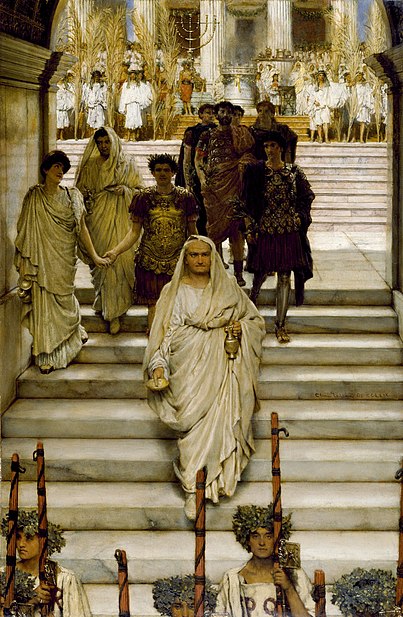
In Ancient History, the name is borne by Titus Flavius Vespasianus, the tenth Roman emperor in the Roman Empire and the second of the Flavian Dynasty.

In the New Testament, the name is borne by a companion of St. Paul who later became the first bishop of Crete and was a recipient of one of Paul’s epistles.

The name was also used by Shakespeare for his tragedy Titus Andronicus (1593).

Currently, Titus is the 253rd most popular male name in Germany, (2011) and the 397th most popular in the United States, (2010).

Other forms of the name include:

  • Tito (Aragonese/Basque/Galician/Italian/Portuguese/Spanish)
  • Titus (Czech/Danish/Dutch/English/French/German/Latin/Norwegian/Swedish)
  • Tiitus (Finnish)
  • Tite (French)
  • Titos Τιτος (Greek Biblical)
  • Titou τιτου (Greek Modern)
  • Titusz (Hungarian)
  • Títus (Icelandic/Slovak)
  • Titas (Lithuanian)
  • Titu Тітъ (Old Church Slavonic)
  • Tytus (Polish)
  • Tit Тит (Romanian/Russian/Croatian/Slovene)

An Italian, Portuguese and Spanish feminine form is Tita.

The designated name-day is January 4th.

Florentine

Gender: Feminine
Origin: Latin
Meaning: “prosperous; flourishing.”

The name is German or French form of the Latin female name, Florentina, which is a feminine form of the Late Latin male name Florentinus, which is ultimately derived from florens (prosperous, flourishing).

Currently, Florentine is the 197th most popular female name in Germany, (2011).

Other forms of the name include:

  • Florentine (Dutch/French/German)
  • Florentina (German/Italian/Latin/Spanish)
  • Florentyna (Polish)
Masculine forms include the French, Florentin and the Italian, Florentino.


Leandra

Gender: Feminine
Origin: Greek
Meaning: “lion man.”
Eng (lee-AHN-druh); Germ/Grk/Rus (ley-AHN-drah)

The name is a feminine form of Leander.

Currently, Leandra is the 182nd most popular female name in Germany.

The name is also in Greece, Poland, Romania, Russia and throughout the former Yugoslav. It is also used in Italy and in Spanish and Portuguese-speaking countries.

The name is borne by teen German-pop singer, Leandra Gamine (b.1994) and Belarusian-German pianist, Leandra Ophelia Dax (b.1981)

Sandro

Gender: Masculine
Origin: Italian სანდრო, Сандро

The name is a contracted form of Alessandro and is used as an independent given name in Italy,  Hungary, the Ukraine, Georgia, throughout South Eastern Europe, Spanish-speaking countries and in German-speaking countries, especially Switzerland.

The name was most notably borne by Sandro Botticelli (1445-1510).

Currently, Sandro is the 267th most popular male name in France (2009) and the 269th most popular male name in Germany, (2011).


Leonidas

Gender: Masculine
Origin: Greek Λεωνιδας
Meaning: “lion.”
Eng (lee-o-NYE-dus)

The name is derived from the Greek λεων (leon) meaning “lion.”

The name was borne by several famous leaders in Classical Greek history, one being King Leonidas I of Sparta, known for his heroic defense of the Thermopylae Pass from the Persians in the 5th-century B.C.E. His life has been the inspiration of Frank Miller’s 1988 comic 300, later adapted into a movie of the same name. He came to be deified in Sparta as a hero god. A Belgian Chocolate company is also named in his honour and he is the inspiration for their logo.

The name was also borne a teacher of Alexander the Great and by the father of Origen, St. Leonidas (3rd-century CE).

Leonidas seems to have enjoyed some popularity in 18th and 19th-century America and England. This may have been due to the epic eponymous poem based on the Spartan hero, written by Richard Glover (1737).

In more recent history, it was borne by Confederate general, Leonidas Polk (1806-1864) and the first modern Greek Olympic gold medalist, Leonidas Pyrgos (*1871).

Currently, Leonidas is the 282nd most popular male name in Germany, (2011) and the 922nd most popular in the United States, (2010).

Other forms of the name include:

  • Leonit (Albanian)
  • Ljeanid Леанід (Belarusian)
  • Leònides (Catalan)
  • Leonida (Croatian/Italian/Serbian)
  • Leónidás (Czech)
  • Leonidas Λεωνιδας (English/German/Greek/Lithuanian/Romanian)
  • Léonide (French)
  • Leonidasi ლეონიდასი (Georgian)
  • Leoneidas (German)
  • Leonides (German)
  • Leónidasz (Hungarian)
  • Leonīds (Latvian)
  • Leonid Леонид (Macedonian/Polish/Russian/Ukrainian)
  • Leónidas (Portuguese-European)
  • Leônidas (Portuguese-Brazilian)
  • Leónidas (Spanish)
A feminine form is Leonida, occassionally used in Spanish-speaking countries, Greece and Poland.

Rico

Gender: Masculine
Origin: Italian/Romansch/Spanish
(REE-koh)

The name comes from a Latinate diminutive form of either Enrico or Ricardo. It is now used as an independent given name in Italy, Spanish-speaking countries and in the Romansch-speaking regions of Switzerland.

Coincidentally, rico is also the Spanish word for “rich” and is used as a term of endearment for small children. It would roughly be the equivalent of “precious.”

Currently, Rico is the 314th most popular male name in Germany, (2011).


Rocco, Rock

Gender: Male
Origin: Italian
Meaning: “rest”
(ROCK-ko); (ROCK)

The name is derived from the Germanic hroc meaning rest.

It was borne by a 14th-century saint whose cult is still very popular in Italy. He was known for his care and selflessness toward the plague victims. He would nurse them when nobody else would.

Legend has it that he himself contracted the deadly disease. He chose to go out into the woods and die, however, thanks to a loyal dog that visited him and nursed him back to health each day, he was able to live and go on to help more victims. As a result, he is the patron saint against dog bites and of dogs.

The name is also borne by actor Rock Hudson, Rocky Balboa, Rocco DiSpirito, and singer Madonna has used this name for her own child.

Currently, Rocco is the 341st most popular male name in Germany, (2011) and the 389th most popular male name in the United States, (2010).

Other forms include:

  • Rok (Breton)
  • Roc (Catalan)
  • Roko (Croatian)
  • Rochus (Dutch/German)
  • Rock (English)
  • Roche (French)
  • Rocque (French)
  • Rokus (Frisian)
  • Rokkó (Hungarian)
  • Rollux (Latin)
  • Rokas (Lithuanian)
  • Ròc (Occitanian)
  • Ro (Poitvin)
  • Roch (Polish)
  • Rocque (Portuguese/Spanish)
  • Rok (Slovene)

Sonja

Gender: Feminine
Origin: Russian
Eng (SONE-yah); Germ (ZONE-yah)

The name is from a Russian diminutive form of Sophia. Among Russian-Jews, the name was often used as a Russian cognate for the Yiddish, Shayndel, though the two names are not etymologically related.

Sonia could also be from the Hindi word sona सोना  meaning “gold.”

In South Eastern Europe and Northern Europe, the name has been used as an independent given name since at least the turn of the 20th-century.

In the English-speaking world, the name was popularized by a 1917 eponymous novel by Stephen McKenna.

Currently, Sonja is the 297th most popular female name in Germany, (2011)

Other forms of the name include:

  • Soňa (Czech/Slovak)
  • Sonia (English/Italian/Portuguese/Romanian/Spanish)
  • Sonya (English/Russian)
  • Sonja Соња (Croatian/Dutch/Estonian/Finnish/German/Icelandic/Macedonia/Polish/Scandinavian/Serbian/Slovene)
  • Sonje (German)
  • Szonja (Hungarian)

The name is borne by Norwegian figure skater and actress, Sonja Henie (1916-1969).