Matilda

Gender: Feminine
Origin: Germanic
Meaning: “might in battle; strength in battle.”
Eng (mah-TIL-dah)

The name is composed of the Germanic elements, maht meaning, “might, strength” and hild meaning, “battle.”

In the English speaking world, the name has existed since Anglo-Saxon times, in the form of Mæðhilde but the Anglo-Norman forms of Matilda and Maud had replaced the former by the 10th-century.

The name was so common among the Norman aristocracy that it took on the reputation as a “Norman name.” The Normans extended their power throughout Western Europe and introduced the name to non-Germanic countries such as Italy, Spain, France and Portugal.

The name was borne by several medieval personages, who include:

St. Matilda (895-968), the first wife of Henry I the Fowler and mother of Otto I. The details of her life are recorded in the Res Gestae Saxonicae, (Deeds of the Saxons), as well as in the vita antiquior and in the vita posterior. Despite her royal lineage, St. Matilda was known for her piety and charity.
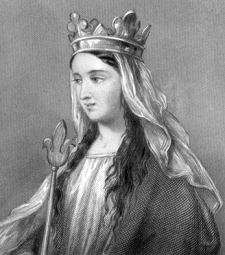
It was later borne by the wife of William I the Conquer, Matilda of Flanders, also known as Maud Le-Vieux, (1031-1083).

In Italian history, it was borne by Countess Matilda of Tuscany (1046-1115), who was known for her support for Pope Gregory VII and for her military exploits.

Edith of Scotland, (1080-1118), changed her name to Matilda upon marrying Henry I of England.

Another English queen who bore the name was Matilda of Boulogne, (1104-1152), wife of Stephen of England. It was also borne by the daughter of Henry II of England, Matilda, the Duchess of Saxony (1156-1189).

In Portugal, it was borne by their first queen-consort, Matilda of Savoy (1125-1158).

Maud was a common vernacular form used more frequently among the lower classes in both England and France. Maud is believed to have originated among the Low Germans since Matilda of Flanders, (who introduced this form of the name), was the daughter of Baldwin of Flanders. Also, in Medieval Dutch and Flemish, when a t appeared between two vowels, it was usually dropped, hence the creation of Maud.

The name was prevalent in England until the end of the 15th-century and was revived at the end of the 19th-century. The name was considered rather old fashioned between the mid to the latter part of the 20th-century, but is now suddenly rising in popularity in several countries.

Currently, in England, she is the 43rd most popular female name, (2008). Her rankings in other countries are as follows:

  • # 14 (Australia, 2008)
  • # 53 (Chile, 2006)
  • # 26 (France, 2006)
  • # 485 (the Netherlands, 2009)
  • # 25 (Norway, 2009)
  • # 25 (Sweden, 2009)
  • # 828 (the United States, 2008)

Its diminutive offshoot of Tilly is currently the 93rd most popular female name in the United Kingdom, (2008).

Other forms of the name include:

  • Matilda Матильда (Afrikaans/English/Finnish/Lithuanian/Russian/Slovak/Spanish/Swedish)
  • Mahthildis (Ancient Germanic)
  • Mæðhilde/Mǣþhild (Anglo-Saxon)
  • Matylda (Czech/Polish)
  • Mathilde (Danish/Dutch/French/German/Norwegian)
  • Machteld/Mechteld (Dutch)
  • Maud (Dutch/English)
  • Maude (English: MAWD)
  • Tilda (English/Finnish/Swedish)
  • Tilly (English: used as an independent given name)
  • Malda/Maldi (Estonian)
  • Milda/Mildi (Estonian)
  • Matilde (Estonian/Italian/Portuguese/Spanish)
  • Mahaut (French: archaic. mah-O)
  • Mahault/Maheu/Maheut (French: archaic)
  • Mechthild/Mechtilde (German)
  • Matild/Mátildá (Hungarian)
  • Matthildur (Icelandic)
  • Mafalda (Italian/Portuguese)
  • Matelda (Italian)
  • Mechtylda (Polish)
  • Matélda (Romanesque)
  • Mallt (Welsh)

Common German diminutives are: Mati, Matty, Hilde, Patty, Patsy, Tilli and Tilly.

English short forms include: Mattie, Tilly and Tilda.

A Dutch and Limbergish pet form is Til.

An Italian short form is Ilde.

A common Germanic diminutive occasionally used as an independent given name is Mette.

Obscure Italian masculine forms include: Matildio and Matildo.

The designated name-day is March 14.

It is also the name of a popular Australian national folk song, Waltzing Matilda.

Sources

  1. http://www.askoxford.com/firstnames/matilda?view=uk
  2. http://www.behindthename.com/name/matilda
  3. http://www.ssa.gov/cgi-bin/babyname.cgi
  4. Das große Vornamenlexikon, Rosa and Volker Kohlheim, Dudenverlag, Mannheim 2007, S. 292
  5. Ladó János, Bíró ÁgnesMagyar utónévkönyv. Budapest: Vince Kiadó. ISBN 963 9069 72 8 (2005)
  6. http://women.timesonline.co.uk/tol/life_and_style/women/article3074698.ece
  7. https://192.49.222.187/Nimipalvelu/default.asp?L=3
  8. http://www.ssb.no/navn/

Samuel

Gender: Masculine
Origin: Hebrew
Meaning: “God has heard.”
Eng (SAM-yoo-el)

The name is derived from the Hebrew שְׁמוּאֵל (Shemu’el) meaning, “God has heard.”

According to 1 Samuel 1:20, Hannah gave her son the name of Samuel in reference to when she had asked God for a son and God had heard her request.

Samuel was the last of the Hebrew Judges and the first of the Hebrew prophets and he also anointed the first two kings of Israel: Saul and David.

The name was always popular among Jews, but did not become prevalent in the English-speaking world until after the Protestant Reformation. The name was especially common among the Puritans of the 17th-century.

Currently, Samuel is the 28th most popular male name in the United States, (2008). In other countries, his rankings are as follows:

  • # 9 Samvel (Armenia, 2008)
  • # 13 (Australia, 2008)
  • # 42 (Belgium, 2006)
  • # 20 (Canada, B.C., 2008)
  • # 88 (Chile, 2006)
  • # 11 (England/Wales, 2008)
  • # 47 (France, 2006)
  • # 98 (the Netherlands, 2009)
  • # 95 (Norway, 2009)
  • # 39 (Scotland, 2009)
  • # 59 (Sweden, 2009)

Other forms of the name include:

  • Samvel (Armenian)
  • Samel (Basque)
  • Samoyla/Samuil Самуил (Bulgarian/Russian/Ukrainian)
  • Samuel (Czech/Dutch/English/French/German/Polish/Portuguese/Scandinavian/Slovak/Spanish)
  • Samuël (Dutch)
  • Samuli (Finnish)
  • Samouel Σαμουηλ (Greek: Biblical)
  • Shemu’el שְׁמוּאֵל (Hebrew: Biblical)
  • Shmuel שְׁמוּאֵל (Hebrew: Modern)
  • Sámuel (Hungarian)
  • Samúel (Icelandic)
  • Samuele (Italian)
  • Samweli (Kiswahili)
  • Samuels (Latvian)
  • Samuelis (Lithuanian)
  • Szmuel (Polish-Hebrew: a Polish transliteration of the modern Hebrew form, used primarily among Polish Jews)
  • Samuilu Самѹилъ (Old Church Slavonic)
  • Samuil (Romanian)
  • Samuèli (Sardinian)
  • Sawyl (Welsh)
  • Shem (Yiddish)
  • Schmuel (Yiddish)

Common English/German short forms are Sam and Sammy.

Czech short forms are: Samo, Samko, Samik , Samenko and Saminko.

A Polish diminutive is Samek.

A Hungarian and Finnish short form is Samu.

An Italian feminine form is Samuela and an obscure Norwegian feminine form is Samueline.

Designated name-days are: February 16 (Germany), August 20 (France/Poland), August 26 (Slovakia) and September 1 (Czech Republic and Sweden).

Sources

  1. http://www.panorama.am/en/society/2008/02/02/name/
  2. http://www.mechon-mamre.org/p/pt/pt08a01.htm#20
  3. http://www.askoxford.com/firstnames/samuel?view=uk
  4. http://www.behindthename.com/php/find.php?name=samuel
  5. Atikian, Martha Bilezikian. Armenians’ Names (Martha Bilezikian Atikian, 1973)
  6. Hoffman, William F. and George W. Helon. First Names of the Polish Commonwealth: Origins & Meanings. (Polish Genealogical Society of America, 1998)

Jonathan

Gender: Masculine
Origin: Hebrew
Meaning: “Yahweh has given.”
(JON-a-THEN)

The name is derived from the Hebrew יְהוֹנָתָן (Yehonatan) meaning, “Yahweh has given.” The name is considered a longer version of Nathan, and shares the same roots as Matthew. Contrary to some sources, John did not start off as short form of Jonathan.

In the Old Testament, it is the name of the eldest son of Saul and a friend of David. Their friendship is often used as an example of the most perfect form of brotherly love among Christian and Jewish ethicists.

In the English speaking world, Jonathan did not catch on until after the Protestant Reformation.

Currently, Jonathan is the 26th most popular male name in the United States, (2008). His rankings in other countries are as follows:

  • # 75 (Australia, 2008)
  • # 58 (Canada, B.C., 2008)
  • # 69 (Chile, 2006)
  • # 101 (the Netherlands, 2009)
  • # 41 (Norway, 2009)
  • # 33 (Sweden, 2009)

Other forms of the name include:

  • Jonatan (Catalan/Croatian/German/Polish/Scandinavian/Slovene)
  • Jonatán (Czech/Slovak/Spanish)
  • Jonathan (Dutch/English/French/German/Scandinavian)
  • Joonatan (Finnish)
  • Ionathan/Jehonathan Ιωναθαν (Greek: Biblical)
  • Yonatan/Yehonatan יוֹנָתָן יְהוֹנָתָן (Hebrew)
  • Jónatan (Icelandic)
  • Ionatán (Irish-Gaelic)
  • Gionatan (Italian)
  • Jónatas (Portuguese)

Common English short forms include: Jon, Jonny, Jonty and sometimes even Nathan.

A common Hebrew short form is Yoni.

The designated name-day is March 1 (France).

Sources

  1. Judges 18:30
  2. http://www.behindthename.com/name/jonathan
  3. http://www.askoxford.com/firstnames/jonathan?view=uk
  4. Hanks, Hardcastle and Hodges, Oxford Dictionary of First Names, Oxford University Press, 2nd edition, p.147.
  5. The Crosslinguistic Study of Language Acquisition – Page 342 by Dan Isaac Slobin

Dorothy

Gender: Feminine
Origin: Greek
Meaning: “gift of the god.”
Eng (DOR-thee); (DORE-e-THEE)

The name is derived from the Greek female name, Δωροθέα (Dōrothea), which is composed of the Greek elements, δωρον (doron) and θεος (theos).

In the early Christian church, the name was borne by a Greek virgin martyr. It was also borne by a 13th-century German saint who is considered the patron saint of Prussia.

In the English speaking world, the name has been in usage since the Middle Ages, but like other saints names, fell out of usage during the Protestant Reformation and was revived in the 18th-century.

Dorothy fell out of the U.S. top 1000 after 2006, when she came in 990th most popular female name. Between 1920 and 1927, she was the 2nd most popular female name.

The name is found in L. Frank Baum’s children fantasy series, The Wonderful Wizard of Oz (1900).

Its English diminutive offshoot, Dolly, was also occasionally used as an independent given name, as is the case with American First Lady, Dolley Madison, (née Dolley Payne Todd Madison), 1768-1849. In fact, the modern English word for doll is supposedly derived from the female given name.

Other forms of the name include:

  • Doroteja Доротеја (Bulgarian/Polish/Serbian)
  • Dorotea (Catalan/Croatian/Estonian/Italian/Norwegian/Slovene/Spanish/Swedish)
  • Dorota (Czech/Polish/Slovak)
  • Dorothea (Dutch/English/German/Greek/Norwegian)
  • Teija (Finnish)
  • Terhi (Finnish: literally means “mist” but is also used as a cognate of Dorothy. See Terhi).
  • Dorothy (English)
  • Dolly (English)
  • Durita (Faroese)
  • Dorothée (French)
  • Dortje/Doortje/Dörtje (Frisian)
  • Dorika (Hungarian)
  • Dorina/Dorinka (Hungarian/Romansch)
  • Dorottya (Hungarian)
  • Dórótea (Icelandic)
  • Dace (Latvian: currently the 7th most popular female name in Latvia, 2005. DAHT-say).
  • Darta (Latvian)
  • Darata (Lithuanian)
  • Dorotëja (Lithuanian)
  • Urta/Urtė (Lithuanian)
  • Dorte/Dorthe (Low German)
  • Dörte/Dörthe (Low German)
  • Dürte/Dürten (Low German)
  • Dortea/Dorthea (Norwegian)
  • Dochna (Polish: archaic)
  • Doroteia (Portuguese)
  • Dorofei Дорофей (Russian)
  • Dorofeja (Russian)
  • Dorote (Swedish)
  • Dorit (Swedish)
  • Dorofija/Dorotija (Ukrainian)

An obscure French diminutive is Dorette.

A Danish diminutive form is Ditte.

German short forms include: Dodo, Dora, Dore, Dorel, Dorett, Dorle, Dorli, Doro, Tea and Thea.

English nicknames are: Dodie, Dodo, Doll, Dolly, Dot, Dottie and Thea.

Polish diminutives are Dosia and Dorotka.

Dorita is a Spanish diminutive.

An Italian masculine form is Doroteo and the Greek masculine form is Dorotheos.

Theodora shares the same etymology.

The designated name-day is February 6.

Gaston

Gender: Masculine
Origin: French
Meaning: debated
gas-TAWN

The name is derived from the Flemmish, Vaast, which is derived from an even older name, Vedastus which could either be from a Germanic source meaning, “stranger” or it could be from the Latin meaning, “of Gascony.”

The name was borne by an early French saint, Gaston of Arras, as well as by a few French royals.

Other forms of the name include:

  • Gastó (Catalan)
  • Gastone (Italian)
  • Vaast (Dutch/Flemmish)
  • Gaston (Dutch/French/German/Polish)
  • Gaszton (Hungarian)
  • Vedastus (Latin)
  • Gastonas (Lithuanian)
  • Wedast (Polish)
  • Gastão (Portuguese)
  • Gastón (Spanish)

The designated name-day is February 6.

Svetlana

Gender: Feminine
Origin: Russian
Meaning: “light.”
Светлана
(svet-LAH-nah).

The name is derived from the Slavic element, svetlo, meaning “light.”

It was used as a vernacular form of the Greek, Photine, (see Photine), in honour of St. Photine, the Samaritan woman.

Its usage was further popularized in 1813 via Alexander Vostokov, a Russian philologist and poet. Another Russian poet of the same period, Vasily Zhukovsky, also used the name for his ballade, Svetlana.

Other forms of the name include:

  • Svjatlana Святлана (Belarusian)
  • Svetla (Bulgarian)
  • Svjetlana (Croatian)
  • Světlana (Czech)
  • Swetlana (German)
  • Szvetlána (Hungarian)
  • Świetlana (Polish: shvyet-LAH-nah)
  • Swietłana (Polish: svyet-WAH-nah)
  • Sveta Света (Russian)
  • Svitlana Світлана (Ukrainian)

The name is also used in Bulgarian, Latvian, Macedonian, Serbian, Slovene and Slovakian.

A South Slavic masculine form is Svetlan.

The designated name-days are: February 6 (Bulgaria), February 26 (Russia), March 15 (Slovakia), March 20 (Czech Republic), April 2 (Russia) and September 28 (Latvia).

The name is borne by Svetlana Alliluyeva aka Lana Peters, the youngest daughter of Joseph Stalin, (b.1926) and the current first lady of Russia, Svetlana Medvedeva

Sveta, Sveti, Svetlanka and Lana are used as short forms in Russian.

Zoe, Zoë

Gender: Feminine
Origin: Greek
Meaning: “life.”
Ζωη
(ZO-wee)

The name comes directly from the Greek word for life. It has always been a common name among Greeks and among Greek Jews, it was often used as vernacular form of Eve.

In the Greek Orthodox Church, (and in the Catholic) it is borne by two early Christian martyrs. It was also borne by an 11th-century Byzantine Empress.

In Western Europe, the name did not come into usage till the 18th-century, when there was a widespread revival of the classics.

In modern Catholic Church history, it was borne by a 19th-century French nun, mystic and saint Catherine Labouré (née Zoé Labouré), who introduced the usage of the Miraculous Medal.

Currently, the name is the 58th most popular female name in the United States, (2008), her rankings in other countries are as follows:

  • # 17 (Australia, 2008)
  • # 25 (Belgium, 2006)
  • # 50 (Canada, B.C., 2008)
  • # 83 (England/Wales, 2008)
  • # 44 (Hungary, 2008)
  • # 25 (the Netherlands, 2009)
  • # 36 (Scotland, 2009)

Other forms of the name include:

  • Zoya Зоя (Aragonese/Macedonian/Russian/Serbian/Ukrainian)
  • Zoë (Dutch/English/German/Scandinavian)
  • Zoe (Catalan/Croatian/Czech/English/Italian/Polish/Spanish)
  • Zoi Ζωη (Greek: Modern)
  • Zoé (French/Hungarian/Portuguese)
  • Zója (Hungarian)
  • Zoja (Polish/Slovak/Slovene)

The designated name-days are: Feburary 26 (Russia), April 13 (Greece), May 2 (France) and October 27 (Czech Republic).

The name is borne by Zoe Saldana (b. 1978) and Zooey Deschanel (b.1980)/

Benjamin

Gender: Masculine
Origin: Hebrew
Meaning: “son of the south; son of the right hand.”
Eng (BEN-juh-min)

The name is borne in the Old Testament by the youngest son of Jacob and Rachel. According to Rabbinical scholars, Benjamin was initially named Benoni, an illusion to Rachel dying after childbirth, meaning, “son of my pain.” Jacob had changed his name to Benjamin, a name which is somewhat debated.

According to most sources, Benjamin is composed of the Hebrew elements ben meaning, “son of” and jamin, which can either be interepreted as meaning, “the right side” or “the south” since in ancient Hebrew, there was no grammatical difference between “right” and “south.” This may be in reference to the idea that Benjamin was born in Canaan. However, the meaning of “the right side” can also be in reference to strength and virtue.

In the Samaritan Penteteuch, the name is rendered as Benjamim, which literally means “son of days” which may be a reference to Jacob’s old age when Benjamin was born.

The name was always common among Jews, but did not become common among western Christians until after the Protestant Reformation, among Eastern Orthodox, the name was in usage since the Middle Ages, since it was also borne by an early Eastern Christian martyr.

Currently, Benjamin ranked in as the 25th most popular male name in the United States, in other countries, his rankings are as follows:

  • # 10 (Australia, 2008)
  • # 62 (Belgium, 2006)
  • # 7 (Canada, B.C., 2008)
  • # 1 (Chile, 2006)
  • # 18 (England/Wales, 2008)
  • # 53 (Hungary, 2008)
  • # 65 (the Netherlands, 2009)
  • # 17  (Norway, 2009)]
  • # 60 (Scotland, 2009)
  • # 47 (Slovenia, 2005)
  • # 36 (Sweden, 2009)

In French, benjamin is also a slang term for a young child, roughly translating to “kid.”

Other forms of the name include:

  • Binyamin בִּנְיָמִין بنيامين (Arabic/Hebrew)
  • Benxamín (Asturian/Galician)
  • Benkamin (Basque)
  • Benjamí (Catalan)
  • Benghjaminu (Corsican)
  • Benjamin Бењамин (Croatian/Danish/Dutch/English/Finnish/French/German/Serbian)
  • Benjamín (Czech/Icelandic/Slovak/Spanish)
  • Beniamín Βενιαμίν (Greek)
  • Peni (Hawaiian)
  • Benjámin (Hungarian)
  • Beniamino (Italian)
  • Bendžamins (Latvian)
  • Benjaminas (Lithuanian)
  • Beniamin (Polish/Romanian)
  • Benjamim (Portuguese)
  • Veniamin Вениамин (Russian)
  • Bünyamin (Turkish)

Common Dutch, German and English short forms are: Ben, Benny and Benji.

French short forms are Ben and Jamin.

Hungarian diminutives are Benke, Benkő, Benő and Béni.

Obscure but legitimate feminine forms are: Benjamine (French), Benjámina (Hungarian), Beniamina (Italian).

Famous bearers include:

Current Prime Minister of Israel, Benjamin Netanyahu (b.1949), Jewish Khazar ruler, Benjamin (9th-century C.E.), St. Benjamin of Persia (5th-century C.E.), Pope Benjamin II of Alexandria (1327-1339), Benjamin Franklin (1706-1790) Benjamin Disraeli (1804-1881) and Ben Affleck (b.1972).

Designated name-days are: January 3 (Hungary), March 31 (France/Slovakia), December 20 (Finland) and December 28 (Sweden).

Agatha

Gender: Feminine
Origin: Greek
Meaning: “good.”
Eng (AG-uh-thuh)

The name is derived from the Greek, αγαθος (agathos), meaning, “good.”

The name was borne by an early Christian martyr, St. Agatha of Sicily, who, according to legend, refused the advances of a suitor and was renounced as a Christian. Before being beheaded, she was tortured by having her breasts tinctured off. Due to this she has been considered the patron saint against breast cancer and other breast diseases. Her feast day and the designated name-day is February 5.

The name was popular in Medieval England but fell out of usage after the Protestant Reformation. It was revived in the 19th century, one famous modern bearer being English mystery writer, Agatha Christie (1890-1976).

Currently, the name does not appear in the U.S. top 1000, the last time she was seen was in 1945, coming in as the 917th most popular female name.

She remains a staple in other countries, particularly in Poland and France.

Other forms of the name include:

  • Agate (Basque)
  • Àgueda/Àgata (Catalan)
  • Agata Агата (Croatian/Icelandic/Italian/Latin/Norwegian/Polish/Romanian/Russian/Serbian/Slovene/Swedish)
  • Agáta (Czech/Hungarian/Slovak)
  • Agate/Agathe (Danish/German/Latvian/Norwegian: ah-GAH-te)
  • Agatha (Dutch/English/German)
  • Aet (Estonian)
  • Agaate (Estonian)
  • Ita/Iti (Estonian)
  • Akaata (Finnish)
  • Agathe (French: ah-GAHT)
  • Ádega (Galician)
  • Agathê/Agathi ἀγαθή (Greek: Modern)
  • Ágota (Hungarian)
  • Agra (Latvian: this one has a completely different etymology, but has also been traditionally used as a form of Agatha).
  • Agota (Lithuanian)
  • Ågot (Norwegian)
  • Aita (Romansch/Estonian)
  • Agafia Агафья (Russian)
  • Gaèa (Serbian)
  • Àita (Sicilian)
  • Agatija (Slovene)
  • Gadea (Spanish: archaic)
  • Águeda (Spanish/Portuguese)
  • Agda (Swedish)
  • Ahafiya (Ukrainian)

An English short form is Aggie.

Croatian diminutives are: Agica, Jaga and Jagica.

A Czech pet form is Hota.

Polish short forms are: Aga, Agatka and Agusia.

Russian diminutives are: Agasha, Gafiya, Ganya, Gasha and Gashka.

A Hungarian short form is Ági.

A male Greek form is Agathon Αγαθων.

Agate is also the name of a precious stone.

Veronica, Berenice, Bernice

Gender: Feminine
Origin: Greek
Meaning: “true image; bringer of victory.”
Eng (veh-RON-ik-uh); Eng (bare-eh-NIE-see); Eng (ber-NEES)

Veronica and Berenice have a very long history of usage.

In the ancient world, Berenice was a Greek royal name, possibly derived from the Greek elements, φερω (phero), meaning, “to bring” and νικη (nike), meaning “victory.” However, other sources contend that Veronica is a completely different name of a different etymology, being composed of the Latin phrase, vera icon, meaning, “true image.” This meaning is most likely in reference to the legend of St.Veronica, who in Catholic and Orthodox tradition was a lady who wiped Christ’s face with her veil. According to the legend, Christ’s face miraculously imprinted itself on her veil.

Berenice also appears in the New Testament, but seems to have been a common female name in the ancient Greek world. It was borne by several Greek and Macedonian royal princesses.

Veronica was occasionally used in Medieval England, but went out of usage, even before the Protestant Reformation. It remained common on the Continent.

Veronica became prevalent in 2oth-century America due to the sudden influx Catholic European immigrants. Currently, Veronica is the 216th most popular female name in the United States, (2008). She experienced a short surge of popularity between the 1970s and 80s, the highest she ranked was at # 68.

Berenice/Bernice were introduced into the English speaking world during the Protestant Reformation. Currently, Berenice does not appear in the U.S. top 1000, the last time she was seen was in 2003, coming in as the 855th most popular female name. However, in 1921, Bernice was the 39th most popular female name in the United States. Bernice fell out of the top 1000 in 1985.

Other forms of Veronica include:

  • Veronika Вероника (Croatian/Czech/German/Hungarian/Latvian/Lithuanian/Norwegian/Russian/Serbian/Slovak/Slovene/Swedish)
  • Veronica (Danish/English/Finnish/Italian/Romanian)
  • Véronique (French)
  • Weronika (Polish)
  • Weronikia (Polish: obscure)
  • Verônica (Portuguese)
  • Feruna (Slovene: obscure)
  • Verónica (Spanish)

An Italian masculine form is Veronico.

Russian diminutives include: Veronichka, Vera, Verona, Ronya, Ronyusha, Verunya, Verusha, Vicky, Nick, Nikasha, and Nikusha.

Slovene diminutives include: Nika, Roni, Ronja, Ronka, Verona, Veroni, Veronica, Veronka and Veruša.

Common English short forms are: Nicki, Ronnie and Vera.

Other Berenice forms include:

  • Vernika (Czech)
  • Berenika (Czech/Polish/Slovene)
  • Berenice (English/Italian: be-reh-NEE-che)
  • Bernice (English)
  • Berenike Βερενικη (Greek)
  • Bernike Βερνικη (Greek)
  • Pherenike Φερενικη (Greek: ancient Attic Greek)
  • Bereniké (Hungarian)
  • Verenika (Russian)

In English, Bunny is used as a pet form of Bernice.

The designated name-day is February 4.