Walid

Gender: Masculine
Origin: Arabic
Meaning: “newborn.”
(WAH-leed)

The name is derived the Arabic ولد (walada), “to give birth.”

It is primarily used in honour of Al-Walid I (668 – 715) and Ummayid Caliph who had ruled in the early 700s. He is known for instituting Arabic as the official language across the Islamic World and his conquer of Spain.

As of 2009, Walid was the 163rd most popular male name in France.

Other forms of the name include:

  • Velid (Albanian/Azeri/Bosnian/Bulgarian/Central Asian/Turkish)

Naim

The name could be from the Hebrew נעים‎ meaning, (pleasant) or the Arabic نعیم‎ (tranquil).

As of 2009, Naïm (Maghrebin orthograph) was the 182nd most popular male name in France.

A feminine form is Naima.

Sami

Gender: Masculine
Origin: Arabic سامي
Meaning: “high; elevated; supreme.”
(SAH-mee)

The name is derived from the Arabic meaning, “high; elevated; supreme.”

However, it could also be a Finnish short form of Samuel. In Finland, it has often been used as an independent given name and in recent years is most likely used in reference to the language and ethnic group which is found in Finland, Norway and Russia, perhaps among people of Sami heritage. Sami is also the name of a lake in Finland.

As of 2009, Sami was the 183rd most popular male name in France while in 2010 he came in as the 193rd most popular male name in the Netherlands.

A feminine form of the Arabic is Samia.

Karim

Gender: Masculine
Origin: Arabic  كريم Карим
Meaning: “noble; generous.”
(KAH-REEM)

The name comes directly from the Arabic word for, “noble; generous.” In Islam, Karim is one of the 99 designations of Allah and is used to describe the Qu’ran (Al-Qur’an Al-Karim), literally meaning “the Noble Qu’ran.”

The name is used throughout the Islamic world, but is also used among Middle Eastern Christians.

The name has been occasionally used in Latin America, in Brazil, it seems to be a Portugized spelling for the Scandinavian female name Karin, but in this case it is pronounced (kah-REEN).

The name has numerous famous bearers.

As of 2009, Karim was the 260th most popular male name in France.

Other forms of the name include:

  • Kerim (Azeri/Turkish)
It is sometimes transliterated as Kareem. Feminine forms are Karima, Kerime (Turkish) or Kareema.

Adel, Adil

Gender: Masculine
Origin: Arabic عادل
Meaning: “just; fair.”

The name is derived from the Arabic adjective,  عدل  (adala), meaning, “just.”

The name is used throughout the Islamic world, though, the it is also used among Middle Eastern Christians.

As of 2009, Adel was the 285th most popular male name while Adil was the 378th most popular.

Other forms of the name include:

  • Adel پور (Algerian/Arabic/Coptic/Egyptian/Ethiopian/Kurdish/Lebanese/Persian/Sudanese/Syrian/Tunisian/Uyghur)
  • Adil Адиль
  • (Albanian/Azeri/Bangali/Baloch/Bashkir/Bosnian/Bulgarian/Chechen/Circassian/Dagestani/Kazakh/Moroccan/Ossetian/Pakistani/Tatar/Turkish/Turkmen/Uzbek)
  • Jedil/Yedil Эдил (Kyrgyz)

A feminine form is Adila (Arabic) and Adile (Turkish)

Sabri

Gender: Masculine
Origin: Arabic صبريّ
Meaning: “patient.”
(SAH-bree)

The name comes directly from the Arabic meaning, “patient.”

As of 2009, Sabri was the 397th most popular male name in France.

Feminine forms are Sabriyya and Sabriye (Turkish).

Nabil

Gender: Masculine
Origin: Arabic نبيل
Meaning: “noble”
(NAH-BEEL)

The name comes from the Arabic meaning, “noble”, and is popular among Christians, Muslims and even Baha’i.

It was borne by a an early Christian saint and martyr, a king of Mauretania, who was martyred under his brother Gildon, who took the side of the Pagan Romans.

It was also borne by Nabíl-i-Akbar (1829-1892), one of the 19 Apostles of Bahá’u’lláh and the Great Nabíl (1831–1892), a renowned Bahai historian.

As of 2009, Nabil was the 399th most popular male name in France.

A Berber form is Navil and a feminine form is Nabila.

Said

Gender: Masculine
Origin: Arabic سعيد
Meaning: “happy.”
(sah-EED)

The name comes directly from the Arabic meaning, “happy.”

As of 2009, Said was the 459th most popular male name in France.

Other forms of the name include:

  • Said سعيد Саид (Albanian/Arabic/Azeri/Bosnian/Bulgarian/Chechen/Circassian/Dagestani/Egyptian/Indonesian/Iranian/Javanese/Kazakh/Kyrgyz/Lebanese/Ossetian/Pashtun/Syrian/Tatar/Turkmen/Uzbek)
  • Saïd (Algerian/Moroccan/Tunisian)
  • Sead (Bosnian)
  • Sejad (Bosnian)
  • Sait (Kurdish/Turkish)
The feminine form is Saida.
 

Idris

Gender: Masculine
Origin: Arabic إدريس‎ or Welsh
Welsh Meaning: “ardent lord.”
Arabic Meaning: uncertain

Idris is of two different origins and is used in two separate cultures. In Welsh, it is composed of the elements, udd (lord; prince) and ris (ardent, enthusiastic.” In Welsh mythology it was borne by a giant who used the mountain peak of Cadair Idris (Seat of Idris) as an observatory. Legends claims that if you spend one night on the mountain peak you wake up either as a madmen or as a great poet. The name was also borne by a 7th-century Welsh prince, Idris ap Gwyddno.

In the Qu’ran, the name is borne by a prophet, traditionally ascribed to being the same as the Biblical prophet Enoch. Many modern Islamic scholars now believe that Idris was a separate person from Enoch. In this case, the name is believed to be of pre-Islamic and possibly of non-Arabic roots of undeterminate etymology, some, however have connected the name with the Arabic root d-r-s, meaning, “study.”

As of 2009, Idris was the 479th most popular male name in France. In France it is used both among the Bretons and among recent Muslim immigrants.

Other forms of the Arabic include:

  • Idris إدريس‎) Идрис (Albanian/Arabic/Baloch/Bosnian/Bulgarian/Circassian/Dagestani/Ethiopian/Indonesian/Javanese/Malaysian)
  • İdris (Azeri/Turkish)
  • Idriss (Chadian)
  • Driss (Berber/Maghrebi Arabic)
  • Ydyrys Ыдырыс (Chechen/Kazakh/Kyrgyz/Tajik/Tatar/Turkmen/Uzbek)
  • Idrîs (Kurdish)
  • Idriis (Somali)
  • Idrissa (West African)

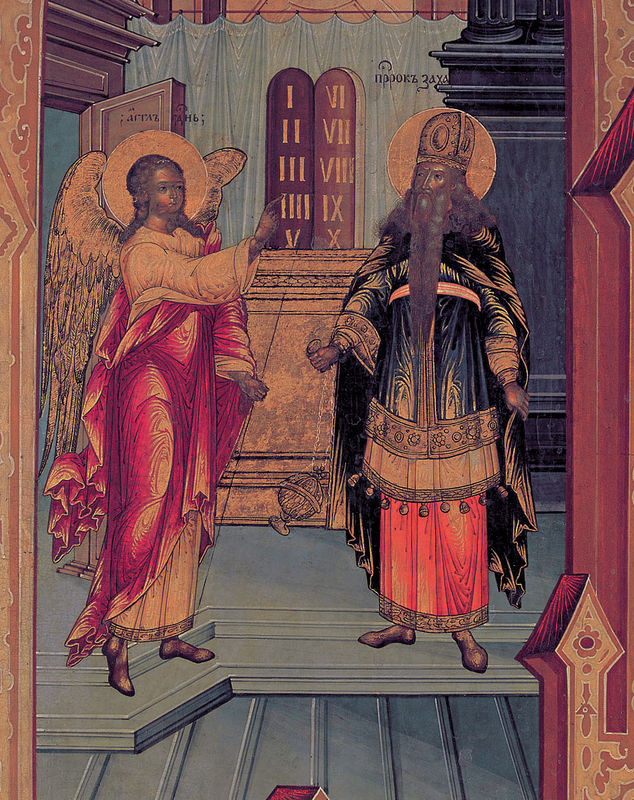
Zechariah, Zachary

St. Zachary Gender: Masculine
Origin: Hebrew  זְכַרְיָה
Meaning: “God remembers.”
Eng (zek-e-RIE-ah); (ZACK-e-REE)

Zachary is an English form of the Hebrew Zechariah, a theophoric name that means “God remembers; Yahweh remembers.”

The name is borne by several characters in both the Old and New Testament. In the Old Testament, it was borne by a prophet who authored the Book of Zechariah and in the New Testament, it was borne by the father of John the Baptist.

In the Qu’ran, the father of John the Baptist is viewed as a prophet and also as the protector of Mary, the mother of Jesus.

The name also appears as Zacharias, a Greek rendition, in some versions of the New Testament.

In the English speaking world, the name has been in usage since Medieval times. In Eastern Europe, especially in Orthodox dominated countries, it has always been a common name.

Currently, Zachary is the 61st most popular male name in the United States, (2010). In 1994, he ranked as high as # 12.

In other countries, his popularity is as follows:

  • # 51 (Australia, NSW, 2010)
  • # 51 (England/Wales, 2010)
  • # 55 (Canada, BC, 2010)
  • # 331 (Zacharie, France, 2009)
  • # 446 (France, 2009)

Other forms of the name include:

  • Sagarias (Afrikaans)
  • Zakariyya زكرياء (Arabic/Assyrian/Circassian/Coptic/Ethiopian/Lebanese/Syrian)
  • Zacharij/Zachari Захари (Bulgarian)
  • Zacaries (Catalan)
  • Zekarija Закария (Chechen/Kazakh)
  • Zakaria ზაქარია (Coptic/Ethiopian/Georgian/Kurdish)
  • Zaharije Зaxapиje (Croatian/Serbian)
  • Zachariáš (Czech/Slovak)
  • Zachary (Czech/English/French/Polish)
  • Zacharias (German/Scandinavian)
  • Sakarias (Faroese/Norwegian/Swedish)
  • Sakari (Finnish: Sakke is a diminutive form)
  • Saku (Finnish)
  • Zacharie (French)
  • Sagaire/Sagairi (Gaelic)
  • Zacharias Zαχαριας (Greek)
  • Zakariás (Hungarian)
  • Zakeus (Hungarian)
  • Zekarja (Hungarian)
  • Zaccaria (Italian)
  • Zaccheo (Italian)
  • Cherian (Malayalam)
  • Sakaria (Malayalam)
  • Scaria (Malayalam)
  • Zaxaria Захарїа (Old Church Slavonic)
  • Zachariasz (Polish)
  • Zacarias (Portuguese)
  • Zaharia (Romanian)
  • Zaccaria(s) (Romansch)
  • Zachar Захар (Russian)
  • Sachairi (Scottish-Gaelic)
  • Zacarías (Spanish)
  • Zakarya (Swahili)
  • Zekeriya (Turkish)

The name is also borne by several saints as well as by one Roman Catholic pope and a Coptic pope.

Zaharina Захарина is a Bulgarian feminine form and Zara is its pet form.

Other notable bearers include an 8th-century Nubian king, a 9th-century Khazar king, and American president, Zachary Taylor (1784-1850)

Sources

  1. http://www.askoxford.com/firstnames/zachary?view=uk
  2. http://www.behindthename.com/php/find.php?name=zachary
  3. http://www.svenskanamn.se/
  4. http://bibref.hebtools.com/?book=%20Matthew&verse=23:35&src=!