Adhan, Azaan

429px-Jean-Léon_Gérôme_010


The name is derived from the Arabic root ʾadhina أَذِنَ meaning “to listen, to hear, be informed about,” or ʾudhun (أُذُن), meaning “ear.” The Adhan, sometimes romanized as Azaan, is the name of the Islamic call to prayer, which is rung 5 time a day.

Currently, Azaan is the 406th Most Popular Male Name in England & Wales, (2018). Other transliterated forms include: Adaan, Adan, Adhaan, Athan, Edan & Edhaan.

Other forms include:

  • Ezani (Albanian)
  • Ezan Езан (Albanian, Bosnian, Bulgarian, Kurdish, Turkish)
  • Azan Азан (Azeri, Kazakh, Kyrgyz, Malay, Tatar)
  • Azán Аза́н (Chechen)
  • Adan (Javanese)
  • Aadaan (Somali)
  • Azon Азон (Tajik)
  • Ezane (Zazaki)

Sources

Igor, Ingvar

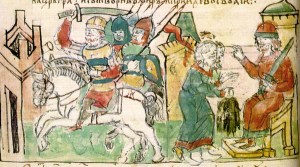
Radzivill_Igor-945


Ingvar is the modern Scandinavian form of the Old Norse, Yngvarr, meaning “Ing’s warrior.” It was introduced into Russia in the 10th-century by the Varangians, which gave the world the Igor form. The latter was borne by 2 Grand Princes of Kiev and has been a favorite in several Slavic countries since.

Currently, Igor is the 19th Most Popular Male Name in Poland (2018) and the 48th Most Popular in Moscow, Russia (2018), while in England he currently ranks quite low at #497 (2018).

Igor is used in Bulgarian, Czech-Slovak, Dutch, Estonian, German, Hungarian, Italian, Macedonian, Portuguese, Romanian, Serbo-Croatian, all modern Scandinavian languages, Slovene, & Spanish

Other forms of the name include:

  • Ihar Ігар (Belarusian)
  • Ingvar (Danish, Estonian, Finnish, Icelandic, Norwegian, Swedish)
  • Iku (Finnish)
  • Ingwar, Ingwer (German)
  • Ingvaari (Greelandic)
  • Ingvâre (Greenlandic)
  • Ígor (Icelandic)
  • Inguarus (Late Latin)
  • Ingvars, Igors (Latvian)
  • Igoris (Lithuanian)
  • Ignar (Nowegian)
  • Yngvar (Norwegian)
  • Yngvarr (Old Norse)
  • Ingwar (Polish)
  • Inguar (Portuguese)
  • Ingor (Swedish)
  • Ihor Ігор  (Ukrainian)

Sources

Nora, Nour

1024px-Dawn._Buryatia,_Russia


This multicultural name has recently experienced a revival. In European countries, the name stems from any name ending in the -nora element, such as Honora & Eleanora. In Arabic, Nora is a variant transliteration of Nurah, which is a strictly feminine version of the unisex Arabic name, Nur (light). Nur is used as one of the 99 attributes of Allah, al-Nur (the light).

The name was used by Henrik Ibsen for his main character in his play, A Doll’s House (1878).

Outside of East Asia, there isn’t a counry where Nora is unhead of or is not in use. Nora has been in out of the U.S. Top 100 since 1880! She currently ranks in as the 30th Most Popular Female Name in the United States. Her rankings in other countries are as follows:

  • #2 (Norway, 2018)
  • #10 (Netherlands, 2018)
  • #11 (Hungary, 2018)
  • #14 (Switzerland, 2018)
  • #15 (Denmark, 2018)
  • #20 (Belgium, 2018)
  • #23 (Austria, 2018)
  • #26 (Catalonia, Spain, 2018)
  • #28 (Sweden, 2018)
  • #38 (Canada, BC, 2018)
  • #47 (Spain, 2018)
  • #64 (Norah, Netherlands, 2018)
  • #79 (Bosnia & Herzegovina, 2018)
  • #84 (Norah, Canada, BC, 2018)
  • #85 (Italy, 2018)
  • #119 (France, 2018)
  • #140 (Norah, United States, 2018)
  • #184 (Norah, France, 2018)
  • #197 (England & Wales, 2018)
  • #283 (Norah, England & Wales, 2018)

Its Dutch version of Noor also ranks high in several popularity charts. This name is also used by Muslim families as a variation of Nur. Her rankings in other countries are as follows:

  • #10 (Netherlands, 2018)
  • #25 (Belgium, 2018)
  • #279 (England & Wales, 2018)
  • #311 (France, 2018)

Noortje is another Dutch version which currently ranks in as the 203rd Most Popular Female Name in the Netherlands.

Other forms of its European version include:

  • Nora Нора Νόρα (Bulgarian, Greek)
  • Noera (Dutch)
  • Noor (Dutch)
  • Noortje (Dutch)
  • Norah (Dutch, English, French)
  • Nonie (English)
  • Noreen (English, Irish)
  • Noora (Estonian, Finnish)
  • Nóra Но́ра (Faroese, Hungarian, Irish, Russian)
  • Nuura (Finnish, Scandinavian)
  • Nóirín (Gaelic)
  • Norina (Italian, Provençal, Romansch)
  • Norá (Sami)
  • Norea (Scandinavian)
  • Norena (Scandinavian)
  • Noria (Scandinavian)
  • Norita (Spanish, Scandinavian)

The Arabic Nur is traditionally a unisex name which is popularly used in many Islamic countries. Its Maghrebi form of Nour currently ranks in the following popularity charts for girls:

  • #40 (Belgium, 2018)
  • #48 (Catalonia, Spain, 2018)
  • #48 (France, 2018)
  • #76 (Spain, 2018)
  • #137 (Italy, 2018)
  • #197 (Netherlands, 2018)

Nur is currently the 87th Most Popular Female Name in Bosnia & Herzegovina (2018).

Other forms of the Arabic version include:

  • Noora, Nura (Arabic, strictly feminine)
  • Noura (Maghrebi Arabic, strictly feminine)
  • Núria (Catalan)
  • Nor (Malay, unisex)
  • Nuru (Swahili, strictly feminine)

Sources

Dunya, Dounia

download

The name is derived from the Arabic dunyā (دُنْيَا) meaning “world, kingdom, universe.”

It is a concept in Islam used to describe worldly concerns, and it is also used to describe anything that is close or near.

Its Maghrebi form of Dounia is currently the 445th most popular female name in France.

Other forms include:

  • Dynja (Albanian)
  • Dünya (Azeri/Turkish)
  • Donja Донъя (Bashkir)
  • Dunja (Bosnian)
  • Djunjà/ дюня̀/Dunjà дуня̀ (Bulgarian)
  • Denya (Egyptian-Arabic)
  • Donya  دنیا (Egyptian-Arabic/Javanese/Persian)
  • Duniya (Hausa)
  • Ddunit (Kabyle)
  • Dünïe дүние (Kazakh)
  • Dinya (Kurdish)
  • Düynö (Kyrgyz)
  • Dunia (Malay/Indonesian/Swahili)
  • Dinja (Maltese)
  • Dunida (Somali)
  • Dunyo дунё (Tajik/Uzbek)
  • Dön’ya дөнья (Tatar)
  • Dünyä (Turkmen)
  • Duniyâ دنیا (Urdu)

Sources

Zara

ZaraThe name has recently become a success in several countries, from England to Turkey, it has several possible derivatives and meanings.

Its English use may have been inspired by the Voltaire play, Zara (1732) (Zaïre in French) which may have been a French corruption of the Arabic female name, Zahra. The play recounts the exploits of a Christian woman named Zara or Zaïre, who is enslaved by Muslims. The name became extremely popular in the U.K. after Princess Anne chose this name for her daughter, Zara Phillips (b.1981).

Alternately, the name has recently become popular in many Slavic countries. It is probably a borrowing from the Bulgarian hypochoristic form of Zaharina (a feminine form of Zachary) or it may be from an Old Slavonic element, žar (fervor, ardor, ember).

Zara currently ranks in several countries’ top female names. Her rankings across the world are as follows:

  • #11 (Malaysia, 2016)
  • #22 (Bosnia & Herzegovina, 2016)
  • #23 (Australia, 2017)
  • #38 (New Zealand, 2016)
  • #40 (Scotland, 2016)
  • #46 (Slovenia, 2016)
  • #56 (Ireland, 2016)
  • #68 (England/Wales, 2016)
  • #197 (Netherlands, 2016)
  • #318 (United States, 2016)

Zara is also the name of a clothing store.

Sources

Iris

IrisOrigin: Greek Ιρις
Meaning: “rainbow”
Gender: Feminine

The name is derived from the Greek “Îris (Ἶρις) Írídos (ίρίδος) “rainbow” and is borne in Greek mythology by the goddess of the rainbow and messenger of the Olympian gods. It later became associated with the body part, the flower, and a colour, all of which were named for the Greek goddess.

In recent years, the name has experienced a surge in popularity in several countries. Its rankings in other countries are as follows:

  • #21 (Iceland 2017, Íris)
  • #25 (Portugal, 2016, Íris)
  • #31 (Sweden, 2017)
  • #32 (France, Paris, 2016)
  • #56 (Catalonia, 2016)
  • #73 (Spain, 2016)
  • #84 (England/Wales, 2016)
  • #85 (Netherlands, 2017)
  • #85 (Slovenia, 2016)
  • #116 (Norway, 2016)
  • #121 (France, entire country, 2016)
  • #186 (United States, 2016)
  • #199 (Scotland, 2016)

Other forms of the name include:

  • Iris Ирис Իրիս (Armenian/Bulgarian/Catalan/Czech/Danish/Dutch/English/Estonian/Finnish/French/German/Greek/Italian/Serbo-Croatian/Norwegian/Polish/Romanian/Slovenian/Spanish/Swedish)
  • Iryda Ірыда (Belarusian/Polish)
  • Irida Ирида (Bulgarian/Croatian/Greek/Italian/Russian/Serbian)
  • Iiku (Finnish)
  • Iiri (Finnish)
  • Iiris (Finnish)
  • Írisz (Hungarian)
  • Íris (Icelandic/Portuguese/Slovak)
  • Iride (Italian)
  • Iridė (Lithuanian)
  • Yryda Ирида (Ukrainian)

Sources


Myron

Myron

Origin: Greek
Meaning: “myrrh; perfume”
Gender: Masculine
Eng. (MY-ron); GRK (MEE-rone)

The name comes from the Greek meaning “myrrh; perfume.” It was borne by a 5th-century B.C.E Greek sculptor as well as several Christian saints.

In the United States, especially at the turn of the century, it was used among Jewish families as a form of the Hebrew Meir.

Myron is also the name of a genus of snakes.

For 100 years, between 1900-2000, it was in the U.S. Top 1000 Most popular male name. Myron peaked in 1931 when it was the 192nd most popular male name.

Other forms of the name include:

  • Mirón (Asturian/Galician/Portuguese/Spanish)
  • Miran Міран (Belarussian)
  • Miron Ми́рон (Bulgarian/Croatian/Romanian/Russian/Serbian/Slovenian/Ukrainian)
  • Miró (Catalan)
  • Myrón (Czech)
  • Myron (Dutch/English/French/German/Polish)
  • Mürón (Hungarian)
  • Mýron (Icelandic)
  • Mirone (Italian)
  • Mironi მირონი (Georgian)
  • Mironas (Lithuanian)

A feminine form is Myra.

Sources


Vuk

VukOrigin: Serbo-Croatian
Meaning: “wolf”
Gender: Masculine
(VOOK)

The name comes directly from the Serbo-Croatian word for “wolf” and has been in use since at least the 13th-century. According to tradition, the name was used on a child who had been born after multiple infant deaths, it was used as a sort of token against evil spirits.

The name was borne by several Medieval Serbian rulers and military leaders.

Vuk is also the name a novel and of the title character in the Hungarian children’s novella by István Fekete (1965).

Medieval feminine forms include: Vlkava and Vlčenka.

Sources

Katia, Katja, Katya

KatiaThe name is a Russian diminutive form of Ekaterina and spun off as a well-established independent given name across Western Europe. In Russian, this is the equivalent of Katie.

In France, Katia appeared among the Top 100 most popular female names between 1968 and 1979. Katia peaked at #42 in 1970. As of 2018, the name has not been in the French Top 1000 since 2004. Likewise, in Italy, it appeared in the Top 200 Most Popular Female Names between 1999 and 2007 and peaked at #141 in 1999. While in the United States, Katia appeared in the Top 1000 between 1996 and 2001 and peaked in 1996 at #772.

In the 1980s, Katja became extremely popular in Northern Europe, especially in Germany and Scandinavian countries.

In English, the name is sometime transliterated as Katya.

Its latinate form of Catia is occassionally used in Italy, Romania, Portuguese-Speaking and Spanish-speaking countries. Cátia and Kátia is used in Brazil.

As an independent given name, it is seldom used in Russia.

Countries/Languages in which Katia is in use: Bulgarian, Danish, English, French, German, Greek, Hungarian, Italian, Norwegian, Romanian, Portuguese, Spanish, Swedish.

Countries/Languages in which Katja is in use: Bosnian, Croatian, Danish, Dutch, Estonian, Finnish, German, Latvian, Macedonian, Norwegian, Serbian, Slovenian, Swedish

Sources

Darian, Dariana

DarianOrigin: various
(Eng. DARE-ee-en; Slov/Bul. DAR-yahn)

Darian is of several different origins and meanings.

The most solid source is that is an Eastern Slavic form of Darij (Darius) or based on the Slavic element, dar (gift).

Its use in the English-speaking world is far more convoluted.

Many sources believe this name is just an elaborate form of Darren, which itself is a name of uncertain origins. Sources indicate this name has been in use since at least the 16th-century in England. Variations that appear in 16th-century records include Darens and Doran in Cornwall. The latter may be from the Cornish element, dor (ground, earth), however, it is unknown if Darian is linked with Doran. The earliest use of Darian as a given name is from Spain (circ. 1572).

Darin appears a few times in 16th-century German and Swiss records. Darin is a another South Slavic name that shares the same element as Darian, but it is doubtful that this is the same source that appears in German and Swiss records. In what is now Croatia, Darian appears in records as early as the 17th-century.

Its feminine form of Dariana is used in all South Slavic countries and Romania and has also been in occasional use among English-speakers of non-Eastern European roots. Dariana appeared in the U.S. Top 1000 Female Names one time in 2000, ranking in as the 837th most popular female name.

In the U.S., Darian has also been in occasional use as a female name. It even appeared in the U.S. Top 1000 Female Names between 1992 and 2002 and peaked at #313 in 1994. For males, the name has been in the U.S. Top 1000 since 1965. Darian currently ranks in as the 846th most popular male name. It peaked at #358 in 1994.

Another English form of Darian is Darien.

Sources