Vahur

Gender: Masculine
Origin: Estonian
Meaning: “brave.”

The name is derived from the Estonian, vahva meaning “brave.” The name was coined by Estonian author Edward Börnhohe for a character in his 1880 novel Tasuja.

The designated name-day in Estonia is November 4.

Other forms of the name include: Vaho and Vahto.

Sources

  1. http://en.wiktionary.org/wiki/Vahur
  2. http://www.miksike.ee/documents/main/referaadid/tasuja3.htm
  3. http://www.behindthename.com/namedays/lists/11.php


Toussaint

Gender: Masculine
Origin: French
Meaning: “all saints.”
(TOO-SAHn)

The name is derived from the French, tous and saint, literally meaning, “all saint.”

The name was usually bestowed on males born on the 1st of November, the Feast of All Saints.

The feminine form is Toussainte.

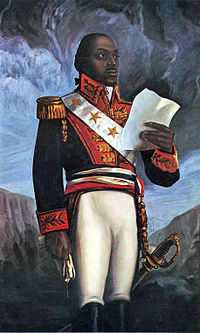
The name was borne by Toussaint du Breil de Pontbriand (1776-1844), a chouant during the French Revolution. French general, Toussaint Campi (1777-1832). Belgian Mine Ingeneer, Toussaint-Henry-Joseph Fafchamps (b.1783).  Leader of the Haitian Revolt, Toussaint Louverture (1743-1803).

The designated name-day is November 1.

Source:

  1. http://www.behindthename.com/name/toussaint

Vaida, Vaidas, Vaidotė

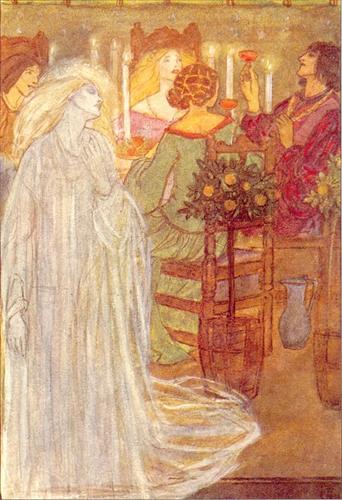
At Home by Emma Florence HarrisonOrigin: Lithuanian
Meaning: “ghost like.”
(VYE-dah; vy-DOH-tey)

In 2016, my home state of Illinois had 5 babies named Vaida, which is not surprising as we do have a significant amount of Lithuanian immigrants, though not as large as other groups, they are still strongly represented in the Southwestern suburbs, such as Lemont and Lisle.

Vaida is derived from the Lithuanian elements, vaid- which is from (vaidytis, vaidentis), meaning “to appear, to ghost, to haunt.”

Its masculine form is Vaidas, and it is uncertain if the male or female name came first.

Alternately, Vaida may be used among English-speaking parents as an alternate spelling of Veda.

Other popular offshoots include Vaidotė, Vaidota, Vaidutė, and Vaidotas for males.

In Lithuania, the designated name-day is April 15th.

Note: This post was updated on 01/02/2018.

Sources

  1. https://en.wikipedia.org/wiki/Vaidas
  2. https://www.behindthename.com/name/vaida/submitted
  3. https://www.ssa.gov/oact/babynames/limits.html
  4. http://www.vornamen-liste.de/female-lithuanian-first-names-v.html
  5. https://www.nordicnames.de/wiki/Vaida
  6. https://www.baltictimes.com/news/articles/6062/

Gunnar

Gender: Masculine
Origin: Old Norse
Meaning: “war warrior.”
Eng (GUN-ner); Swe (GOON-nahr)

The name is composed of the Old Norse elements, gunnr (war) and arr (warrior).

The name was borne a legendary 5th-century Burgundish king. His exploits appear in the ancient Germanic poetic text Nibelungelied and the Medieval poem Walthurius.

In the Nibelungelied he is mentioned as the King of Worms, the husband of Brunhild and the brother of Kriemhild, whom Siegfried comes to woo.

In some tales, he was betrayed by Attila the hun and murdered by him.

The same character later appears in JRR Tolkien’s epic poem based on Norse legend, The Legend of Sigurd and Gudrun.

Gunnar did not appear in the U.S. top 1000 till 1991 coming in as the 705th most popular male names, as of 2009, he was the 551st most popular male name.

Other forms of the name include:

  • Gūðhere (Anglo-Saxon)
  • Gondicari (Catalan)
  • Vintíř (Czech)
  • Gunder (Danish/Norwegian/Swedish)
  • Gunnar (Danish/English/Estonian/Norwegian/Swedish)
  • Gunner (English/Norwegian/Swedish)
  • Gundur (Faroese)
  • Kunkku (Finnish)
  • Kunnari (Finnish)
  • Kunto (Finnish)
  • Gondicaire (French)
  • Gundohar (Frisian/Dutch)
  • Gundahar (German: archaic)
  • Günter/Günther (German/Hungarian)
  • Gunther (German)
  • Gunter (German/Polish/Spanish)
  • Gundicaro (Italian)
  • Gundaharius (Late Latin)
  • Gunnarr (Old Norse)
  • Gunnár (Sami)
  • Gundo (Swedish)
  • Gunnerius (Swedish: archaic)

The name was also borne by a medieval Czech saint.

The designated name-days are January 8 (Estonia); January 9 (Sweden) and October 9 (Germany).

Sources

  1. http://www.behindthename.com/name/gunnar
  2. http://www.nordicnames.de/wiki/Gunnarr

Thaïs

Gender: Feminine
Origin: Greek
Meaning: debated
Θαΐς
(tye-EES)

The name is of uncertain derivation, though it has been suggested to be from a Greek source meaning “bondage.”

In history, the name was borne by a hetaera (concubine) of Alexander the Great. She is credited by historians for pursuading Alexander to burn down his palace.

Thaïs the concubine is credited more for her fictional roles. In Terence’s Eunuchus, the female protoganist of the same name is loosely based off of her.

In Dante’s Divine Comedy, she is depicted in Hell in the circle of the flatterers (Inferno, XVIII,133-136).

The name was also borne by an early Greek Christian saint. In 1890, Anatole France wrote a novel based on her life, a novel which was later adapted by Jules Massenet into a famous opera of the same name.

Other forms of the name include:

  • Taís (Catalan)
  • Thaïs (English/Greek/French)
  • Thais (German/Spanish)
  • Taide (Italian)
  • Taida (Polish)
  • Taisa/Taisiya Таисия (Russian)
  • Taja (Slovene)
  • Tajda (Slovene)
  • Tajka (Slovene)
  • Tajša (Slovene)

In France, the designated name-day is October 8.

Source

  1. http://www.behindthename.com/name/thais

Edmund

Gender: Masculine
Origin: English
Meaning: “rich protector.”
Eng (ED-mund)

The name is composed of the Anglo-Saxon elements, ead (wealth; riches) and mund (protector).

The name was quite common in Medieval England, both before and after the Norman conquest, and remained common all the way up until this century.

It was borne by two English kings and by two saints.

The highest the name has ranked in U.S. naming history was in 1913, when Edmund was the 130th most popular male name. As of 2009, he does not even rank in the U.S. top 1000.

Other forms of the name include:

Eadmund (Anglo-Saxon)
Edmund (Czech/English/Estonian/German/Polish/Slovak/Slovene)
Edmundur (Faroese)
Edmé (French: archaic)
Edmond (French)
Emond (German)
Ödön (Hungarian)
Játmundur (Icelandic)
Jetmund (Icelandic)
Eamon/Éamonn (Irish-Gaelic)
Edmeo (Italian)
Edmo (Italian)
Edmondo (Italian)
Edno (Italian)
Edmao (Limburgish)
Mao (Limburgish)
Edmundo (Portuguese/Spanish)

Feminine forms include:

Edmonia (English)
Edmée (French)
Edma (Italian)
Edmea (Italian)
Edmonda (Italian)

Nicknames include:

Ed, Eddie, Ned (Dutch/English)
Edi/Edo (Czech/Slovak)
Ödi (Hungarian)

Notable bearers include: English poet Edmund Spenser (1552-1599); Czech philosopher, Edmund Husserl (1859-1938) and New Zealand mountaineer Sir Edmund Hillary (1919-2008)

The designated name-days are:

October 6 (Estonia); October 16 (Poland); October 30 (Poland); November 20 (Poland); December 1 (Poland/Slovakia); March 18 (Sweden).

Source

  1. http://www.behindthename.com/name/edmund