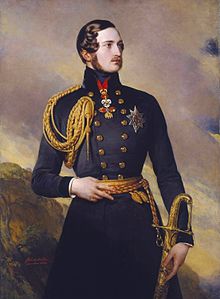
Albert is a Norman contracted form of Adalbert that was introduced into England after the Norman Conquest of 1066. Though there is an Anglo-Saxon form of Æðelberht, it was completely usurped by its Norman version.
The name fell out of use in England by the end of the 13th-century but was revived in the 19th-century when Queen Victoria of England chose a German prince by the name of Albert to be her husband. Speaking of which, Albert was a much-loved name among German royalty.
Between 1880-1967, Albert remained in the Top 100 Most Popular Male Names. He peaked at #14 in 1910. As of 2018, he currently ranks in as the 452nd Most Popular Male Name.
Albert is currently quite popular in Europe. These are his rankings in the following countries:
- #37 (Denmark, 2018)
- #55 (England & Wales, 2018)
- #84 (Norway, 2018)
- #422 (Netherlands, 2018)
Albert is used in Albanian, Catalan, Croatian, Czech, Danish, Dutch, English, Estonian, Finnish, French, German, Hungarian, Icelandic, Polish, Romanian, Russian, Slovakian, Slovenian & Ukrainian.
Other forms include:
- Alberzh (Breton)
- Aalt (Dutch)
- Aalbert (Dutch)
- Aalbertus (Dutch)
- Aelbrecht (Dutch)
- Albercht (Dutch)
- Alberd (Dutch)
- Albertus (Dutch, Late Latin)
- Appe (Dutch)
- Brecht (Dutch)
- Elbert (Dutch, German)
- Ethelbert (English)
- Alpertti (Finnish)
- Albertin (French)
- Aubert (French)
- Aubertin (French)
- Abbe, Abe (Frisian)
- Ailbeart (Gaelic)
- Alberte (Galician)
- Albertos (Galician)
- Alberti ალბერტი (Georgian)
- Albrecht (German)
- Albertinello (Italian)
- Albertino (Italian)
- Alberto (Italian, Portuguese, Spanish)
- Alperto (Italian)
- Ulberto, Ulperto (Italian)
- Albaer (Limburgish)
- Baer, Bèr (Limburgish)
- Alberts (Latvian)
- Albertas (Lithuanian)
- Albertet (Occitanian)
- Olbracht (Polish)
Its feminine for of Alberta was borne by Princess Louise Caroline Alberta (1848-1939), daughter of Queen Victoria & Prince Albert. The Canadian province was named in her honour.
Alberta is used in Albanian, Catalan, Croatian, Czech, Danish, Dutch, English, Estonian, Finnish, French, German, Hungarian, Icelandic, Italian, Polish, Portuguese, Romanian, Russian, Slovakian, Slovenian, Spanish & Ukrainian.
Alberte is currently the 12th Most Popular Female Name in Denmark. Alberte (ahl-BARE-teh) is also used in French, but pronounced differently from its Danish counterpart (AHL-BAIRT). Other feminine forms include:
- Alberthe, Albertha (Danish, Swedish)
- Albertina (Dutch, German, Hungarian, Italian, Portuguese, Spanish)
- Brechtje (Dutch)
- Bertina (English, Hungarian, Italian)
- Albertine (French, German, Danish, Norwegian)
- Auberte (French)
- Aubertine (French)
- Bertine (French)
- Abelke (Frisian)
- Albertin (Hungarian)
Sources
 Origin: Greek Ιρις
 Origin: Greek
 The name is a Russian diminutive form of
  This name is one of the ultimate cross-cultural names, it has various meanings and legitimate origins from Europe, to Asia and to the Middle East.
 From the name of a city mentioned in the Bible which is now located in Palestine. The meaning of the name is debated, some sources claim the name is from a Caananite word reah meaning “fragant” or the Canaanite word for moon (yareah), as the city was once the centre of worship for the Caananite moon-god Yarikh. Yarikh’s name also appears as Jarah, Jerah and Jorah. In modern times, the name is referred to as ʼArīḥā, in Arabic, meaning “fragrant.”
 Origin: Greek
 Origin: Greek
 Gender: Masculine