
Foster, Gaston, Vedastus
- Origin: Germanic
- Meaning: “wood guest.”
- Gender: Male
- Fre (gas-TAWN); Eng (FAWS-ter)
These names may look completely unrelated, but they are traditionally considered variations of the same ancient Germanic name. All three are ultimately linked with Widogast, composed of the Germanic elements widu (wood) and gast (guest; stranger). The name was Latinized as Vedastus and developed into several different forms throughout medieval Europe, including Vaast in Dutch and Vedast and Foster in English.
Gaston is traditionally considered another descendant of Vedastus, though its exact origin is debated. Another theory derives Gaston from Gascon, originally referring to someone from Gascony in southwestern France. The similarity between Gaston and the various medieval forms of Vedastus may also have resulted in the two names becoming confused or conflated over time.
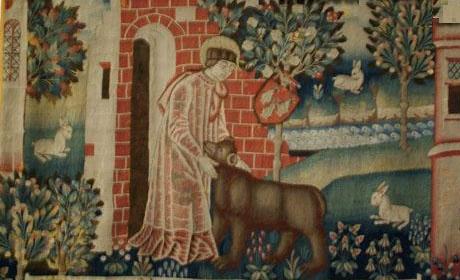
The name was borne by Saint Vedast, a 6th-century bishop of Arras in northern France. According to tradition, Vedast helped instruct the Frankish king Clovis I in Christianity and later became bishop of Arras and Cambrai. Legends of him running out a bear and the healing of blindness were attributed to him, making him the patron saint of eye sight. His cult became particularly important in northern France and the Low Countries, where numerous churches were dedicated to him.
In England, the saint was known as Saint Vedast or Saint Foster. The latter represents an English development of his name and survives in the dedication of St Vedast-alias-Foster, a church in the City of London. The surname of Foster may also descend from this in some cases, referring to someone who was related to a Foster, although the origin of the surname Foster does have various derivations.
Gaston became particularly associated with southwestern France and was borne by several medieval rulers, most notably the counts of Foix and viscounts of Béarn. Among them was Gaston III, Count of Foix (1331–1391), better known as Gaston Fébus or Phoebus, a powerful medieval prince and the author of the celebrated hunting treatise Livre de chasse. The name was also borne by Gaston, Duke of Orléans (1608–1660), the younger brother of King Louis XIII of France.
Other notable bearers include French novelist Gaston Leroux (1868–1927), author of The Phantom of the Opera. The name was later introduced to a new generation through Gaston, the boastful antagonist of Disney’s 1991 animated film Beauty and the Beast.
In France, Gaston was among the Top 100 Most Popular Male Names from 1900 to 1951, peaking at #23 in 1900 and again between 1909 and 1914. Its popularity declined considerably during the mid-20th century, and it disappeared from the French Top 1000 altogether in 1972. After a forty-year absence, Gaston re-entered the charts in 2012 at #453 and has been rising in popularity ever since. It currently ranks as the 194th most popular male name in France (2024).
In Belgium, Gaston has also experienced a revival and is currently among the Top 100, ranking at #63.
Gaston has had minor use in the United States as well, where it was likely especially familiar among Cajuns and Huguenot descendants in the American South, but it was also used among Anglo-Americans. It appeared in the U.S. Top 1000 between 1881 and 1936, peaking at #527 in 1903. It may have also been used as an anglicized form of Gastone among Italian immigrants during this time.
In modern times, Foster has seen renewed use as a male given-name in the English-speaking world. Although Foster is also a common English surname, its modern use as a first name cannot necessarily be attributed to the surname, since Foster has a much older history as a personal name in its own right.
Foster has been in and out of the Top 1000 Most Popular Male Names since 1880. It peaked at #278 in 1894. It disappeared from the Top 1000 in 1962 and reappeared in 2012, coming in at #993. The highest it has peaked during this period thus far is #901 in 2025.
Other forms of the name include:
- Gastó (Catalan)
- Vaast (Dutch, Flemmish, Norman, Picard)
- Gaston (Dutch, French, German, Polish)
- Foster (English)
- Vedast (English, German, French)
- Fedastus (Frisian)
- Gaszton (Hungarian)
- Gastone (Italian)
- Vedasto (Italian, Portuguese)
- Vedastus (Latin)
- Gastonas (Lithuanian)
- Widogast (Old German)
- Waast (Picard)
- Wedast (Polish)
- Gastão (Portuguese)
- Gastón (Spanish)
The designated name-day is February 6.
Sources
- https://en.wikipedia.org/wiki/Vedast
- https://www.behindthename.com/name/vedast
- https://www.behindthename.com/name/foster-2
- https://www.behindthename.com/name/vaast
Ad space — add Google AdSense code in Appearance › Ad Settings