
Jethro
- Origin: Hebrew
- Meaning: “abundance; excellence; surplus; overflow.”
- Gender: Male
- Diminutives: Jet(t)
- Eng Pron: JETH-roh
The name derives from the Biblical Hebrew יִתְרוֹ (Yitrō or Yithrō), from the Hebrew root יתר (y-t-r), meaning “to remain over.” Related forms carry such meanings as “surplus,” “abundance,” “excellence,” and “pre-eminence.”
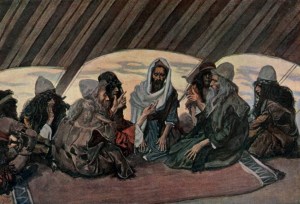
In the Book of Exodus, Jethro is a priest of Midian and the father of Zipporah. He gives refuge to Moses after his flight from Egypt and subsequently becomes his father-in-law. He later visits Moses in the wilderness and advises him to appoint judges to help resolve disputes among the Israelites.
Jethro came into use in Protestant countries following the Protestant Reformation. It was especially established in England and was subsequently carried to the American colonies. The name has also experienced occasional usage in the Netherlands, Germany, and the Nordic countries.
In the United States, Jethro appeared sporadically in the early popularity rankings, reaching #857 in 1899, #982 in 1911, and #914 in 1913. It did not appear in the Top 1000 again for more than a century, and returned to the U.S. Top 1000 Male Names in 2025 at #953.
Jethro has also appeared sporadically in the England and Wales Top 1000 Male Names. It ranked at #938 in 1996 and #1000 in 1998 before returning briefly at #883 in 2007
It was notably borne by English agriculturist Jethro Tull (1674–1741), who helped introduce more efficient methods of cultivation and developed an improved horse-drawn seed drill. His name was later adopted by the British rock band Jethro Tull, formed in the late 1960s.
During the mid-20th century, the name became strongly associated in the United States with Jethro Bodine, a comically unsophisticated character on the television series The Beverly Hillbillies. Another prominent fictional bearer is Leroy Jethro Gibbs, portrayed by Mark Harmon on NCIS. It was also borne by British-Australian male model, Jethro Lazenby Cave (1991-2022), son of Australian musician Nick Cave.
Other historical bearers include Jethro Sumner (c. 1733–1785), a brigadier general in the Continental Army during the American Revolutionary War, and American inventor Jethro Wood (1774–1834), who developed an influential cast-iron plow.
Other forms as appears in translated Biblical texts
- Jetró (Catalan, Spanish)
- Jetro (Danish, Dutch, Finnish, German, Norwegian, Polish, Portuguese, Swedish)
- Jeter (Dutch)
- Jéthro (French)
- Jitro (German)
- Ietro (Italian)
- Yofor Иофор (Russian)
Sources
- https://www.behindthename.com/name/jethro
- https://www.nordicnames.de/wiki/Jetro
- https://fi.wikipedia.org/wiki/Jetro
- https://www.abarim-publications.com/Meaning/Jethro.html
- https://en.wikipedia.org/wiki/Jethro_(biblical_figure)
Ad space — add Google AdSense code in Appearance › Ad Settings