
Tarcisius, Tarcissus
- Origin: Late Latin/Greek
- Meaning: “from Tarsos”
- Gender: Male
- Eng Pron: (tar-SIH-shus; TAR-sis-sus); It Pron: (tar-CHEE-see-yoh)
A Late Latin name of uncertain origin, it is possibly derived from the Greek Tarsikos, denoting someone from the city of Tarsos, hence “of Tarsos” or “from Tarsos.”
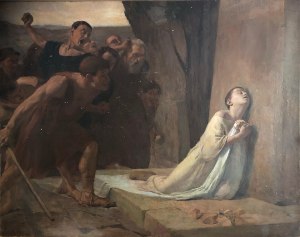
The name was notably borne by a third-century Christian martyr saint who is traditionally believed to have lived during the reign of Emperor Valerian. According to later tradition, Tarcisius was an acolyte who helped distribute the Eucharist to imprisoned Christians. He was eventually betrayed and murdered by a group of pagan friends and playmates when they discovered his secret endeavors. He was buried in the Catacomb of Callistus, and his relics were later said to have been transferred to the Church of San Silvestro in Capite in Rome.
The saint was the subject of a poem by Pope Damasus I in the fourth century, who compared him to St. Stephen. Cardinal Nicholas Wiseman later retold his story in the 1854 novel Fabiola, or the Church of the Catacombs. His feast-day is August 15th and he is considered the patron saint of alter servers and first communicants.
Since his feast-day coincides with the Feast of the Assumption of Mary, his memorial isn’t included in the General Roman Calendar, although he remains listed in the Roman Martyrology.
Other Forms
- Tarcisi, Tarsici (Catalan)
- Tarzicije (Croatian)
- Tarcisius (Czech)
- Tarcissus, Tarcisius (English)
- Tarcise (French)
- Tarsicio (Galician)
- Tarsitius, Tarzisius, Tarkisius (German)
- Tarsizios Ταρσίζιος (Greek – modern)
- Tarzíciusz (Hungarian)
- Tarcidio (rare), Tarcisio, Tarciso (rare), Tarsizio (rare), (Italian)
- Tharsicius, Tarcisius, Tarsitius (Late Latin)
- Tarsycjusz, Tarcyzjusz (Polish)
- Tarciso (Portuguese – Brazilian)
- Tarcísio, Tarsício (Portuguese)
- Tarsizi Тарцизий (Russian – rare)
- Tarzícius (Slovene)
- Tarcisio, Tarsisio (Spanish)
The Italian form, Tarcisio, became widespread primarily due to the veneration of St. Tarcisius. By the 1970s, there were approximately 14,000 bearers of the name in Italy, as well as around 800 bearers of its feminine form, Tarcisia. The name was concentrated almost exclusively in Lombardy, the Triveneto region and Tuscany.
Tarzisius is the most common German rendition and has experienced use mainly in Austria and German-speaking Switzerland, one example is Swiss politician, Tarzisius Caviezal (b. 1954).
Its Portuguese form has experience some use in Brazil, notable Brazilian bearers include actor Tarcísio Meira (1935–2021) and politician Tarcísio de Freitas (b. 1975).
Female Forms
- Tarcidia, Tarcisa, Tarcisia (Italian)
- Tarcisa, Tarcisia (Portuguese, Spanish)
The Brazilian Portuguese feminine name Tarciane is perhaps a modern feminine offshoot of Tarcísio. It is notably borne by Brazilian footballer Tarciane Karen dos Santos de Lima (b. 2003), commonly known simply as Tarciane.
Sources
- Bongioanni, Angelo. Nomi e cognomi: Saggio di ricerche etimologiche e storiche. Turin: Fratelli Bocca, 1928. Digitized PDF
- https://it.wikipedia.org/wiki/Tarcisio
- https://de.wikipedia.org/wiki/Tarzisius_(Vorname)
- https://www.ewtn.com/catholicism/library/st-tarcisius-5890
- https://sk.wikipedia.org/wiki/Tarz%C3%ADcius
- https://en.wikipedia.org/wiki/Tarcisio
- https://www.nasejmena.cz/m/cetnostm.php?id=103066
- https://hr.wikipedia.org/wiki/Sveti_Tarzicije
Ad space — add Google AdSense code in Appearance › Ad Settings