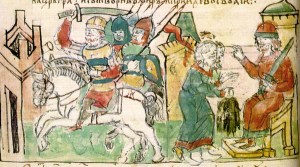
Ingvar is the modern Scandinavian form of the Old Norse, Yngvarr, meaning “Ing’s warrior.” It was introduced into Russia in the 10th-century by the Varangians, which gave the world the Igor form. The latter was borne by 2 Grand Princes of Kiev and has been a favorite in several Slavic countries since.
Currently, Igor is the 19th Most Popular Male Name in Poland (2018) and the 48th Most Popular in Moscow, Russia (2018), while in England he currently ranks quite low at #497 (2018).
Igor is used in Bulgarian, Czech-Slovak, Dutch, Estonian, German, Hungarian, Italian, Macedonian, Portuguese, Romanian, Serbo-Croatian, all modern Scandinavian languages, Slovene, & Spanish
Other forms of the name include:
- Ihar Ігар (Belarusian)
- Ingvar (Danish, Estonian, Finnish, Icelandic, Norwegian, Swedish)
- Iku (Finnish)
- Ingwar, Ingwer (German)
- Ingvaari (Greelandic)
- Ingvâre (Greenlandic)
- Ígor (Icelandic)
- Inguarus (Late Latin)
- Ingvars, Igors (Latvian)
- Igoris (Lithuanian)
- Ignar (Nowegian)
- Yngvar (Norwegian)
- Yngvarr (Old Norse)
- Ingwar (Polish)
- Inguar (Portuguese)
- Ingor (Swedish)
- Ihor Ігор (Ukrainian)
Sources