 Gender: Feminine
Origin: Russian
Meaning: “light.”
Светлана
(svet-LAH-nah).
The name is derived from the Slavic element, svetlo, meaning “light.”
It was used as a vernacular form of the Greek, Photine, (see Photine), in honour of St. Photine, the Samaritan woman.
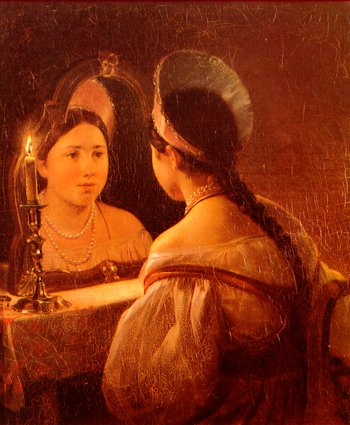
Its usage was further popularized in 1813 via Alexander Vostokov, a Russian philologist and poet. Another Russian poet of the same period, Vasily Zhukovsky, also used the name for his ballade, Svetlana.
Other forms of the name include:
- Svjatlana Святлана (Belarusian)
- Svetla (Bulgarian)
- Svjetlana (Croatian)
- Světlana (Czech)
- Swetlana (German)
- Szvetlána (Hungarian)
- Świetlana (Polish: shvyet-LAH-nah)
- Swietłana (Polish: svyet-WAH-nah)
- Sveta Света (Russian)
- Svitlana Світлана (Ukrainian)
The name is also used in Bulgarian, Latvian, Macedonian, Serbian, Slovene and Slovakian.
A South Slavic masculine form is Svetlan.
The designated name-days are: February 6 (Bulgaria), February 26 (Russia), March 15 (Slovakia), March 20 (Czech Republic), April 2 (Russia) and September 28 (Latvia).
The name is borne by Svetlana Alliluyeva aka Lana Peters, the youngest daughter of Joseph Stalin, (b.1926) and the current first lady of Russia, Svetlana Medvedeva
Sveta, Sveti, Svetlanka and Lana are used as short forms in Russian.
Please visit:
http://www.vedicrussia.wordpress.com
http://www.vedichistoryresearch.wordpress.com
This name is found in Northern part of India