- Origin: Anglo-Saxon
- Meaning: “desiring peace.”
- Gender: masculine
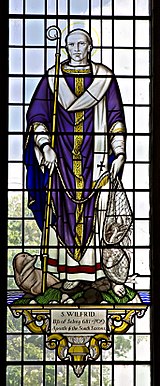
The name is composed of the Anglo-Saxon elements, wil (will, desire) and frið (peace). It was borne by 2 English bishops of Worcester, one of whom is a Catholic saint and a 9th-century Catalan count, known as Wilfred the Hairy (b. 878-897). Wilfred was of Gothic origins and he is known to have established a hereditary dukedom in Catalonia. It’s Spanish form of Wilfredo traces its origins back to the Visigoths in Spain and has remained a fairly common male name in many Hispanic countries.
Many name books and dictionaries claim this name fell out of use by the Norman Conquest, but records contradict this claim as Wilfred was still recorded by the 16th-century. More accurately, the name became extremely popular at the turn of the 20th-century in both England & the United States
Wilfred appeared in the U.S. Top 1000 between 1880-1984 & peaked at #164 in 1917. In England & Wales, he is currently the 143rd most popular male name (2018).
Other forms include:
- Wilfrið (Anglo-Saxon)
- Guifré (Catalan)
- Vildfred, Wildfred (Danish)
- Wilfried (Dutch, German)
- Wifred (English)
- Wilfrid (English)
- Wilfrith (English
- Vilfrid (Finnish, Swedish)
- Wilfryd (Frisian, Polish)
- Vilfredo (Italian)
- Wilfredus, Vilfredus (Late Latin)
- Willifred (Old German)
- Wilfredo (Portuguese, Spanish)
- Vilfred, Willfred (Scandinavian)
- Wifredo (Spanish)
In the English-speaking world, common short forms include Will, Wilf, Wilfy & Fred. A feminine form that is used in German-speaking countries, the Netherlands, Spanish-speaking countries, Portuguese speaking countries is Wilfreda, while Vilfrida is a Scandinavian feminine form.
Sources