Origin: Greek
Meaning: “myrrh; perfume”
Gender: Masculine
Eng. (MY-ron); GRK (MEE-rone)
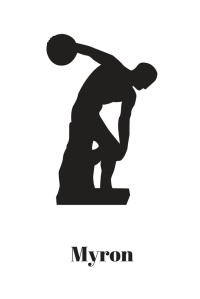
The name comes from the Greek meaning “myrrh; perfume.” It was borne by a 5th-century B.C.E Greek sculptor as well as several Christian saints.
In the United States, especially at the turn of the century, it was used among Jewish families as a form of the Hebrew Meir.
Myron is also the name of a genus of snakes.
For 100 years, between 1900-2000, it was in the U.S. Top 1000 Most popular male name. Myron peaked in 1931 when it was the 192nd most popular male name.
Other forms of the name include:
- Mirón (Asturian/Galician/Portuguese/Spanish)
- Miran Міран (Belarussian)
- Miron Ми́рон (Bulgarian/Croatian/Romanian/Russian/Serbian/Slovenian/Ukrainian)
- Miró (Catalan)
- Myrón (Czech)
- Myron (Dutch/English/French/German/Polish)
- Mürón (Hungarian)
- Mýron (Icelandic)
- Mirone (Italian)
- Mironi მირონი (Georgian)
- Mironas (Lithuanian)
A feminine form is Myra.
Sources