 Gender: Masculine
Origin: Hebrew
Meaning: “Yahweh has given.”
(JON-a-THEN)
The name is derived from the Hebrew יְהוֹנָתָן (Yehonatan) meaning, “Yahweh has given.” The name is considered a longer version of Nathan, and shares the same roots as Matthew. Contrary to some sources, John did not start off as short form of Jonathan.
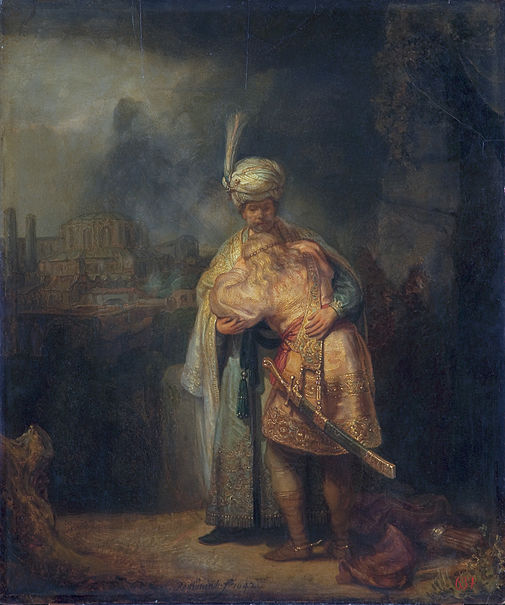
In the Old Testament, it is the name of the eldest son of Saul and a friend of David. Their friendship is often used as an example of the most perfect form of brotherly love among Christian and Jewish ethicists.
In the English speaking world, Jonathan did not catch on until after the Protestant Reformation.
Currently, Jonathan is the 26th most popular male name in the United States, (2008). His rankings in other countries are as follows:
- # 75 (Australia, 2008)
- # 58 (Canada, B.C., 2008)
- # 69 (Chile, 2006)
- # 101 (the Netherlands, 2009)
- # 41 (Norway, 2009)
- # 33 (Sweden, 2009)
Other forms of the name include:
- Jonatan (Catalan/Croatian/German/Polish/Scandinavian/Slovene)
- Jonatán (Czech/Slovak/Spanish)
- Jonathan (Dutch/English/French/German/Scandinavian)
- Joonatan (Finnish)
- Ionathan/Jehonathan Ιωναθαν (Greek: Biblical)
- Yonatan/Yehonatan יוֹנָתָן יְהוֹנָתָן (Hebrew)
- Jónatan (Icelandic)
- Ionatán (Irish-Gaelic)
- Gionatan (Italian)
- Jónatas (Portuguese)
Common English short forms include: Jon, Jonny, Jonty and sometimes even Nathan.
A common Hebrew short form is Yoni.
The designated name-day is March 1 (France).
Sources
- Judges 18:30
- http://www.behindthename.com/name/jonathan
- http://www.askoxford.com/firstnames/jonathan?view=uk
- Hanks, Hardcastle and Hodges, Oxford Dictionary of First Names, Oxford University Press, 2nd edition, p.147.
- The Crosslinguistic Study of Language Acquisition – Page 342 by Dan Isaac Slobin