Tooba, Tuba, Tuğba

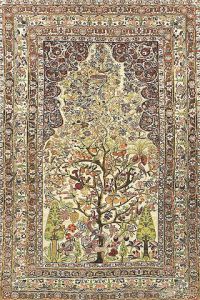
320px-Tuba_Tree_-_Carpet_Board_-_Mashhad_Museum


  • Origin: Arabic طُوْبَى
  • Meaning: “bliss; blessedness.”
  • Gender: feminine
  • (TOO-bah)

The name is derived from the Arabic root T-Y-B meaning “bliss; blessedness.” According to an Islamic hadith, this is a tree that grows in paradise.

Another form is Toba.

The city of Touba in Senegal gets its name from the legendary tree.

Other forms include:

  • Touba (Maghrebi-Arabic)
  • Tuğba (Turkish)
  • Tooba (Urdu)

Sources

Zikra

download


  • Origin: Arabic ذكرى
  • Meaning: “memory; recollection; thoughts of the past; remembrance.”
  • Gender: feminine
  • (ZEEK-ruh, THEEK-rah)

The name can either be pronounced with a z or th sound depending on the dialect of Arabic. It is sometimes used in reference to al-Dikr, (remembrance of Allah), which is mentioned by the Islamic scholar Ibn Hajar al-Askalani as being the name of one of the seven gates of Jannah.

The name was borne by Tunisian pop-singer, Thekra (1966-2003).


Other forms and transliterations include:

  • Dekra, Dhikra, Dikra
  • Zaakirah (ZAH-kee-ruh)
  • Zekra
  • Zikraa (zee-KRAH)
  • Thikra, Thekra

Sources

Liyana

220px-Liyana_film_poster


The name can be derived from the Arabic root L-Y-N لَيِّن meaning “softness, tenderness.” لِيانَةٌ is pronounced the same as Liana, which sounds the same but is not related, though it may sometimes be transliterated as such. It is essentially a variation of Layyan. Other transliterations include: Liyanna, Liyane, Liyanah, Liyyana, and Liyyanah.

The name is also Zulu and means “it’s raining.” It was recently the subject of a 2017 documentary recounting the struggles of several Swazi orphans, one of whom is a girl named Liyana. The name is usually given to girls born while it is raining.

Liyana can also be Erzya meaning, “unique, different, not like the others,” or derive from the Erzya word, liyaanaz (flax).

Currently, Liyana is the 298th Most Popular Female Name in England & Wales & the 227th Most Popular in the Netherlands (2018).


Sources

Aizah, Aiza

Aizah


This is another cross-cultural name that stems from across the globe. It is pronounced (I-zah) in all of its incarnations.

Its recent appearance in the U.K. Top 500 is most likely due to its use among the Pakistani community, in which case it derives from the Arabic Aydhah meaning, “replacement; substitute.” Others have suggested it derives from the Arabic عزّ (‘izz) meaning “glory, honour, majesty, power.” Aiza is also used as a Central Asian form of Aydhah. Another transliteration is Aizah.

Aiza is a Basque name and is recorded as a female name as early as the 12th-century in Navarre, it is the feminine form of Aizo which is of uncertain meaning. It has been suggested to be from aits (rock, stone). Although, there was a Basque king who had the feminine form as his byname, it is sometimes hispanified as Arista, which in his case may have been a corruption of the Basque Aritza (oak). As a result, Aiza appears as a surname throughout the Spanish-speaking world. Aiza has also been suggested to mean”cliff, rock” or “abyss.” Another Basque feminine form is Aizeti.

Aiza has also been very rarely used as feminine given-name in Latvia, its inspiration may be the Latvian word for river or gorge or it may be a contraction of another unknown name. The database of Latvian name statistics indicates the name has been used at least 6 times.

Finally, Aiza can be Japanese, from the Kanji characters 愛 (ai) meaning “love, affection” and 座 (za) meaning “seat; pin; cushion.”

Currently, Aiza is the 314th Most Popular Female Name in England & Wales (2018).

Sources

Adhan, Azaan

429px-Jean-Léon_Gérôme_010


The name is derived from the Arabic root ʾadhina أَذِنَ meaning “to listen, to hear, be informed about,” or ʾudhun (أُذُن), meaning “ear.” The Adhan, sometimes romanized as Azaan, is the name of the Islamic call to prayer, which is rung 5 time a day.

Currently, Azaan is the 406th Most Popular Male Name in England & Wales, (2018). Other transliterated forms include: Adaan, Adan, Adhaan, Athan, Edan & Edhaan.

Other forms include:

  • Ezani (Albanian)
  • Ezan Езан (Albanian, Bosnian, Bulgarian, Kurdish, Turkish)
  • Azan Азан (Azeri, Kazakh, Kyrgyz, Malay, Tatar)
  • Azán Аза́н (Chechen)
  • Adan (Javanese)
  • Aadaan (Somali)
  • Azon Азон (Tajik)
  • Ezane (Zazaki)

Sources

Hashim

The name is most likely derived from the Arabic root H26-SH-M  meaning “breaker or pulverizer.” This was a sobriquet for Hāshim ibn ‘Abd Manāf (circ. 5th-century C.E.) who was the great-grandfather of the Prophet Muhammad and found of the Banu Hashim tribe. Borne ‘Amr al-‘Ulā, ot is said he took this name because he used to break up his bread to share in a broth among pilgrims to Mecca and he is also said to have saved the poeple of Mecca from a famine by breaking up his bread into tiny crumbs.

Another transliteration is Hasheem

Currently, Hashim is the 436th Most Popular Male Name in England & Wales (2018).

Other forms include:

  • HIashim ХӀашим (Chechen)
  • Haysim (Indonesian)
  • Hashem هاشم (Persian)
  • Haşim (Turkish)

Sources

Raheem, Rahim

From the Arabic root R-H-M meaning “kind; merciful; compassionate.” The name is used in reference to الرحيم (al-Rahim), which is one of the 99 Names in Islam used to refer to Allah.

Another transcription is Roheem.

Raheem is currently the 465th Most Popular Male Name in England & Wales.

Rəhim is the Azeri form.

Sources

Nora, Nour

1024px-Dawn._Buryatia,_Russia


This multicultural name has recently experienced a revival. In European countries, the name stems from any name ending in the -nora element, such as Honora & Eleanora. In Arabic, Nora is a variant transliteration of Nurah, which is a strictly feminine version of the unisex Arabic name, Nur (light). Nur is used as one of the 99 attributes of Allah, al-Nur (the light).

The name was used by Henrik Ibsen for his main character in his play, A Doll’s House (1878).

Outside of East Asia, there isn’t a counry where Nora is unhead of or is not in use. Nora has been in out of the U.S. Top 100 since 1880! She currently ranks in as the 30th Most Popular Female Name in the United States. Her rankings in other countries are as follows:

  • #2 (Norway, 2018)
  • #10 (Netherlands, 2018)
  • #11 (Hungary, 2018)
  • #14 (Switzerland, 2018)
  • #15 (Denmark, 2018)
  • #20 (Belgium, 2018)
  • #23 (Austria, 2018)
  • #26 (Catalonia, Spain, 2018)
  • #28 (Sweden, 2018)
  • #38 (Canada, BC, 2018)
  • #47 (Spain, 2018)
  • #64 (Norah, Netherlands, 2018)
  • #79 (Bosnia & Herzegovina, 2018)
  • #84 (Norah, Canada, BC, 2018)
  • #85 (Italy, 2018)
  • #119 (France, 2018)
  • #140 (Norah, United States, 2018)
  • #184 (Norah, France, 2018)
  • #197 (England & Wales, 2018)
  • #283 (Norah, England & Wales, 2018)

Its Dutch version of Noor also ranks high in several popularity charts. This name is also used by Muslim families as a variation of Nur. Her rankings in other countries are as follows:

  • #10 (Netherlands, 2018)
  • #25 (Belgium, 2018)
  • #279 (England & Wales, 2018)
  • #311 (France, 2018)

Noortje is another Dutch version which currently ranks in as the 203rd Most Popular Female Name in the Netherlands.

Other forms of its European version include:

  • Nora Нора Νόρα (Bulgarian, Greek)
  • Noera (Dutch)
  • Noor (Dutch)
  • Noortje (Dutch)
  • Norah (Dutch, English, French)
  • Nonie (English)
  • Noreen (English, Irish)
  • Noora (Estonian, Finnish)
  • Nóra Но́ра (Faroese, Hungarian, Irish, Russian)
  • Nuura (Finnish, Scandinavian)
  • Nóirín (Gaelic)
  • Norina (Italian, Provençal, Romansch)
  • Norá (Sami)
  • Norea (Scandinavian)
  • Norena (Scandinavian)
  • Noria (Scandinavian)
  • Norita (Spanish, Scandinavian)

The Arabic Nur is traditionally a unisex name which is popularly used in many Islamic countries. Its Maghrebi form of Nour currently ranks in the following popularity charts for girls:

  • #40 (Belgium, 2018)
  • #48 (Catalonia, Spain, 2018)
  • #48 (France, 2018)
  • #76 (Spain, 2018)
  • #137 (Italy, 2018)
  • #197 (Netherlands, 2018)

Nur is currently the 87th Most Popular Female Name in Bosnia & Herzegovina (2018).

Other forms of the Arabic version include:

  • Noora, Nura (Arabic, strictly feminine)
  • Noura (Maghrebi Arabic, strictly feminine)
  • Núria (Catalan)
  • Nor (Malay, unisex)
  • Nuru (Swahili, strictly feminine)

Sources

Aya, Ayah, Aija, Aja

download (4)


Pronounced I-yah, this name has several different origins and meanings.

Aya is a popular Japanese female name, depending on the kanji used, it has several different meanings, the most popular being 彩 (aya) meaning “colour,” or 綾 (aya) meaning “design.” In the Japanese case, it is also occasionally used on males. Other meanings and kanji characters used to represent the name include:

  • 綾, “twill”
  • 理, “truth, logic”
  • 亜矢, “Asia, arrow”
  • 亜弥, “Asia, all the more”
  • 亜夜, “Asia, night”
  • 順, “order, sequence, turn”
  • 文, “writings”
  • 紗, “gauze”
  • 技, “technique”
  • 愛, “love”
  • 恵, “blessed”
  • 朱, “vermillion”
  • 藻, “algae”
  • 娃夜, “beautiful night”

It was borne by an Ancient Egyptian queen of the Thirteenth Dynasty (between 1803 and 1649 BCE). Its meaning and etymology in this case is unknown.

Aya is also an Akan name, denoting a girl born on a Thursday. Its masculine form being Yao.

In Hebrew, Aya is an acronym for ארץ ישראל היפה (the beautiful land of Israel) and allegedly from  איה, איא meaning “bird” or “to fly swiftly.” It is borne by a minor male character in the Bible but seems to exclusively be used on females in modern Israel. There is a famous Israeli pop-singer who bears this name, Aya Korem.

Ayah آية is Arabic meaning “sign; clue” and refers to Quranic verses. It is also sometimes transliterated as Aya or Aja among Bosnians, Albanian and Central Asians. Another variation is Ayat, sometimes spelled Ayaat.

In Akkadian, the name means dawn and was borne by an ancient Sumerian goddess, the consort of Shamesh. The name is still used among Assyrian Christians who trace their heritage back to the Akkadian peoples.

In Tamil, spelled ஆயா, it means “old woman,” “grandmother,” or ” caretaker” and in the Nepalese language of Raute it means “sister-in-law.”

In Scandinavia, Aija, Aja & Aya are offshoots of Maria, they started off as diminutive forms but are now used as independent names. Aya is currently the 22nd Most Popular Female Name in Denmark (2018). However, I am unable to determine if in this case, it is used by Muslim families in reference to the Arabic form or if it is used by non-Muslim families in reference to its Scandinavian form. Aija can also be a Finnish form of Eija, which is from an exclamation eijaa!

In Latvia, Aija is most likely derived from aijāt (to rock, to lull) and was popularized as a given-name at the turn of the 20th-Century when it was used by Latvian author Jānis Jaunsudrabiņš for the title character in his eponymous novel, Aija (1911).

Aja is a Bosnian, Albanian & Central Asian form of the Arabic, Ayah.

In Mongolian, it is derived from ая (aya), meaning “melody.”

In Europe, Aya appears on several popularity charts, most likely used in reference to its Arabic origins by Muslim immigrants, its rankings in other countries are as follows:

  • #46 (France, 2018)
  • #48 (Belgium, 2018)
  • #65 (Catalonia, Spain, 2018)
  • #95 (Spain, 2018)
  • #122 (Netherlands, 2018)
  • #184 (Italy, 2018)
  • #309 (Ayah, England & Wales, 2018)
  • #317 (England & Wales 2018)
  • #749 (United States, 2018)

Sources

Israa, Isra

  • Origin: Arabic
  • Meaning: “night journey”
  • Gender: Female
  • Pronunciation: is-RAH

The name is derived from the Arabic سرى (sara) meaning “to travel at night.” In Islam, it is the the name of the 17th Chapter of the Quran, which outlines the journey the Prophet Muhammad took between Mecca and Jerusalem.

Isra is currently the 181st Most Popular Female name in the Netherlands & the 351st Most Popular in France, while its other transliterated form of Israa is the 433rd Most Popular Female Name in France (2018).

Isra is used throughout the Islamic world, while Israa is usually used in mainly, Arabic-speaking Muslim countries. Another transliteration is Isra’

Other forms include:

  • Isrá (Bashkir)
  • Îsra (Kurdish)
  • İsra (Turkish)

Sources