Ida

Gender: Feminine
Origin: German
Meaning: “labour; work.”
Eng (I-dah); Germ/Swe (EE-da)

The name is derived from the Germanic element, id, meaning “work; labour.”

The name was introduced into England by the Normans and fell out of usage by the late Middle Ages. It experienced a revival during the 19th-century, possibly due to the heroin of the Lord Tennyson poem, The Princess (1847); which was later adapted into a play entitled Princess Ida.

The name could also, likewise, be related to the Greek female name, which is found in Greek Mythology as the name of a nymph who nursed Zeus. Mount Ida on Crete is supposedly named after her.

In Hinduism it is the name of an earth goddess.

The name does not appear in the U.S. top 1000, the highest she has ranked in U.S. naming history was between 1880-1882, where she consecutively came in as the 7th most popular female name. She is, however, the 2nd most popular female name in Denmark, (2010). Her rankings in other countries are as follows:

  • # 7 (Norway, 2010)
  • # 8 (Iida, Finland, 2010)
  • # 17 (Sweden, 2010)

The name was borne by St. Ida of Lorraine (1040-1115); Russian ballerina, Ida Rubenstein (1885-1960); First Lady Ida Saxton McKinley (1847-1907); African-American Journalist and Early Civil Rights Activist, Ida B. Wells (1862-1931).

Ida is used across Europe, and rarely deviates from the original form. In Finnish she is rendered as Iida, and there is a very archaic Polish form of Hida, no longer in usage.

The designated name-days are: February 16 (Slovakia); March 14 (Czech Republic); September 4 (Germany, Norway, Poland); September 14 (Finland/Sweden).

Source

  1. http://www.behindthename.com/name/ida

Cecilia, Cecily

Gender: Feminine
Origin: Latin
Meaning “blind”
Eng (seh-SEE-lee-yuh); Lat (kay-KEE-lyah); Italian (chay-CHEEL-yah).

This four syllable, melodic name has been in usage throughout the Western World since the early Middle Ages. Thanks to the cult of Saint Cecilia, an early Christian martyr, considered to be the patron saint of music and musicians.

Geoffrey Chaucer made the saint a subject of his writings and refers to the name as meaning “lily of heaven”; “the way for the blind”; “contemplation of heaven and an active life”; “as if lacking in blindness”; “a heaven for people to gaze upon.”

However, these were only epithets used by the early English writer describing the wondrous attributes and virtues of the saint, and should not be confused for its real meaning.

The name is a feminine form of the Latin Caecilius which comes from the word caecus meaning blind.

The name was introduced into England after the Norman conquest in the form of Cecily (SES-ih-LEE). The name was very popular in England until the Protestant Reformation where it fell out of usage.

Its Latin counterpart of Cecilia was not introduced into the English speaking world until the 18th-century, afterwards, its early English form of Cecily became quite popular during Victorian England.

As of 2010, its Danish form of Cecilie was the 30th most popular female name in Denmark. Her rankings in other countries are as follows:

  • # 39 (Silje, Denmark, 2010)
  • # 65 (Silje, Norway, 2010)
  • # 277 (Cecilia, United States, 2010)
  • # 385 (Cécile, France, 2009)
  • # 486 (Cecilia, France, 2009)
  • # 741 (Cecelia, United States, 2010)

There is the masculine English form of Cecil. Other forms of the name include:

  • Aziliz (Breton)
  • Cicilia (Corsican)
  • Cecilija (Croatian)
  • Cila (Croatian)
  • Cecílie (Czech: tset-TSEEL-yeh)
  • Cecilie (Danish/Norwegian)
  • Cille (Danish)
  • Sille (Danish)
  • Cecile/Ceciel (Dutch)
  • Cecilia (Dutch/Finnish/German/Italian/Romanian/Spanish/Swedish)
  • Cilla (Dutch/Swedish)
  • Cecelia (English)
  • Säsil (Estonian)
  • Sesilia (Faroese)
  • Selja/Silja (Finnish)
  • Cécile (French)
  • Silke (Frisian/German: ZIL-kə)
  • Síle (Gaelic)
  • Kek’ik’ilia კიკილია (Georgia)
  • Cäcilia/Caecilia (German: tsay-TSEEL-yah or tsay-TSEE-lee-yah)
  • Cäcilie (German: tsay-TSEEL-yə or tsay-TSEE-lee-yə)
  • Zilla (German: originally a diminutive form sometimes used as an independent given name, another diminutive is Zilly)
  • Kekilia (Greek Modern)
  • Sissiilia/Sissii (Greenlandic)
  • Kikilia (Hawaiian)
  • Cecília (Hungarian/Portuguese/Slovak)
  • Cili (Hungarian/Slovene)
  • Szöszill (Hungarian)
  • Seselía, Sesilía, Sesselía, Sessilía (Icelandic)
  • Sisilia (Indonesian)
  • Sheila (Irish)
  • Caecilia (Latin)
  • Cecilė/Cilė(Lithuanian)
  • Cissolt (Manx: SIS-solt)
  • Sidsel (Norwegian/Danish)
  • Silje (Norwegian/Danish)
  • Sissel (Norwegian/Danish)
  • Cilgia (Romansch)
  • Tsetsiliya (Russian)
  • Sìleas (Scottish)
  • Cecília (Slovakian)
  • Šejla (Slovakian)
  • Cecilija (Slovenian)
  • Cilika (Slovenian)
  • Cilka (Slovenian)
  • Sisel (Yiddish)
  • Zisel (Yiddish)

Male forms include

  • Cecil (English)
  • Cecilio (Italian/Spanish)
  • Caecilius (Latin)
  • Cecilijus (Lithuanian)
  • Cecilián (Slovakian)

Czech diminutive forms are: Cecilka, Celia, Cilia, Cilka and Cilinka.

English diminutive forms are: Cece, Celia and Sissy.

The designated name-day is November 22nd.

Armin

Gender: Masculine
Origin: German
Meaning: “whole; universal.”
(AHR-meen)

The name is derived from the latinized Germanic name, Arminius, which is believed to be derived from the Germanic element, ermen, (whole; universal). It is suggested that Arminius was a latinized form of Herman.

The name was borne by a 1st-century Cherusci leader who lead a rebellion against the Romans and defeated the Romans in the famous Battle of the Teutoburg Forest.

As of 2010, Armin was the 15th most popular male name in Bosnia & Herzegovina. His rankings in other countries are as follows:

  • # 65 (Hungary, 2010)
  • # 380 (Netherlands, 2010)

Other forms of the name include:

  • Armini (Azeri/Catalan)
  • Armin (Bosnian/Croatian/Dutch/German/Hungarian/Serbian/Slovene)
  • Arminije (Croatian)
  • Arminij Арминий (Bulgarian/Macedonian/Russian/Ukrainian)
  • Arminio (Galician/Italian/Spanish)
  • Arminiusi არმინიუსი (Georgian)
  • Arminijus (Lithuanian)
  • Armínio (Portuguese)
  • Arminiu (Sicilian)

Erna

Gender: Feminine
Origin: German/Old Norse

The name could either be a feminine form of the Germanic male name, Ernest, meaning, “serious,” or it could be a feminine form of the Old Norse, Árni, meaning, “eagle.”

In Norse Mythology, this was the name of the mother of the warrior race, fathered by Jarl.

As of 2010, this was the 37th most popular female name in Bosnia & Herzegovina.

Irma

Gender: Feminine
Origin: German
Meaning: “world; whole; universal”
Germ (AIR-mah); Eng (ER-muh)

The name is ultimately from the Old German word, irmin meaning, “world; whole; universal.” She shares the same etymology with Emma.

This element has appeared in several other Germanic female names such as Irmengarde, Irmela and Irmentraud.

In 1911, Irma was the 136th most popular female name, as of 2009, she does not even appear in the top 1000. In the anglophone world, the name has come to be associated as a very dated name.

In Sweden, the name has ranked as high as the 94th most popular female name (2008), as of 2009, she fell out of the Swedish top 100.

As of 2010, Irma was the 68th most popular female name in Bosnia & Herzegovina.

Other forms of the name include:

Erma (English/German)
Imma (Frisian)
Imke (Frisian/German)
Irmela (German/Swedish)
Irmeli (German/Swedish)
Irmelin (German/Swedish)
Irmine (German)
Irmuska (Hungarian)
Irmina (Polish/Italian)

Irma itself is used in English-speaking, German-speaking and Spanish speaking countries. She has also had a history of usage in Scandinavia, the Baltic, Central Europe and Eastern Europe.

The name was borne by a German singer, Irma Baltuttis (1920-1958) and is borne by American soul singer, Irma Thomas (b.1941).

The designated name-days are: March 20 (Lithuania); March 31 (Estonia/Finland); April 7 (Sweden); May 3 (Hungary); September 10 (Czech Republic); September 18 (Poland); October 13 (Latvia); November 14 (Slovakia); December 24 (Poland).

Source

  1. http://www.behindthename.com/name/irma

Louis, Lewis

Gender: Masculine
Origin: Germanic
Meaning: “famous warrior.”
Eng (LOO-ee; LOO-is); Fre (LOU-ee)

The name is a franconized form of the German name, Ludwig, which is composed of the ancient Germanic elements, hlud (fame) and wig (warrior). The name is a cognate of the Frankish male name Chlodovech or Clovis.

It was a very popular name among the French monarchs, being borne by 18 kings of France, one of whom was canonized as a saint.

The name was introduced into England after the Norman Conquest and was usually rendered as Lewis. The name fell out of usage after the Protestant Reformation and was revived in 19th-century America, the more popular form being its French counterpart of Louis.

In France, the name fell out of usage after the French Revolution but immediately gained popularity by the 19th-century remaining a French classic.

As of 2009, Louis was the 4th most popular male name in France and the 5th most popular in Belgium. His rankings in other countries are as follows:

  • # 2 (Lewis, Scotland, 2010)
  • # 27 (Lewis, England/Wales, 2010)
  • # 30 (Lewis, Northern Ireland, 2010)
  • # 51 (Luis, Spain, 2010)
  • # 55 (Luis, Austria, 2010)
  • # 69 (England/Wales, 2010)
  • # 78 (Luis, United States, 2010)
  • # 91 (Luis, Catalonia, 2010)
  • # 334 (Luis, France, 2009)
  • # 343 (United States, 2010)
  • # 434 (Netherlands, 2010)
  • # 717 (Lewis, United States, 2010)

Other forms of the name include:

  • Ludovik (Albanian)
  • Luigj (Albanian)
  • Hloþwig (Anglo-Saxon)
  • Lluís (Asturian/Catalan)
  • Aloxi (Basque)
  • Koldo (Basque)
  • Koldobika (Basque)
  • Luki (Basque)
  • Loeiz (Breton)
  • Alojzije (Croatian)
  • Ljudevit (Croatian/Slovene)
  • Ludovik (Croatian)
  • Luj Луј (Croatian/Serbian/Slovene)
  • Ludvík (Czech)
  • Lodewijk (Dutch)
  • Lode (Dutch)
  • Lowie (Dutch)
  • Aloysius (English/Latin)
  • Louis (English/French)
  • Lewis (English)
  • Ludovic (English)
  • Lois (Galician)
  • Luís (Galician/Portuguese/Spanish)
  • Khlodvigi ხლოდვიგი (Georgian)
  • Alois (German)
  • Ludwig (German)
  • Luis (German/Romansch)
  • Loudovikos Λουδοβίκος (Greek)
  • Lui (Hawaiian)
  • Lajos (Hungarian)
  • Loðvík (Icelandic)
  • Alaois (Irish)
  • Alabhaois (Irish)
  • Lughaidh (Irish)
  • Luigi (Italian)
  • Lodovico/Ludovico (Italian)
  • Lujs (Latvian)
  • Liudvikas (Lithuanian)
  • Loís (Occitanian)
  • Ludwik (Polish)
  • Aloísio (Portuguese)
  • Aluísio (Portuguese)
  • Liset (Poitvin)
  • Ludovico (Portuguese)
  • Luiz (Portuguese: archaic)
  • Aloys (Provençal)
  • Ludovic (Romanian)
  • Duitg (Romansch)
  • Ludivic (Romansch)
  • Lyudovik Людовик (Russian)
  • Ludvig (Scandinavian)
  • Ľudovít (Slovak)
  • Alojz (Slovene)
  • Lojze (Slovene)
  • Love (Swedish)
  • Lüìs (Tuscan)
Diminutive forms include:
  • Luděk (Czech)
  • Lou (English)
  • Ludek (Polish)
  • Lucho (Spanish)
  • Luisito (Spanish)
  • Wicho (Spanish)
Feminine forms include:
  • Loeiza (Breton)
  • Lluïsa (Catalan)
  • Luisa (German/Portuguese/Spanish)
  • Louise (English/French/Scandinavian)
  • Louisette (French)
  • Louison (French)
  • Ludovica (Italian/Portuguese/Romanian)
  • Luigia (Italian)
  • Lise (Poitvin)
  • Lisète (Poitvin)
  • Ludwika (Polish)
  • Luiza (Polish)
  • Ludivica (Romansch)
  • Luisia (Romansch)
  • Lovisa/Lovise (Scandinavian)
  • Lova (Swedish)

(For a moral thorough list of its feminine forms and trends please go to Louise).

Nadia

Gender: Feminine
Origin: Slavonic/Arabic نديّة
Meaning: see below
(NAHD-yah); (NAH-dee-uh)

Nadia has a touch of class, a mysterious vibe and an exotic appeal. Nadia is also very cross-cultural, she has two different origins and meanings and can easily be used in virtually every country in the world.

First, we have Slavic Nadia, a derivative of the Russian Nadezhda, meaning, “hope.” If that meaning isn’t sweet enough for you, then you might like Nadia’s meaning in Arabic, “delicate; tender; moist.” Though its Arabic version is sometimes transliterated as Nadiyya نديّة, its pronounced exactly the same way as its Slavic homonym.

During the Soviet era of Russia, Nadia was used as a neologism, that is one of the hundreds of Russian given names created during the Russian Revolution to celebrate communistic ideas. In this case, Nadia was suppose to be a formation of nad (above) and ia/ija (era).

Nadia has enjoyed popularity outside of the East. It suddenly became vogue in France in the 19th century, possibly due to the Ballet Russe, where it was later francanized to Nadine. In Germany, it is often rendered as Nadja (NAHD-yah). The name is very popular throughout Eastern Europe.

The name is borne by Nadia Comaneci a famous Romanian Olympic gold gymnast.

Currently, Nadja is the 86th most popular female name in Bosnia & Herzegovina. Her Nadia counterpart’s rankings in other countries are as follows:

  • # 22 (Poland, 2010)
  • # 69 (Catalonia, 2010)
  • # 96 (Spain, 2010)
  • # 240 (Netherlands, 2010)
  • # 247 (United States, 2010)
  • # 444 (France, 2009)

Other forms include:

  • Nadia Надя Ναδια Nადია (Albanian/Bulgarian/Dutch/English/Georgian/German/Greek/Lithuanian/Macedonian/Polish/Romanian/Scandinavian/Spanish)
  • Nadiyya (Arabic: variant transcripted form)
  • NadyaՆադյա (Arabic/Armenian/Persian)
  • Nadiye (Azeri/Kurdish/Turkish)
  • Nadja Надя (Bosnian/Chechen/Circassian/Croatian/Estonian/German/Kazakh/Kyrgyz/Latvian/Serbian/Slovene/Russian/Tatar/Turkmen/Ukrainian)
  • Naďa (Czech/Slovak)
  • Nadine (French/English)
  • Nádja (Hungarian)
  • Nadinka (Hungarian)
  • Nadea (Italian: obscure)
  • Nadiana (Italian: obscure)
  • Nadina (Italian)
  • Nádia (Portuguese)
  • Nodja Нодя (Tajik/Uzbek)

Unusual Italian masculine forms are: Naddo/Naddo, Nadio and Nadino.

Designated name-days are: January 17 (Italy), August 1 (Hungary/Spain), August 18 (Poland), September 30/December 18 (German),

Arthur

Gender: Masculine
Origin: Debated
Meaning: Debated
Eng (ARE-ther)

The name is of debated origin and meaning. Several theories have been attributed to the name’s origins, one is that it is derived from an obscure Roman cognomen, Artorius, which is believed to be of Etruscan origins of unknown meaning. Another theory is that it is derived from an ancient Brittonic name, *Arto-rīg-ios , meaning “bear-king.” An even less likely alternative is that it is connected with Welsh Artgwr (bear-man). A newer and yet unlikely suggestion is that it is related to the Greek Arcturus,  that is, the name of the brightest star in the Constellation Boötes, meaning “bear guardian.”

The name was borne by a mythical British king who is the topic of several medieval romances. His existence has never been proven, yet his legacy has left an indelible mark in Western Europe, especially in England and France. The name’s usage among the general populous can be traced all the way Medieval England. It surged in popularity in the 19th-century when English Romanticism had become popular.

As of 2008, Arthur was the 6th most popular male name in Belgium. His rankings in other countries are as follows:

  • # 4 (Brazil, 2010)
  • # 10 (Arturs, Latvia, 2010)
  • # 15 (France, 2009)
  • # 23 (Arttu, Finland, 2010)
  • # 82 (England/Wales, 2010)
  • # 99 (Arturo, Spain, 2010)
  • # 288 (Netherlands, 2010)
  • # 389 (United States, 2010)
  • # 420 (Arturo, United States, 2010)

Other forms of the name include:

  • Artur Артур Արթուր (Albanian/Armenian/Basque/Belarusian/Bosnian/Bulgarian/Catalan/Croatian/Czech/Estonian/Galician/German/Kazakh/Picard/Polish/Portuguese/Romanian/Romansch/Russian/Serbian/Slovak/Slovene/Ukrainian)
  • Dury (Alsatian)
  • Arturu (Asturian/Maltese)
  • Artús (Asturian/Catalan)
  • Artza (Basque)
  • Arzhur (Breton)
  • Artuš (Czech/Slovak)
  • Arthur (Dutch/English/Flemish/French/German/Scandinavian/Welsh)
  • Arto (Finnish)
  • Arttu (Finnish)
  • Artturi (Finnish)
  • Atte (Frisian)
  • Arturo (Galician/Italian/Spanish)
  • Arthoúros Αρθούρος (Greek)
  • Artúr (Hungarian/Icelandic/Irish)
  • Artù (Italian)
  • Arturi ართური (Georgian)
  • Arturs (Latvian)
  • Artūras (Lithuanian)
  • Turu (Maltese)
  • Èrthu (Norman)
  • Artús (Occitanian)
  • Artair (Scottish)
Diminutives include:
  • Arturek (Czech/Polish)
  • Tuur (Dutch)
  • Art (English)
  • Artie (English)

Feminine forms include the Italian: Artura and Arturina

Amber

418px-Gouttes-drops-resine-2Gender: Feminine
Origin: English

September is almost over and the season of Fall is really starting to hit home. The trees are finally shedding their leaves and some are even exposing their yellow brown colors before falling off the branches. The name Amber has always brought to mind the autumnal season for me. Possibly due to her brownish yellow hues that she is known for, though Amber also comes in spring greens and bright yellows. The appellation itself gets somewhat of a bad rap. I have heard her being classified as “trashy” and even as an “exotic dancer” name. She didn’t seem to hit big really till the late 1970s to early-mid 1980s. Ever curious as to the origins and beginnings of all given names, I decided to track her down. How and when did Amber begin to be used as a first name? I know that in other cultures, the equivalent forms such as Dzintra in Latvian, Gintare in Lithuanian have been used as given names for centuries. Evidently, Amber is derived from an Arabic word ‘anbar. Amber of course is the word for the fossilized resin used in jewellery as well as the name of a colour. Its usage seems to have begun around the 19th-century. It was brought to the spot-light thanks to Katherine Winsor’s explicit 1944 novel Forever Amber. It was later turned into a movie, and the book sparked quite a bit of controversy at the time of its publication. Forever Amber tells the story of  a woman by the name of Amber St. Clair, living in 17th-century England, who manages to sleep her way to the top by hanging around with British aristocrats. I found this very interesting since Amber does seem to have those associations for many people, and I truly wonder if Katherine Winsor is the culprit for Amber’s sullied reputation. I suppose we will never know.

As for her popularity, the highest that Amber ever reached in the United States was #13 way back in 1986. I found this rather surprising as I don’t know many girls born in that same year named Amber. Compare that to this past year, Amber remains in the top 1000, but has slid down to # 224 (2010). Surprisingly, Amber is quite popular in both the Netherlands and Belgium. In Belgium alone, she came in at #24 for the most popular female names in Belgium, (2008). Meanwhile, over in the Netherlands, she stands at # 36 as of 2010. Her rankings in other countries are as follows:

  • # 45 (Scotland, 2010)
  • # 52 (England/Wales, 2010)
  • # 65 (Northern Ireland 2010)
  • # 71 (Ireland, 2010)
  • # 80 (Australia, NSW, 2010)

The French form of Ambre has recently become a trend in France, in 2009, she was the 29th most popular female name in France. There is the more elaborate French form of Ambrine. In Italian there is the form of Ambra. Another interesting fact is that the Greek female given name of Electra is related to the word for amber in Greek, which is electron. In Hebrew, the name is Inbar, and in recent years, has been used as a given name. Ámbar is the Spanish form, also occasionally used as a given name in Spanish-speaking countries.

The name has been given to the United State’s Child Abduction Emergency code the Amber Alert. Originally named for Amber Hangermann the term is now used as a backronym for America’s Missing: Broadcast Emergency Response.

Quentin

Gender: Masculine
Origin: Latin
Meaning: “fifth.”
Eng (KWEN-tin)

The name is an English form of the Latin cognomen, Quintinus meaning “the fifth.”

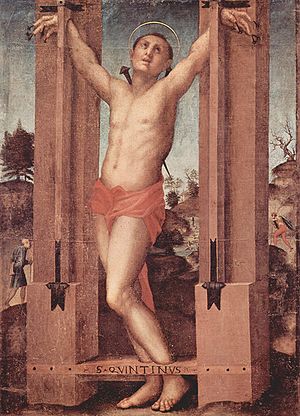
The name was popularized by a 3rd-century Gaulic saint, missionary and martyr who was beheaded by the Romans in what is now Picardy. He is considered the patron saint of Picardy and as a result, the name has always been common in that particular region of France.

It was introduced into England after the Norman Conquest.

In the United States, the name was brought to spotlight by Theodore Roosevelt’s son, Quentin Roosevelt (1897-1918) who was killed in World War I.

Currently, Quentin is the 35th most popular male name in France, (2009), while its Dutch form of Quinten is the 60th most popular male name in Belgium, (2008) and the 67th most popular in the Netherlands, (2010).

Quentin is the 396th most popular male in the United States, while Quinten is the 884th most popular, (2010).

Other forms of the name include:

  • Kindin (Basque)
  • Kentin (Breton)
  • Quintí (Catalan)
  • Quintinu (Corsican)
  • Kvintin Квинтин (Croatian/Russian/Serbian/Slovene/Ukrainian)
  • Quinten (Dutch/English)
  • Quentijn (Dutch)
  • Quintijn (Dutch)
  • Kwinten (Flemish)
  • Quentin (French/English/Picard)
  • Quintin (German/Slovak)
  • Koïntínos Κοϊντίνος (Greek)
  • Quintino (Italian/Portuguese/Spanish)
  • Quintinus (Latin)
  • Kventinas (Lithuanian)
  • Kintin (Picard)
  • Kwintyn (Polish)
  • Caointean (Scottish)
  • Quintín (Spanish)
  • Qvintin (Swedish)
  • Qvintinus (Swedish)

Common diminutive forms include:

  • Quentinek (Czech)
  • Quenty (English/German)
  • Quinn (English/German)
  • Quint (English/German)
  • Quinty (English/German)

Feminine forms include:

  • Quintina (Catalan/Italian/Latin/Portuguese/Spanish)
  • Quentine (French)
  • Quintine (French)
  • Kintine (Picard)
  • Kwintyna (Polish)