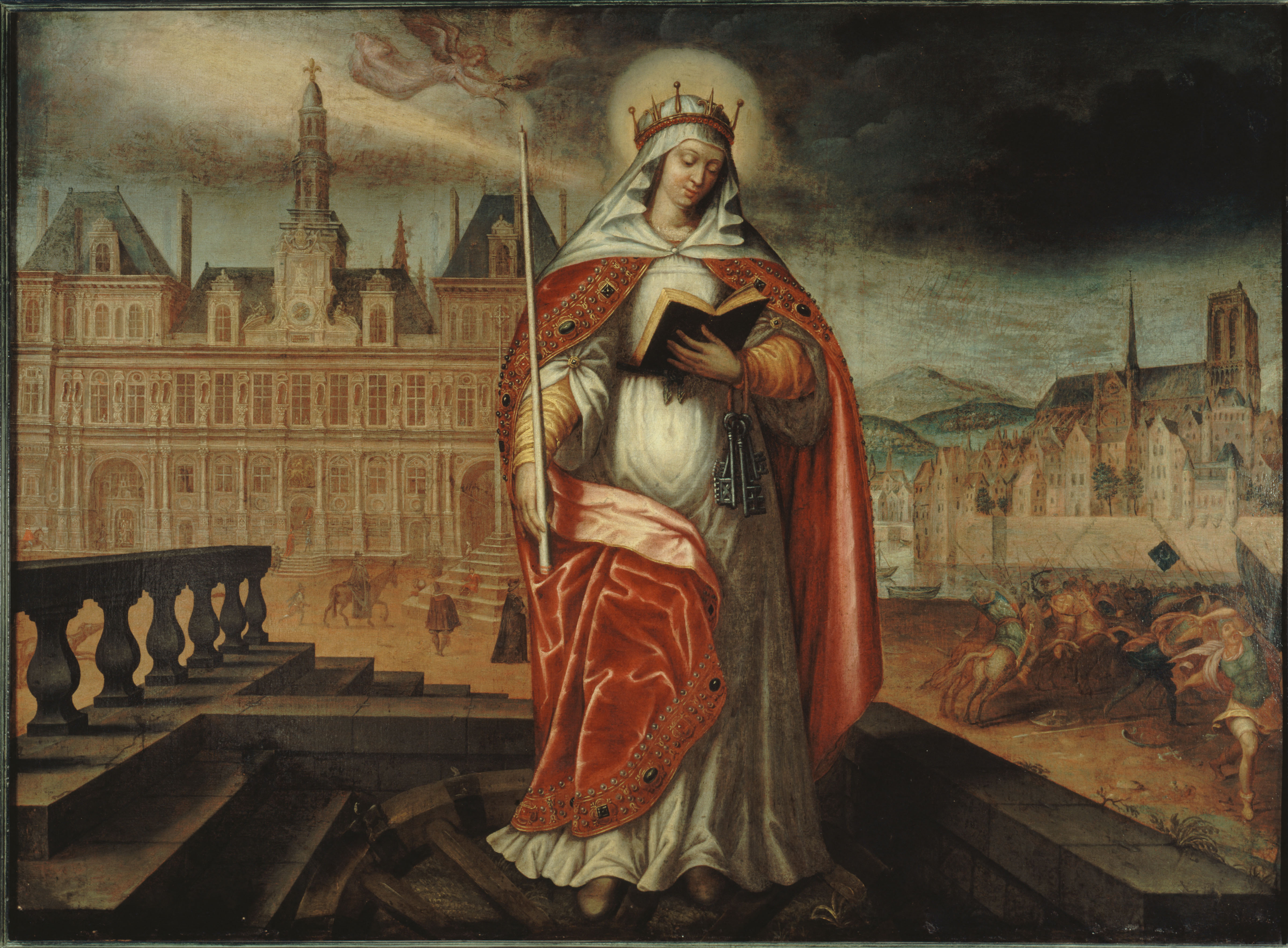
Genevieve

Gender: Feminine
Origin: French
Meaning: debated
Eng (JEN-e-VEEV); Fre (zhe-nə-VYEV, zhawn-VYEV )

The name is of debated origin and meaning, some sources relate it to the Celtic Guinevere, which is composed of the Welsh elements gwyn meaning “white, fair” and hwyfar meaning “smooth.”

However, this theory has been strongly conjectured against, and it is more than likely related to a Frankish source, believed to be an early latinization of the Frankish feminine compound name Kenowefa or Kenuwefa, which is composed of the elements ken meaning “race; tribe” and wefa meaning “woman.”

The name was popularized by an early medieval French saint who is said to have rescued Paris from the invading Huns, a pious woman in life, she is now considered the patron saint of Paris.

Her feast day, and consequently, Genevieve’s name-day, is January 3rd.

As of 2008, Genevieve ranked in as the 324 most popular female name in the United States.

Common English diminutives are Gennie and Vivi.

In French, Ginette was the most common diminutive form, breaking off as an independent given name, now considered dated in the French-speaking world.

In Spanish the nicknames are often Veva and Beba

Other forms of the name include:

  • Xenoveva (Asturian)
  • Genevisa/Bièva (Bearnais)
  • Genoveva (Catalan/Croatian/Dutch/German/Limburgish/Portuguese/Spanish)
  • Ghjenuveffa (Corsican)
  • Jenovéfa/Jenůfa (Czech: the latter is a more archaic form)
  • Geneviève (French: this form has also been used as a borrowing in Scandinavian countries as well as in German-speaking countries)
  • Genevote (French: an archaic form seldom in usage)
  • Genofeva (German)
  • Genovéva (Hungarian/Slovak)
  • Zsinett (Hungarian: corruption of Ginette)
  • Genoveffa (Italian)
  • Genoeffa (Italian: very obscure form)
  • Genovaitė (Lithuanian)
  • Genowefa (Polish: Gienia/Gienka are the common nicknames)
  • Genevivo (Provençal)
  • Genovefa (Slovene, diminutives include: Gena, Geni, Genica, Genija, Genka, Fefa and Fefi)
  • Genova (Spanish)

An obscure masculine Italian form is Genoveffo.

Sylvester/Silvester

Gender: Masculine
Origin: Latin
Meaning: “wooded, wild.”

Sylvester is an English corruption of the Latin name Silvester, which is derived from the Latin word silvestis meaning “wooded” or “wild.”

The name is borne by several saints and popes, “Silvester” became synonymous with the name for New Years Eve in some countries, since December 31st is the feast of St. Silvester.

Silvester is used in Danish, German, English, Slovene and Slovak.

Before the Reformation, Sylvester was a fairly common male name in England, but went out of usage due to its strong papal associations at the time.

Other forms of the name include:

  • Silvestre (Catalan/Spanish)
  • Silivestru (Corsican)
  • Silvestar (Croatian)
  • Silvestr/Sylvestr (Czech)
  • Sylvester (English/Finnish/Swedish/Ukrainian)
  • Silvar/Silver (Estonian)
  • Sylvestre (French)
  • Fester (Frisian/Limburgish)
  • Szilveszter (Hungarian)
  • Silvestro (Italian)
  • Silvester (Latin/Estonian)
  • Silvestrs (Latvian)
  • Vester (Limburgish)
  • Silvestras (Lithuanian)
  • Sylfest/Sølfest (Norwegian)
  • Sylwester (Polish: diminutive forms are: Syc, Syczek, Syczko, Sych, Sychno, Sychta, Sysz, Syszek, Syszka and Syszko)

An Italian and Slovene feminine form is Silvestra.

The name is currently borne by American actor, Sylvester Stallone (b.1946).

In American popular culture, it was borne by the animated cat named for the the felis silvestris catus, a subspecies of wildcat that was believed to be related to the domesticated cat, at the time. Later scientific evidence established them as two separate species..

A common English nickname is Sly.

Barbara

St. Barbara

Gender: Feminine
Origin: Greek
Meaning: “foreigner; barbarian”
Eng (BAR-bruh).

The name is derived from the Greek barbaros (βαρβαρος) meaning “foreign; barbarian.”

The name is borne by a 4th-century Christian martyr. St. Barbara was said to be so beautiful that her wealthy father had her locked away in a tower to protect her from disease and unwanted suitors, however, a Christian tutor of hers, had converted her to Christianity. When Barbara’s father found out, he beheaded her, but afterwards was struck by lightning, hence Barbara was considered the patron saint against lightning. She is also the patron saint of artillery, architecture, prisoners and, in Poland, she is considered the patron saint of miners. Its usage in Poland was originally delegated to miners’ daughters, but now it is widespread and popular among all classes.

Barbara currently ranks in the top 100 in Chile, Hungary, Poland and Slovenia. In the United States, however, she only ranks in at # 758, she did rank in at # 3rd back in 1933.

Other forms of the name include: (listed alphabetically by linguistic origin)

  • Rabab (Arabic)
  • Barbare (Basque/Georgian)
  • Bärbl (Bavarian)
  • Barba (Breton/Estonian/Latvian)
  • Bàrbara (Catalan)
  • Barbara (Croatian, Danish, Dutch, English, Finnish, French, German, Hungarian, Icelandic, Italian, Latvian, Norwegian, Polish, Ripoarisch, Romanian, Slovene)
  • Babeta (Czech/Slovak)
  • Bára (Czech: originally a diminutive form, now used as an independent given name)
  • Barbora (Czech, Lithuanian, Slovakian: 10th most popular female name in the Czech Republic for 2007)
  • Barbel (Danish)
  • Barbertje (Dutch: obscure, also a word for a kitchen rack in Dutch)
  • Parba (Estonian)
  • Varje/Varju/Varve (Estonian)
  • Barbe (French: obscure, not very popular due to it also being the French word for beard)
  • Barber/Berber (Frisian)
  • Babette/Barbette (French diminutive forms, used as independent given names, considered very dated)
  • Varvara Βαρβαρα (Greek Modern)
  • Borbála (Hungarian: 84th most popular female name in Hungary for 2005)
  • Báirbre (Irish)
  • Barbarella/Barbarina/Barberina/Barbera (Italian: obscure forms)
  • Berb (Limburgish)
  • Barbė (Lithuanian)
  • Bäerbel (Luxemburgish)
  • Barbo (Norwegian)
  • Bárbara (Portuguese/Spanish)
  • Barbla/Barla (Romansch)
  • Varvara Варвара (Russian/Bulgarian)
  • Barabal (Scottish)
  • Varjenka/Varja/Varvana (Slovene)
  • Borbora (Sorbian)
  • Barbro (Swedish/Danish/Norwegian)
  • Bäbi (Swiss German)

Popular English diminutive forms are Babbie, Babs, Barb, Barbie and sometimes Bobbie.

Popular Polish diminutives are Basia (BAH-shah) and Baska (BASH-kah).

Czech diminutives are Bára, Barca, Barča, Barka, Barborka and Baruška. Croatian diminutives are Bara and Barica (bah-REET-sah).

Russian and Bulgarian diminutives forms are Varenka, Varinka, Varya and Varyusha.

German diminutive forms are: Baba, Babe, Babi, Bäbs, Babschi, Babsi, Babsili, Babsl, Baby, Bar, Barb, Barbi, Bärbi, Bari, Bobbel, Bobbie, Bobsi, Wara, Wawi, Wetl and Wetty. Slovenian diminutives are: Bara, Barba, Barbi, Barca, Barica, Barbika, Barbina and Barbka.

There are Italian masculine versions, which are: Barbaro, Barbarino and Barberino.

The designated name-day is December 4.

Other notable bearers are Barbara of Celje (1390-1451) a Hungarian queen crowned Holy Roman Empress, known for creating the Order of the Dragon.

Former first lady Barbara Pierce Bush (b.1927), American actresses, Barbara Stanwyck (1907-1990) and Barbara Hershey (b.1948). Renowned journalist, Barbara Walters (b.1929) and singer, Barbra Streisand (b.1942).

Henry, Harry, Harriet, Henrietta

Origin: English/Germanic
Meaning: home ruler

Henry, an age old classic male name, is an anglicized version of the Germanic Heimric, which is composed of the elements heim meaning “home” and ric meaning “ruler.” The name evolved into the modern German Heinrich, the Scandinavian Henrik, the Polish Henryk, the French Henri, the Spanish Enrique and the Italian Enzo.

Henry has a lot of staying power in virtually most European countries. Like many of the other classic English names, this name came to England not through any Anglo-Saxon Germanic connections but through the conquering French Normans. It is has been a very popular choice among British and German royalty alike. It has been borne by the infamous Henry VIII all the way to our very present, Prince Henry, (aka Prince Harry), of England.

Henry has given to the world its diminutive form of Harry, which in many respects, is seen as an independent name in its own right. In Medieval England, Harry was considered the vulgar or everyday form of the name, most of England’s King Henrys were known affectionately as Harry. At one time, the name Henry was so common in the English speaking world, that the phrase, “Every Tom, Dick and Harry,” arose.

Harry is the title character of J.K. Rowling’s wizardry series, Harry Potter and again most the world knows the charming prince by his nickname versus his full name, given it a new appeal to young parents. Once seen as a stodgy and stuffy old man name, it is now seen as a classy and chic choice. Harry has recently enjoyed a surge in popularity in both the United Kingdom and the United States. Currently, Harry sits at # 644 in the 2008 most popular male names of the United States, while Henry comes in at # 76, and seems to be rising. Meanwhile, in Great Britain, Harry came in at a whopping # 5, while Henry at # 34. In France’s top male names of 2006, Henri came in at # 330, while its Italian version of Enzo, seems to be the more preferred version in recent years, Enzo came in as the # 1 most popular male name of France!

Other popular nicknames are Hal and Hank.

It also has feminine forms of Harriet and Henrietta, from both female versions the nicknames Hattie, Hettie and Etta came about. There is also the French form of Henriette, and the Italian feminine form of Enza.

Likes its male counterpart, Harriet seems to be enjoying a recent surge in popularity. In Britain and Wales’ top 100 female names of 2008, she came in at # 73, while in the United States, she still has some ways to go, in fact, she has not been in the top 1000 for at least 9 years. The name was borne by Harriet Beacher Stowe.

The designated name day for all forms of this name is July 13.

Other forms include:

  • Hanrí هنري (Arabic: primarily used among Arab Christians)
  • Endika (Basque)
  • Enric (Catalan)
  • Henrik (Croatian/German/Hungarian/Scandinavian/Slovene)
  • Jindřich (Czech)
  • Hynek (Czech: originally a diminutive form, now used as an independent given name)
  • Henderik (Danish)
  • Henning (Danish/German/Norwegian/Swedish)
  • Driek/Dricus (Dutch: originally a diminutive form, used as an independent given name)
  • Dries (Dutch: originally a diminutive form, used as an independent given name)
  • Hein (Dutch: originally a diminutive form, now used as an independent given name)
  • Heino (Dutch/Estonian)
  • Hendrik (Dutch/Estonian/German)
  • Henk (Dutch/Limburgish: originally a diminutive form, now used as an independent given name)
  • Hal (English: originally a diminutive form, now used as an independent given name)
  • Hank (English: originally a diminutive form, now used exclusively as an independent given name)
  • Enrico (Estonian)
  • Harri (Finnish/Welsh)
  • Heikki (Finnish)
  • Henrikki (Finnish)
  • Henri (French)
  • Haio (Frisian)
  • Aiko/Eiko/Haiko/Heiko (Frisian)
  • Heink (Frisian)
  • Henner (Frisian)
  • Hinrich (Frisian)
  • Hainrixi ჰაინრიხი (Georgian)
  • Heimo (German)
  • Heiner (German: originally a diminutive form, now used as an independent given name)
  • Heinrich (German)
  • Heinz (German: diminutive form occasionally used as an independent given name)
  • Errikos (Greek)
  • Hinrik (Icelandic)
  • Anraí/Einrí (Irish-Gaelic)
  • Anrico (Italian)
  • Arrigo/Errigo (Italian)
  • Enrichetto (Italian)
  • Enrico (Italian)
  • Enzo/Enzio (Italian)
  • Richetto (Italian)
  • Rico (Italian: contracted form)
  • Rigo (Italian)
  • Henricus (Latin)
  • Indriķis (Latvian)
  • Herkus (Latvian)
  • Endrikis (Lithuanian)
  • Henrikas (Lithuanian)
  • Heng/Hari (Lexumbourgish)
  • Henno (Low German)
  • Hinderk/Hinnerk (Low German)
  • Jendrik (Low German)
  • Heimrich (Old German)
  • Hinnerk (Plattdeutsch)
  • Henryk (Polish)
  • Henrique (Portuguese/Galician)
  • Henric (Romanian)
  • Andri/Andrin (Romansch)
  • Gendrich/Genrich (Russian)
  • Eanraig (Scottish-Gaelic)
  • Hendry (Scottish)
  • Heinri/Heiri (Swiss-German: dialectical form)
  • Henrich (Slovak)
  • Hendrich (Sorbian)
  • Enrique (Spanish)
  • Hersh (Yiddish)

Female forms include:

  • Drika (Dutch)
  • Heintje (Dutch)
  • Hendrika/Hendrikje (Dutch)
  • Henriëtte (Dutch)
  • Jetta/Jette (Dutch/German: Originally diminutive forms, now used exclusively as independent given names)
  • Etta (English: contracted form)
  • Harriet (English)
  • Hattie (English: originally a diminutive form, used as an independent given name)
  • Henrietta (English)
  • Hettie (English: originally a diminutive form, used as an independent given name)
  • Henna (Finnish)
  • Henriikka (Finnish)
  • Henriette (French)
  • Hinriette (Frisian)
  • Heinriette (German: obscure)
  • Heinrike (German)
  • Henrike (German/Danish/Norwegian)
  • Enrica (Italian)
  • Enrichetta (Italian)
  • Enza (Italian)
  • Errichetta (Italian)
  • Rica (Italian)
  • Henryka (Polish)
  • Andrina (Romansch)
  • Henrika (Swedish)