Igor, Ingvar

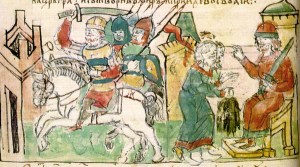
Radzivill_Igor-945


Ingvar is the modern Scandinavian form of the Old Norse, Yngvarr, meaning “Ing’s warrior.” It was introduced into Russia in the 10th-century by the Varangians, which gave the world the Igor form. The latter was borne by 2 Grand Princes of Kiev and has been a favorite in several Slavic countries since.

Currently, Igor is the 19th Most Popular Male Name in Poland (2018) and the 48th Most Popular in Moscow, Russia (2018), while in England he currently ranks quite low at #497 (2018).

Igor is used in Bulgarian, Czech-Slovak, Dutch, Estonian, German, Hungarian, Italian, Macedonian, Portuguese, Romanian, Serbo-Croatian, all modern Scandinavian languages, Slovene, & Spanish

Other forms of the name include:

  • Ihar Ігар (Belarusian)
  • Ingvar (Danish, Estonian, Finnish, Icelandic, Norwegian, Swedish)
  • Iku (Finnish)
  • Ingwar, Ingwer (German)
  • Ingvaari (Greelandic)
  • Ingvâre (Greenlandic)
  • Ígor (Icelandic)
  • Inguarus (Late Latin)
  • Ingvars, Igors (Latvian)
  • Igoris (Lithuanian)
  • Ignar (Nowegian)
  • Yngvar (Norwegian)
  • Yngvarr (Old Norse)
  • Ingwar (Polish)
  • Inguar (Portuguese)
  • Ingor (Swedish)
  • Ihor Ігор  (Ukrainian)

Sources

Alfred, Alfreda

alfred


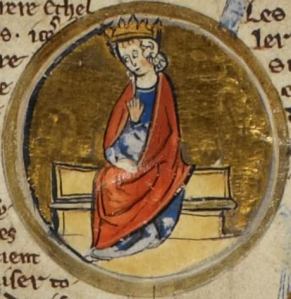
The name is derived from the Anglo-Saxon, Ælfræd, which is composed of the Anglo-Saxon elements, ælf  “elf” and ræd “counsel. A notable bearer was the 9th-century Anglo-Saxon King, Alfred the Great.

This is one of the few Anglo-Saxon male names to survive popular usage after the Norman Conquest and slowly waned in use by the end of the Middle Ages, but was revived in the 18th-century.

Though quite uncommon in the United States in this day and age, it has never completely fallen outside the U.S. Top 1000, and once reigned in the U.S. Top 100 between 1880 and 1951. Alfred peaked at # 32 in 1886.

Alfred reigns supreme in the Scandinavian charts, he is currently the 8th Most Popular Male Name in Denmark (2018), the 12th Most Popular in Sweden (2018) and the 42nd Most Popular in Norway (2018).

He ranks much lower in the U.K., coming in at #106 and even lower in France, ranking in as the 491st Most Popular Male Name (2018).

Alfie, a diminutive form which has become a much loved independent given-name in the U.K, is currently in England & Wales’ Top 100 Baby Names, ranking in at #15 (2018).

Alfred is used in Danish, Dutch, German, Polish, Norwegian & Swedish

Other forms of the name include:

  • Ælfræd (Anglo-Saxon)
  • Alfredo (Aragonese, Galician, Italian, Portuguese, Spanish)
  • Alfredu (Asturian)
  • Alperda (Basque)
  • Aofred (Breton)
  • Alfréd (Czech, Hungarian, Slovak)
  • Alfie (English)
  • Alfre (Finnish, Greenlandic)
  • Alfreeti, Alfreetti (Finnish)
  • Alfrédos Αλφρέδος (Greek)
  • Alfreð (Icelandic)
  • Alfredino (Italian)
  • Alfredus (Late Latin)
  • Alfrēds (Latvian)
  • Alfredas (Lithuanian)
  • Al’fred Альфред (Russian)
  • Alfrid, Allfrid (Scandinavian)
  • Arfredu (Sicilian)

Its feminine form of Alfreda also has an Anglo-Saxon counterpart in the form of Ælfthryth. It was borne by a 9th-century English saint.

Alfreda is used in Croatian, Czech, Danish, Dutch, English, Finnish, German, Hungarian, Italian, Latvian, Lithuanian, Norwegian, Polish, Portuguese, Spanish & Swedish.

Other forms of the female form include:

  • Alfrede (Danish)
  • Elfrida (Croatian, Italian, Spanish)
  • Alfriede, Alfrieda (German, Scandinavian)
  • Elfriede (German)
  • Alfrède (French)
  • Alfrédie (French)
  • Alfride (French)
  • Alfreðsína (Icelandic)
  • Afreda (Italian)
  • Alfredina (Italian)
  • Alfrida (Scandinavian)

Sources

Frida

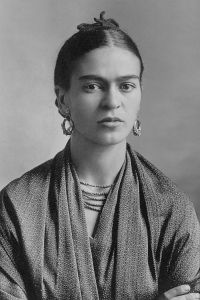
Frida_Kahlo,_by_Guillermo_Kahlo


The name is either derived from the Old Norse fríðr (beautiful; loved) or the German fried (peace, joy), (which is also the same case in Yiddish). In modern Swedish, Danish & Norwegian, the name may also be associated with the word frid, which also means peace.

The name has been imported into several cultures. It is not only used in Northern Europe, but has experienced usage in Anglophone, Francophone & Hispanophone countries. A notable bearer from the latter was Mexican artist, Frida Kahlo (1907-1954).

It is currently the 7th Most Popular Female Name in Norway & the 19th Most Popular in Denmark (2018).

In the United States, it currently comes in as the 693rd Most Popular Female Name.

The Frida form is used in the following languages: Danish, Dutch, Czech/Slovak, Estonian, Faroese, Finnish, Hungarian, German, Italian, Latvian, Lithuanian, Norwegian, Portuguese, Slovenian, Spanish, Swedish, Yiddish

Other forms include:

  • Fritha (Anglo-Saxon)
  • Fryd (Danish, Norwegian, Swedish)
  • Freda (English, German, Spanish)
  • Frieda (Estonian, German)
  • Friida (Finnish)
  • Riitu (Finnish)
  • Friede (German)
  • Friedel, Friedl (German, Yiddish)
  • Fríða FREE-thah (Icelandic, Old Norse)
  • Fríður FREE-thoor (Icelandic)
  • Frid (Norwegian, Swedish)
  • Fryda (Polish, Norwegian, Swedish)
  • Freyda, Frejda (Yiddish)

Sources


Magnus

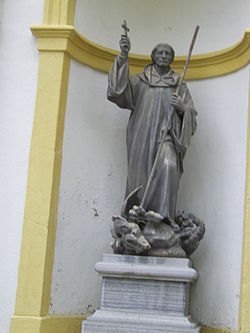
250px-Saint_Magnus_of_Füssen


The name is from the Latin cognomen meaning “great,” and by the 11th-century, was imported to Scandinavia as a synchronized name, likely being used as a latinized form of the Old Norse Magni (power; strength).

The name was especially common among Norwegian and Swedish royalty. King Magnus I is the first bearer of the name in the Norwegian line, who was said to be named for King Charlemagne (Carolus Magnus).

It was also borne by several saints, including St. Magnus of Füssen, a 6th-century saint who is credited for converting the Germanic tribes to Christianity in what is now Bavaria.

It has remained a staple in Scandinavia, it currently ranks in as the 15th Most Popular Male Name in Denmark (2018) & the 9th Most Popular Male Name in Norway (2018). His rankings in other countries are as follows:

  • #414 (England & Wales, 2018)
  • #781 (United States, 2018)

Other forms of the name include:

  • Mang (Alemmanish)
  • Mogens (Danish)
  • Magnuz (Danish, Swedish)
  • Mack (English)
  • Manu (Finnish)
  • Mauno/Maunu (Finnish)
  • Magne (French, Norwegian)
  • Mânuse (Greenlandic)
  • Mághnus, Manus (Irish-Gaelic)
  • Magnús (Icelandic)
  • Magno (Italian)
  • Magnuss (Latvian)
  • Magnar (Norwegian)
  • Maghons (Old Swedish)
  • Mávdnos (Sami)
  • Mankan (Swedish)
  • Måns (Swedish)

Magna is a feminine form and Magnúsína is an Icelandic feminine form.

Sources

Viggo, Vigga

Viggo is a popular Scandinavian male name with a long history of use. It may be a diminutive offshoot of Victor, or be related to an Old Norse element, vígr (to fight). Another theory links it to the Icelandic Vöggur, which is derived from the Old Norse element vöggr, “one who lies in a cradle.” It has also been linked with the Swedish word vigg “lightning.”

A notable bearer is Danish-American actor, Viggo Mortensen (b. 1958).

Viggo is currently the 24th Most Popular Male Name in Denmark (2018), the 48th Most Popular Male Name in Sweden (2018); and the 352nd Most Popular Male Name in the Netherlands.

Other forms include:

  • Vigge (Danish, Swedish)
  • Wigand, Wiegand (German)
  • Wiggo (German, Swedish)
  • Viggó (Icelandic)
  • Vygantas (Lithuanian)
  • Vígi (Old Norse)
  • Viggu (Sami)
  • Vigg/Wigg (Swedish)
  • Wigge (Swedish)

Its feminine form of Vigga has also made its appearance in the Nordic charts, which is currently the 48th Most Popular Female Name in Denmark (2018).

An obscure Danish feminine form is Viggoline.

Sources

Lage, Lauge

Both are derived from the Old Norse byname, Félagi meaning “fellow; partner; companion.”

Lauge is the Danish form while, Lage is the Swedish and Norwegian form.

Currently, Lauge is the 32nd Most Popular Male Name in Denmark (2018).

Other forms include:

  • Lagho (Old Danish, Old Swedish)
  • Lago (Danish, Swedish)
  • Laugi (Icelandic)
  • Lau/Laue (Norwegian)

Sources

Albert, Alberta

Prince_Albert_-_Franz_Xaver_Winterhalter_1842


Albert is a Norman contracted form of Adalbert that was introduced into England after the Norman Conquest of 1066. Though there is an Anglo-Saxon form of Æðelberht, it was completely usurped by its Norman version.

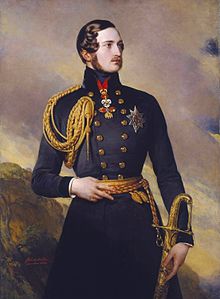
The name fell out of use in England by the end of the 13th-century but was revived in the 19th-century when Queen Victoria of England chose a German prince by the name of Albert to be her husband. Speaking of which, Albert was a much-loved name among German royalty.

Between 1880-1967, Albert remained in the Top 100 Most Popular Male Names. He peaked at #14 in 1910. As of 2018, he currently ranks in as the 452nd Most Popular Male Name.

Albert is currently quite popular in Europe. These are his rankings in the following countries:

  • #37 (Denmark, 2018)
  • #55 (England & Wales, 2018)
  • #84 (Norway, 2018)
  • #422 (Netherlands, 2018)

Albert is used in Albanian, Catalan, Croatian, Czech, Danish, Dutch, English, Estonian, Finnish, French, German, Hungarian, Icelandic, Polish, Romanian, Russian, Slovakian, Slovenian & Ukrainian.

Other forms include:

  • Alberzh (Breton)
  • Aalt (Dutch)
  • Aalbert (Dutch)
  • Aalbertus (Dutch)
  • Aelbrecht (Dutch)
  • Albercht (Dutch)
  • Alberd (Dutch)
  • Albertus (Dutch, Late Latin)
  • Appe (Dutch)
  • Brecht (Dutch)
  • Elbert (Dutch, German)
  • Ethelbert (English)
  • Alpertti (Finnish)
  • Albertin (French)
  • Aubert (French)
  • Aubertin (French)
  • Abbe, Abe (Frisian)
  • Ailbeart (Gaelic)
  • Alberte (Galician)
  • Albertos (Galician)
  • Alberti ალბერტი (Georgian)
  • Albrecht (German)
  • Albertinello (Italian)
  • Albertino (Italian)
  • Alberto (Italian, Portuguese, Spanish)
  • Alperto (Italian)
  • Ulberto, Ulperto (Italian)
  • Albaer (Limburgish)
  • Baer, Bèr (Limburgish)
  • Alberts (Latvian)
  • Albertas (Lithuanian)
  • Albertet (Occitanian)
  • Olbracht (Polish)

Its feminine for of Alberta was borne by Princess Louise Caroline Alberta (1848-1939), daughter of Queen Victoria & Prince Albert. The Canadian province was named in her honour.

Alberta is used in Albanian, Catalan, Croatian, Czech, Danish, Dutch, English, Estonian, Finnish, French, German, Hungarian, Icelandic, Italian, Polish, Portuguese, Romanian, Russian, Slovakian, Slovenian, Spanish & Ukrainian.

Alberte is currently the 12th Most Popular Female Name in Denmark. Alberte (ahl-BARE-teh) is also used in French, but pronounced differently from its Danish counterpart (AHL-BAIRT). Other feminine forms include:

  • Alberthe, Albertha (Danish, Swedish)
  • Albertina (Dutch, German, Hungarian, Italian, Portuguese, Spanish)
  • Brechtje (Dutch)
  • Bertina (English, Hungarian, Italian)
  • Albertine (French, German, Danish, Norwegian)
  • Auberte (French)
  • Aubertine (French)
  • Bertine (French)
  • Abelke (Frisian)
  • Albertin (Hungarian)

Sources

Dania, Danya

DanyaThis name can have several origins and meanings. Spelled Dania it is a Polish diminutive name, which could be short for Daniela or Danuta. In Italian, Dania is also used as a diminutive form of Daniela, but is often used as an independent given name. In Russian, the name is a unisex diminutive form of Danil or Danila, the equivalent of Danny in English.

Dania is also the Latin name for Denmark and has occasionally been used as a given-name in Denmark and other Scandinavian countries. Dania Beach is the name of a city in Florida, which was named in honour of its predominately Danish residents.

Dania دانية is also an Arabic female name, derived from the root d-n-a, meaning “close; near.”

Danya דַּנְיָה, sometimes transliterated as Dania, is a popular female name in Israel, used as a modern feminine form of Dan, it is probably an import from Polish and Russian immigrants from when it was in use as a diminutive form of one of the above mentioned names.

In the United States, Dania appeared in the U.S. top 1000 between 1996 and 2010 and peaked at #764 in 1996.

Regardless of origin, use, and spelling, the name is pronounced (DAHN-yah) in all of the aforementioned languages.

Below is a list of other forms and languages of use:

  • Dania (Arabic/Danish/Faroese/Hebrew/Italian/Norwegian/Swedish)
  • Danja (Danish/Swedish)
  • Danía (Icelandic)
  • Danit (Hebrew)
  • Danya (Hebrew)

Note in Poland and Russia, Dania is used as exclusively as a diminutive form of one of the above mentioned names.

Sources

Iris

IrisOrigin: Greek Ιρις
Meaning: “rainbow”
Gender: Feminine

The name is derived from the Greek “Îris (Ἶρις) Írídos (ίρίδος) “rainbow” and is borne in Greek mythology by the goddess of the rainbow and messenger of the Olympian gods. It later became associated with the body part, the flower, and a colour, all of which were named for the Greek goddess.

In recent years, the name has experienced a surge in popularity in several countries. Its rankings in other countries are as follows:

  • #21 (Iceland 2017, Íris)
  • #25 (Portugal, 2016, Íris)
  • #31 (Sweden, 2017)
  • #32 (France, Paris, 2016)
  • #56 (Catalonia, 2016)
  • #73 (Spain, 2016)
  • #84 (England/Wales, 2016)
  • #85 (Netherlands, 2017)
  • #85 (Slovenia, 2016)
  • #116 (Norway, 2016)
  • #121 (France, entire country, 2016)
  • #186 (United States, 2016)
  • #199 (Scotland, 2016)

Other forms of the name include:

  • Iris Ирис Իրիս (Armenian/Bulgarian/Catalan/Czech/Danish/Dutch/English/Estonian/Finnish/French/German/Greek/Italian/Serbo-Croatian/Norwegian/Polish/Romanian/Slovenian/Spanish/Swedish)
  • Iryda Ірыда (Belarusian/Polish)
  • Irida Ирида (Bulgarian/Croatian/Greek/Italian/Russian/Serbian)
  • Iiku (Finnish)
  • Iiri (Finnish)
  • Iiris (Finnish)
  • Írisz (Hungarian)
  • Íris (Icelandic/Portuguese/Slovak)
  • Iride (Italian)
  • Iridė (Lithuanian)
  • Yryda Ирида (Ukrainian)

Sources


Loki

LokiOrigin: Old Norse
Meaning: debated
Gender: Masculine
(LOH-kee)

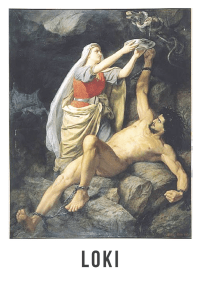
From the name of the trickster god in Norse mythology, Loki was the ultimate pranksters whose pranks always ended up going terribly awry, his biggest blunder being the death of the god Baldur. In Norse legend, Loki’s associations were sometimes neutral to downright evil. Despite this, Loki never had a bad enough connotation to deter Nordic parents, medieval and modern, from using his name on their offspring.

The meaning of the name itself is rather contested. The following possibilities in a nutshell include:

  • from the Old Norse Logi (flame)
  • from an Old Germanic root word *luk, which denotes anything related to knots, locks and anything enclosed/compare to the Old Norse verb loka (to lock; to close; to end”; and the Old Norse verb loki (to loop onthe end).
  • There may be a link with the Old Norse loptr (air).
  • from the Old Norse lok (cover, lid; end)

Loki has made it into the UK’s Top 500 male names, while its modern Scandinavian form of Loke is still a popular choice in Nordic countries.

In 2016, Loki was the 452nd most popular male name in England/Wales, while Loke is the 58th most popular name in Sweden (2017).

Other forms include:

  • Loke (Danish/Norwegian/Swedish)
  • Loki (English/Faroese/Finnish/German/Icelandic/Old Norse)

It should be noted that this was the name of the wife of German Chancelor, Helmut Schmidt, Loki Schmidt (borne Hannelore Schmidt (1919-2010). In this case, Loki seems to have been a childhood nickname that developed from a child’s mispronunciation of Hannelore.

Sources